
How should I study Circles for JEE in six steps?
- Repair prerequisite gaps before attempting mixed problems. To study Circles for JEE, first check completing the square, quadratic discriminants, straight-line equations and perpendicular distance from a point to a line. Repair any weakness before mixing these skills in circle problems.
- Follow the dependency order. Study centre and radius first, then line–circle intersections and chords, then tangents, and finally two circles and circle families. Chord geometry supplies the distance method for tangents. Subtracting circle equations connects the chapter back to straight lines.
- Translate between the two main equations. Centre–radius form exposes distances; general form makes unknown coefficients easier to handle. Practise converting both ways, checking the signs of the centre coordinates.
A non-degenerate real circle requires:
- Classify the geometry before calculating. A line cutting a circle suggests centre-to-line distance. A repeated intersection suggests tangency. Two circles sharing points suggest subtraction or a circle family. Write the question type before choosing a formula.
- Choose the representation that removes the most work. Prefer centre–radius form for distances, general form for unknown coefficients, and a family for shared intersection points. Use a rough sketch to expose impossible configurations, but confirm them algebraically. A sketch suggests the method; it does not prove the answer.
- Check geometry and algebra together. Compare the centre-to-line distance with the radius before using a chord or tangency formula. Test the final equation against every stated condition, including whether it represents a real circle.
Your formula notebook should record trigger, formula and validity condition together. Beside the chord-length formula, write “length required, endpoints unnecessary” and “line must cut the circle”. These entries tell you when to use the formula and when to reject it.
The next three problems are original teaching examples, not attributed JEE previous-year questions.
How do I find a chord length without calculating its endpoints?
Use the centre-to-line distance and a right triangle. When the target is only chord length, calculating both intersection coordinates adds unnecessary algebra.
Problem: Find the length of the chord cut by the following line on the circle:
Complete the square to identify the centre and radius:
The perpendicular from the centre bisects the chord. One half of the chord, that perpendicular and a radius form a right triangle.
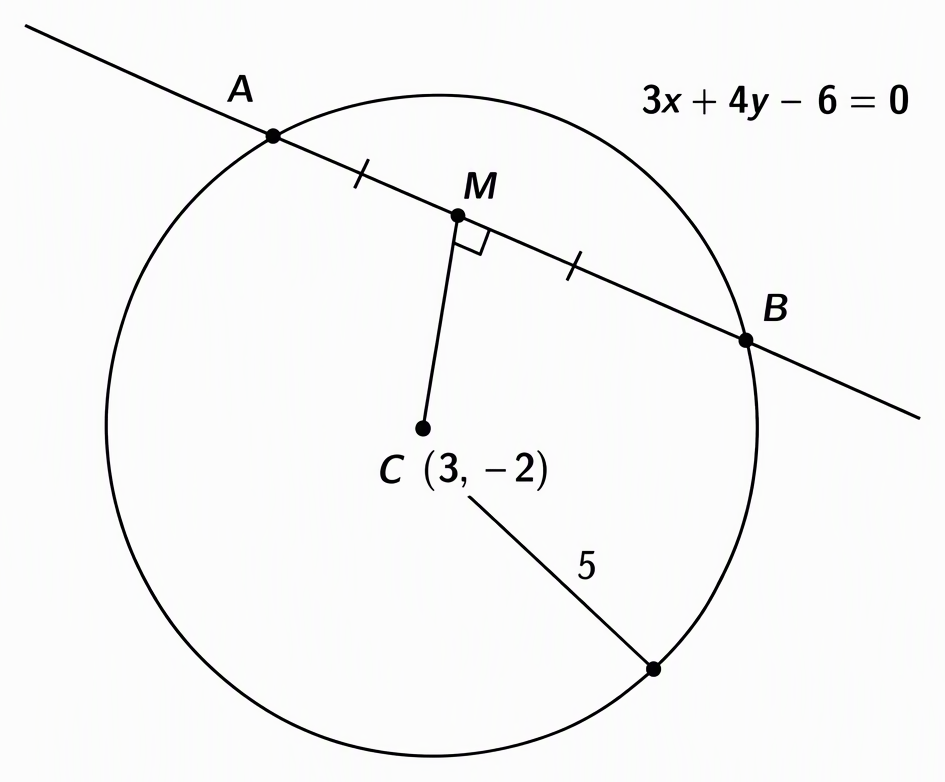
Reasoning sequence: recognise a chord-length target, calculate distance, check that the distance is less than the radius, then use the right triangle.
The line therefore cuts a genuine chord:
Substituting the line into the circle is valid, but it finds endpoint coordinates the question never requests. Distance is enough for chord length; endpoints may require substitution.
How do I find both tangents without losing the vertical one?
Set the centre-to-line distance equal to the radius, but check vertical lines separately if you use slope form. Slope form omits vertical lines, so it can leave out a valid tangent.
Problem: Find the tangents from the origin to:
First check the geometry:
The origin is external, so two distinct tangents must exist. Keep that count as a check on the algebra.
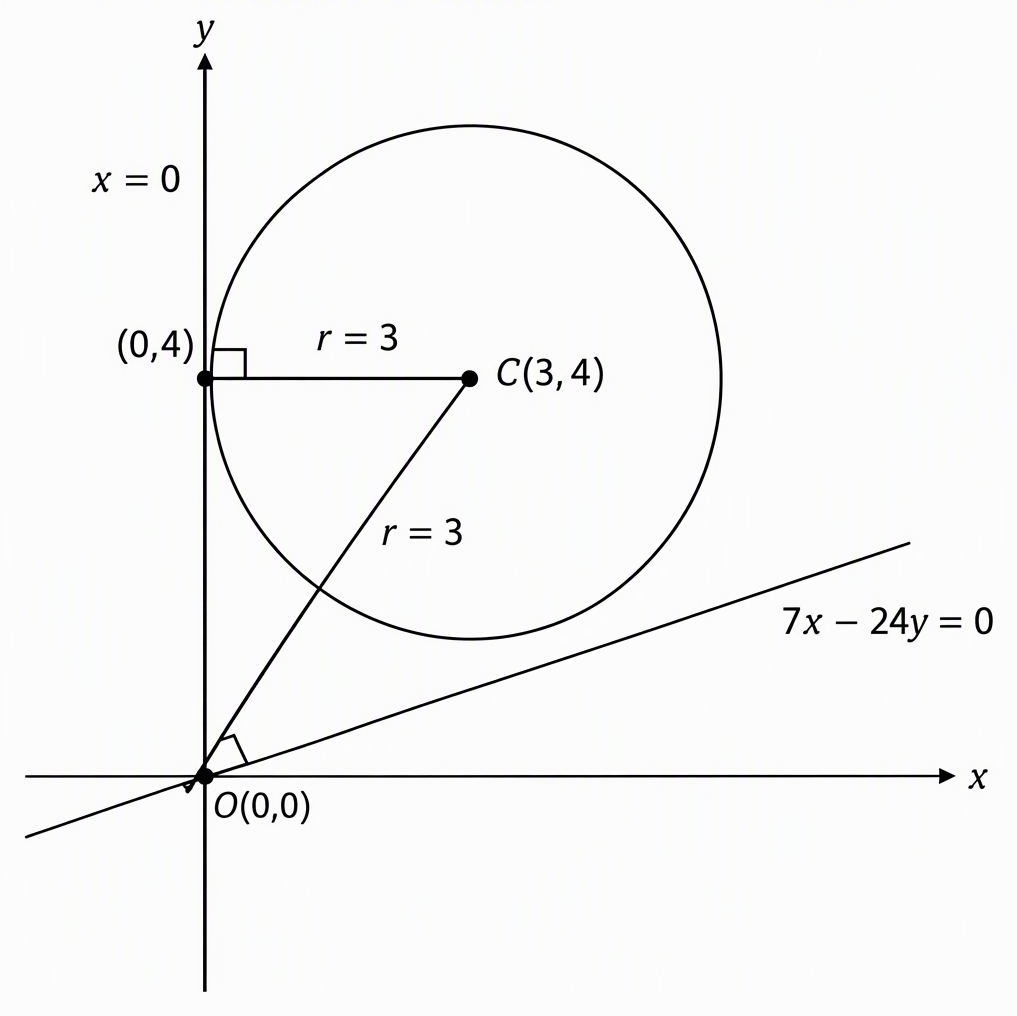
For a non-vertical line through the origin, impose the distance condition:
This gives one tangent:
Now check the omitted vertical line:
Verify both using centre-to-line distance:
Both distances equal the radius, so the required lines are:
The missing answer comes from the slope representation, not a failed tangency formula. The tangent-at-a-point formula also cannot be applied at the origin here: its stated point must lie on the circle, while the origin is external.
How do I use a circle family without finding the intersection points?
Combine the two circle equations so their common points remain on the new curve automatically. Use the extra condition to determine the combination, then check that the quadratic terms do not cancel.
Problem: Find the circle through the common points of:
It must also pass through:
Subtracting gives:
This is the line containing the common chord, not the required circle. To retain the shared points while finding a circle, use:
Both original expressions vanish at every common point, so their combination does too. The second condition prevents cancellation of the quadratic terms.
Evaluate at the additional point:
Therefore:
Choose:
Then:
Check the additional point:
Dividing by two identifies the centre and squared radius:
The result is a real circle. If the coefficient sum were zero, the quadratic terms would cancel and leave the radical axis, not a circle.
Finding the two intersection coordinates first was unnecessary. Reserve that calculation for questions that actually ask for those points.
What should I practise after learning these methods?
Start with a diagnostic, repair the specific weakness it exposes, then move to mixed questions. Judge readiness by whether you can justify a method on an unseen problem, not whether a familiar solution looks easy.
These practice quantities are recommendations, not measured thresholds or guarantees. Use this first ten-question diagnostic:
- Two questions: centre, radius and circle construction.
- Three questions: line–circle position and chords.
- Three questions: tangents, including a vertical-line check.
- Two questions: common chords or circle families.
Before every solution, write question type, chosen representation and validity condition. Afterwards, classify each mistake and choose the matching repair:
- Recognition: identify the geometric clue you missed.
- Algebra: redo the faulty calculation.
- Missed conditions: add the missing validity check to your notebook.
For daily single-topic repetition, JEEnius daily practice problems provide a fresh ten-question set on a topic every day, with free sets daily. Use the diagnostic split above separately rather than assuming a daily set follows that distribution.
Progress through single-concept exercises, JEE Main previous-year questions, then selected JEE Advanced problems combining circles with straight lines, parameters or locus conditions. Use your stage of preparation to choose where to begin:
- Class 11: follow the full dependency sequence before harder combinations.
- Class 12: use the diagnostic to locate prerequisite gaps before mixed practice.
- Droppers: diagnose prerequisite gaps from fresh questions; familiarity with old solutions can hide weak method selection.
Your readiness check is an unseen mixed question where you can explain why your method is shorter and when it is valid. Do not replace that check with a promised completion time.
Reattempt missed questions without the solution after a gap, and practise fresh questions separately. JEEnius practice mode offers topic sets that skip questions already seen, with free sets included, so use it for the fresh-question part of that routine.
Next step: daily practice problems on JEEnius and get a fresh ten-question set on a topic every day (free sets daily).
For a worked example of the same idea, see Coordination Compounds Practice Questions JEE: 6 Solved.
Frequently asked questions
In what order should I study Circles for JEE?
First check completing the square, quadratic discriminants, straight-line equations and point-to-line distance. Then study centre and radius, line–circle intersections and chords, tangents, and finally two circles and circle families. Repair prerequisite gaps before attempting mixed problems.
How do I find a chord length without finding its endpoints?
Find the circle's radius r and the perpendicular distance d from its centre to the line. Check that d < r, then use chord length = 2√(r² − d²). This avoids calculating intersection coordinates when only the length is required.
Why do I get only one tangent when using y = mx?
Slope form excludes vertical lines, so it can miss a valid tangent. If the point is outside the circle, two distinct tangents must exist. Check the vertical line through that point separately and verify that its distance from the centre equals the radius.
How do I find a circle through the intersection of two circles?
For circle equations S1 = 0 and S2 = 0 with matching quadratic coefficients, use the family aS1 + bS2 = 0. Apply the extra condition to determine the coefficient ratio, ensuring a + b is not zero. Finally, verify the stated conditions and check that the squared radius is positive.
What should I practise after learning Circles formulas?
Start with a ten-question diagnostic: two on centre, radius and construction, three on line–circle position and chords, three on tangents, and two on common chords or circle families. Repair recognition errors, algebra mistakes and missed validity conditions separately. Progress through single-concept exercises, JEE Main previous-year questions and selected JEE Advanced mixed problems; these quantities are recommendations, not readiness guarantees.