
How do I choose the right equation in Chemical Kinetics?
In Chemical Kinetics for JEE, choose the model from the evidence before substituting numbers. Study definitions first, rate-law evidence next, concentration–time laws after that, and temperature dependence last.
- Read the explanations before attempting mixed questions. Read NCERT’s treatment of reaction rate, rate law, order, molecularity and temperature dependence. If concentration units or logarithm rules interrupt the reading, revise those first.
- Define the measured rate before doing algebra. For the following reaction at constant volume, divide each species rate by its stoichiometric coefficient:
The disappearance rate of a reactant and the reaction rate need not be numerically equal. Copy the definition used in the question before calculating the rate constant.
- Identify evidence and choose the equation family. Classify what the question measures:
- Initial concentrations and initial rates: choose rate-law ratios.
- Concentration or fraction remaining versus time: consider an integrated law.
- Rate constants at different temperatures: choose the Arrhenius relation.
Use this sequence: identify evidence → choose the appropriate relation → calculate → check units. Establish the model before selecting a specific equation.
- Establish order from evidence, not balanced-equation coefficients. Compare experiments with one concentration unchanged:
Molecularity applies to an elementary step and is a positive integer. Experimental order can be zero or fractional. Do not transfer molecularity or stoichiometric coefficients into an experimental rate law without justification.
- Match the equation to the established model. These integrated forms use the disappearance-rate law for the reactant. Convert any stoichiometrically normalised reaction-rate law first.
- Zero order: concentration falls by equal amounts in equal times. Concentration versus time is a straight line.
- First order: concentration falls by equal fractions in equal times. The natural logarithm of concentration versus time is a straight line, using a fixed concentration reference.
75% reacted means 25% remains. One concentration–time observation alone cannot establish reaction order: different models can fit that single observation with different rate constants.
- Audit units, signs and assumptions. Under the stated concentration-based rate-law convention, the overall order determines the rate constant’s units:
Use kelvin for temperature, dimensionless logarithm arguments, and time units matching the rate constant. Check signs against the physical change: reactant concentration decreases, but its disappearance rate is positive. Keep this conversion ready:
An effectively constant excess reactant can produce pseudo-first-order behaviour. The observed order then need not equal the order of the full rate law.
How do I find the rate law from initial-rate data?
Hold one concentration fixed and compare how the rate changes with the other. Find each exponent before calculating the rate constant. This and the next two examples are constructed teaching problems, not previous-year JEE questions.
Identify evidence: these are initial concentrations and reaction rates. Use the pairs below to isolate each reactant’s effect.
- Experiment 1:
- Experiment 2:
- Experiment 3:
Choose rate ratios: compare experiments 2 and 1, then experiments 3 and 1. Each pair changes only one concentration.
Calculate: substitute any experiment into the established law.
Check units: dividing rate by concentration squared gives the required second-order units.
Substituting the result into experiment 2 also reproduces its measured rate. First order in each of two reactants means second order overall, not first order overall.
How do I solve percentage-completion and half-life questions?
Convert percentage completion into fraction remaining before choosing the concentration ratio. In this constructed problem, a reaction known to follow first-order kinetics is 75% complete after 40 minutes. Find its rate constant and the total time required for 87.5% completion.
Identify evidence: order is explicitly given, so the first-order integrated law is justified. The first observation leaves one-quarter of the reactant:
Choose the integrated law and calculate:
At 87.5% completion, the remaining fraction is:
Check without repeating the algebra: 25% remaining means two half-lives, so each half-life is 20 minutes. Reaching 12.5% remaining takes three half-lives.
The total elapsed time is 60 minutes. The additional time after the first observation is only 20 minutes.
The stated first-order condition is essential. The same percentage and time observation cannot justify a first-order equation unless order is given or established independently.
For focused practice here, JEEnius daily practice problems provide a fresh ten-question set on a topic every day, with free sets daily. Write the remaining fraction before calculating each answer.
How do I solve Arrhenius questions without reversing the sign?
Keep the temperature labels paired with their corresponding rate constants throughout. In this constructed problem, the rate constant doubles between 300 K and 330 K. Assume the Arrhenius parameters remain effectively constant over this interval.
Identify evidence: two rate constants at two temperatures call for the two-temperature Arrhenius equation.
Calculate:
Check signs: the logarithm of the rate-constant ratio is positive. The reciprocal-temperature difference is also positive with these labels, giving positive activation energy.
A plot of the natural logarithm of the rate constant against reciprocal temperature has negative slope. Use the same fixed units for rate constants throughout; dividing by a fixed reference rate constant makes each logarithm’s argument dimensionless.
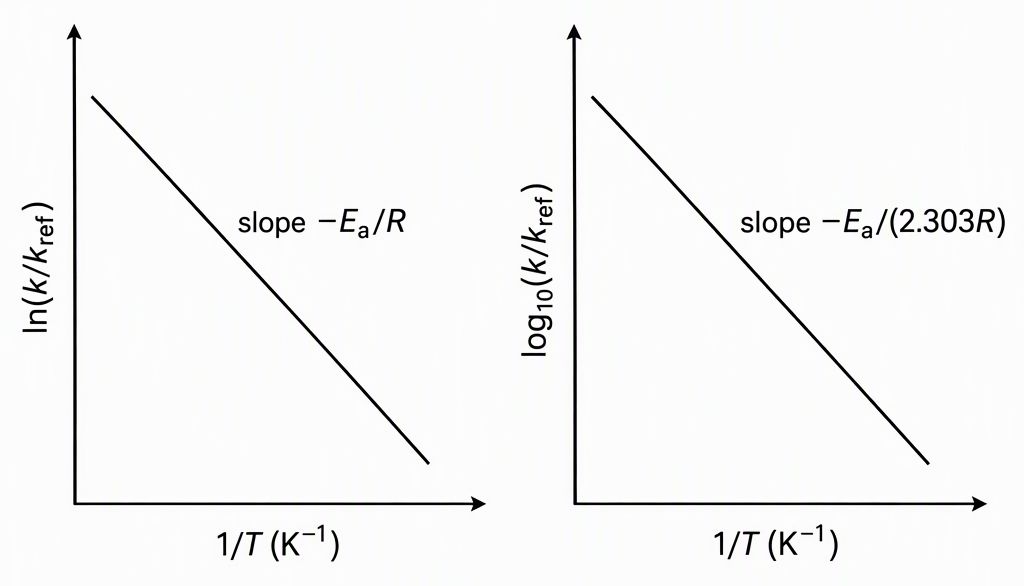
Avoid two errors: substituting Celsius temperatures, and reporting a joule-based answer directly as kilojoules. The gas constant’s units determine the energy units.
What should I practise before mixing Chemical Kinetics questions?
Practise one evidence type at a time, then mix them only when you can defend your equation choice. Use this sequence to distinguish model-selection errors from concentration, logarithm and unit errors.
- Start with concept checks. Separate reaction rate from species disappearance rate, order from molecularity, and rate from rate constant. Derive rate-constant units for different orders, then solve initial-rate tables.
- Move to concentration–time questions. Practise zero-order and first-order laws, percentage completion, half-life dependence on initial concentration, and graph identification. Explain why doubling initial concentration changes zero-order half-life but not first-order half-life.
- Add temperature and excess-reactant reasoning. Solve Arrhenius ratios and slopes, then pseudo-first-order questions. Identify which reactant stays effectively constant and how its concentration enters the observed rate constant.
Before every calculation, write one line: given evidence → inferred or stated model → chosen equation. If you cannot justify the model, revisit the concept rather than hunt for a formula.
Move from topic-wise NCERT exercises to topic-wise JEE Main previous-year questions, then to JEE Advanced questions combining evidence, graphs and assumptions. This is a practice sequence, not a claim that either exam tests only one level of reasoning.
Keep an error log with four labels:
- Model selection.
- Concentration conversion.
- Algebra/logarithms.
- Units.
Re-solve missed questions without looking at the solution. Move to mixed practice when you can explain why the selected law applies and why the tempting alternative does not.
For unseen-question practice, JEEnius practice mode provides topic sets that skip questions already seen, with free sets included. Keep deliberate re-solving of your error-log questions separate from those fresh sets.
Next step: daily practice problems on JEEnius and get a fresh ten-question set on a topic every day (free sets daily).
For a worked example of the same idea, see Continuity Practice Questions JEE: 6 Solved Exercises.
Frequently asked questions
In what order should I study Chemical Kinetics for JEE?
Start with NCERT definitions of reaction rate, rate law, order and molecularity, then study initial-rate data. Next, practise zero-order and first-order concentration–time laws, percentage completion and half-life, followed by Arrhenius and pseudo-first-order questions. Move from topic-wise NCERT exercises to JEE Main previous-year questions, then JEE Advanced questions combining evidence, graphs and assumptions.
How do I find reaction order from initial-rate data?
Compare experiments in which one reactant concentration changes while the others stay fixed. Use the rate ratio and concentration ratio to find that reactant's exponent, then repeat for the other reactants. Add the exponents to obtain overall order; do not infer them from balanced-equation coefficients.
How do I solve first-order percentage-completion questions?
Convert percentage reacted into fraction remaining: 75% completion means 25% remains. Once first-order behaviour is given or independently established, use ln([A]₀/[A]) = kt. For a first-order reaction, 25% remaining represents two half-lives and 12.5% remaining represents three, so distinguish total elapsed time from additional time.
How do I avoid sign errors in the Arrhenius equation?
Keep each rate constant paired with its temperature and use ln(k₂/k₁) = (Eₐ/R)(1/T₁ − 1/T₂). If T₂ is higher and k₂ is larger, both the logarithm and the reciprocal-temperature difference are positive, giving positive activation energy. Use kelvin and match the energy units to the gas constant.