
Should I start with worked continuity questions or a mixed test?
Use guided continuity practice questions for JEE only if you cannot independently calculate the left-hand limit, right-hand limit and function value at a junction. If you know the continuity condition but struggle to recognise the method, start with the answer-first mixed test. Choosing the approach yourself is the practice you need.
Both modes are provided below: three original guided questions and three original mixed-test questions, all with complete solutions and free to read. These are author-created JEE preparation exercises, not previous-year questions or verified JEEnius question-bank content.
What does worked practice fix compared with a mixed continuity test?
Worked practice teaches the procedure; a mixed test checks whether you can select and apply it without a cue. Choose guided practice to repair the method, not because the solutions feel easy to follow. Choose the mixed block when you need to expose errors in your own reasoning.
- Method visibility
- Guided worked practice: The approach appears directly beneath each question.
- Answer-first mixed test: All questions appear before the answer key and solutions.
- Primary benefit
- Guided worked practice: Learn the continuity procedure.
- Answer-first mixed test: Choose and apply that procedure independently.
- Best use
- Guided worked practice: First learning or repairing a concept.
- Answer-first mixed test: Revision and diagnosis.
- Main risk
- Guided worked practice: Mistaking a readable solution for mastery.
- Answer-first mixed test: Checking only the answer and missing a flawed argument.
- Coverage
- Guided worked practice: A standard limit, piecewise matching and a vanishing oscillatory term.
- Answer-first mixed test: Rationalisation, modulus and floor-function structure.
- Access
- Guided worked practice: Three free questions with solutions on this page.
- Answer-first mixed test: Three free questions with a separate key and solutions on this page.
Which continuity practice mode should I choose for my class?
Choose by what you can derive, not by your class or attempt year. At an interior point of the domain, continuity requires both one-sided limits to exist as finite values and equal the function value:
At a domain endpoint, use the relevant one-sided limit. You do not approach through points outside the domain.
- Class 11, studying calculus ahead: Learn one-sided limits first, then use guided practice. Memorising the equality above without understanding the direction of approach is not enough.
- Class 12, substituting into every piecewise expression: Begin with the guided block. Question 2 forces you to separate the applicable branches from the point value.
- Class 12 student or dropper who can explain the condition but misses unfamiliar forms: Start with the mixed block. It tests method selection rather than recognition of a displayed solution.
- JEE Advanced aspirant: Use the floor-function question to test structural reasoning. This short set is not complete JEE Advanced preparation.
If either one-sided limit is guessed rather than derived, return to guided practice regardless of your year. Select the branch first, then calculate the limit.
How do I solve the three guided continuity questions?
Identify the nearby expression, find its limit and compare it with the assigned point value. Attempt each question before reading the solution directly beneath it. Show why the limit exists, not just what you think the constant should be.
Question 1. Angles are measured in radians. Find the constant that makes this function continuous at zero:
Solution. Match the denominator to the angle before using the standard sine limit. Rewrite the quotient as:
The standard limit applies from both sides:
Continuity requires the assigned value to equal this limit:
The original quotient is undefined at zero, but its nearby values approach a definite number. Assigning that number at zero makes the function continuous there.
Trap: Omitting the factor of two changes the answer. The denominator must match the whole angle, not just the variable.
Question 2. Find both constants for continuity at the junction:
Solution. Select each branch before substituting the junction value. Write the three quantities separately:
Now impose continuity:
The left branch determines one constant; the right branch determines the other. Equating only the two limits leaves pairs that fail to match the assigned value.
Trap: Ignoring the point value gives an incomplete condition. Equal one-sided limits alone do not establish continuity.
Question 3. Find the constant for continuity at zero:
Solution. The sine factor oscillates, but its magnitude never exceeds one. Therefore:
Since the bound tends to zero, the squeeze theorem gives:
The sine factor by itself has no limit at zero. Multiplication by the outer factor shrinks the oscillation enough for the product to converge. You cannot use the product rule for limits here because the two factor limits do not both exist.
Trap: Oscillation in one factor does not automatically mean the product has no limit. Check its size before declaring failure.
How should I attempt the three mixed continuity questions?
Attempt all three questions before checking the key or solutions. Give a reason for each answer, including why any claimed limit exists. Keep your working so you can compare the argument, not just the result, with the solutions below.
Question 4. On the following domain, find the constant for continuity at zero:
Question 5. Determine whether any real constant makes this function continuous at the indicated junction:
Question 6. Find all discontinuities on the real line. The floor function gives the greatest integer not exceeding its input:
What are the answers to the mixed continuity test?
- Question 4:
- Question 5: No real constant works.
- Question 6: Every integer is a removable discontinuity. The function is continuous at every non-integer.
How do I justify the three mixed-test answers?
Use rationalisation for Question 4, local sign analysis for Question 5 and separate integer points from the intervals between them for Question 6. Keep the assigned point value separate until you have found the nearby behaviour. A matching final answer does not excuse an invalid cancellation or an unjustified limit.
Question 4 solution. Direct substitution gives an indeterminate form, not proof that the limit fails. Rationalise for nonzero inputs:
The last expression is continuous near zero, so:
Cancellation is valid away from zero, where the limit calculation takes place. The assigned value then fills the hole.
Question 5 solution. Near the junction, the following factor is positive:
Hence the local expression becomes:
Taking the two limits gives:
These unequal limits produce a jump. Changing one point value cannot repair it, so no real constant works.
Question 6 solution. The sum is zero between integers but one at each integer. Its discontinuities come from point values that differ from the limit, not from unequal one-sided limits.
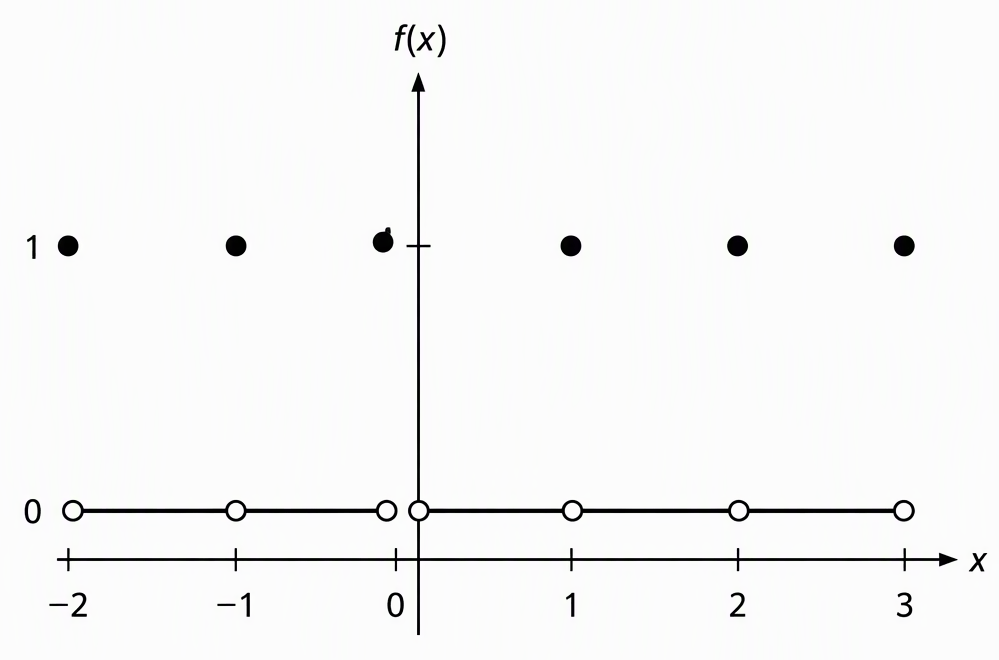
For any integer and any point strictly between it and the next integer:
Thus:
At the integer itself:
Every non-integer has a neighbourhood where the function is constantly zero. At every integer:
Therefore every integer is a removable discontinuity. Replacing each integer value by zero makes the function continuous everywhere.
What should I practise after a wrong continuity answer?
Choose the next exercise by the failed step, not by your total correct answers. An algebra error needs a different repair from a wrong conclusion about whether a limit exists. Use this question-by-question map:
- Wrong Question 1 or 4: Practise standard-limit algebra and rationalisation. Rewrite the expression before evaluating the limit.
- Wrong Question 2: Write the left-hand limit, right-hand limit and function value on three separate lines. Only then equate them.
- Wrong Question 3: Practise bounds and the squeeze theorem. Direct substitution does not resolve an oscillatory factor.
- Wrong Question 5: Practise local sign analysis and the difference between removable and jump discontinuities.
- Wrong Question 6: Evaluate integer points separately from the open intervals between them. Do not infer the behaviour of a sum from either term alone.
Untimed conceptual accuracy should come before testing continuity inside a full paper. These six exercises cannot establish JEE readiness.
Re-solve every missed question with the solution covered. Then write one sentence explaining why the tempting incorrect approach fails. Check that explanation against the solution before opening another set.
Next step: full-length mock tests on JEEnius and sit a full 75-question, 300-mark, 180-minute paper and get a scored per-subject breakdown (free tests included).
If that step was the hard part, work through Definite Integrals JEE 2025: Shifted Sine and Floor Functions.
Frequently asked questions
Should I start continuity practice with solved examples or a mixed test?
Start with guided questions if you cannot independently calculate the left-hand limit, right-hand limit and function value at a junction. If you can calculate all three but struggle to choose a method for unfamiliar expressions, attempt the mixed test before checking its key or solutions.
How do I check continuity of a piecewise function?
At an interior junction, select the applicable branch on each side and calculate the two one-sided limits separately. Both must exist as finite values and equal the assigned function value. At a domain endpoint, use only the relevant one-sided limit.
Is x sin(1/x) continuous at zero?
The expression x sin(1/x) is undefined at zero, but its limit there is zero because its absolute value is bounded by |x|. Defining the function value at zero as zero makes it continuous there. The squeeze theorem justifies the limit even though sin(1/x) itself has no limit at zero.
Where is floor(x) + floor(1-x) discontinuous?
The function equals zero at every non-integer and one at every integer. At each integer, both one-sided limits are zero, so the discontinuity is removable rather than a jump. It is continuous at every non-integer.