
Which Biomolecules practice source should you use first?
Use worked Biomolecules practice questions for JEE to diagnose gaps, NCERT to repair concepts and authentic PYQs to check how those concepts have been tested. No single resource does all three jobs. If you have already revised, go straight to the six questions below and attempt them before reading the solutions.
These are original JEE Main-oriented editorial questions, not previous-year questions or an official difficulty benchmark. Record your reasoning, not just your chosen option.
How do NCERT exercises, authentic PYQs and this free set compare?
Pick NCERT for concept repair, authentic PYQs for exam practice and this worked set for immediate diagnosis. Compare their purpose and limits, not the size of a question collection.
- Purpose
- NCERT chapter exercises: Check textbook concepts.
- Authentic JEE PYQs: Show how concepts have been tested.
- Original worked set: Expose misconceptions through answers and reasons.
- Question format
- NCERT: Textbook questions, not a substitute for exam-style choices.
- PYQs: Preserve the original format. Main and Advanced questions are not one difficulty level.
- This set: Six single-correct MCQs.
- Explanation support
- NCERT: Use the chapter’s explanations alongside exercises.
- PYQs: Official keys establish accepted answers, but are not necessarily worked explanations.
- This set: Free questions and explanations appear below.
- Exam provenance
- NCERT: Textbook material, not exam questions.
- PYQs: Retain exam and year attribution.
- This set: Editorial material with no official or PYQ status.
- Best preparation stage
- NCERT: First learning and targeted repair.
- PYQs: After the underlying distinctions are secure.
- This set: After revision, before choosing what to repair.
- Main limitation
- NCERT: Does not replace exam-format practice.
- PYQs: Remembered answers can hide weak reasoning.
- This set: Narrow coverage, not a readiness certificate.
Which route fits a first-time learner, reviser or dropper?
Choose by what you cannot yet explain, not simply by your class or attempt number. Unfamiliar terms call for textbook work. Familiar terms with weak option elimination call for reasoned practice. Remembering an old paper’s answer is not enough evidence of understanding.
- Class 11 student studying ahead or first-time learner: Start with NCERT if “glycosidic linkage” and “peptide bond” are unfamiliar. Learn what each bond joins, then attempt the related exercises.
- Class 12 student who has revised once: Attempt the on-page set closed-book. Revisit only the concepts you miss or cannot explain, rather than restarting the whole chapter.
- Dropper who remembers PYQ answers: Explain the chemical reason before accepting a correct choice as evidence. Then use fresh original questions to check whether you can apply that reasoning to different wording.
- Advanced aspirant: Use this set for foundational diagnosis, then attempt authentic Advanced questions under each paper’s own instructions. Do not carry Main’s question format or marking assumptions into Advanced.
A short chapter set cannot certify JEE readiness or predict marks. Judge your explanation instead: state why the chosen option works and why the nearest alternative fails.
Which free Biomolecules questions should you attempt before checking answers?
Attempt all six questions closed-book and record an option and a brief reason for each. These are original JEE Main-oriented editorial questions, with one correct option per question, not official exam material.
Write the distinction that rules out your closest alternative. Keep your original response unchanged when checking the solutions so that a guessed answer does not become a remembered success. These questions sample selected concepts, not the entire chapter.
Question 1. Which sugar is non-reducing under the usual alkaline tests used to distinguish reducing sugars?
- A. Glucose
- B. Fructose
- C. Maltose
- D. Sucrose
Question 2. A sample of lactose undergoes complete hydrolysis. Which pair of monosaccharides is obtained?
- A. Glucose and fructose
- B. Glucose and galactose
- C. Two glucose units
- D. Galactose and fructose
Question 3. Which linkage joins amino-acid residues along the primary backbone of a protein?
- A. Amide linkage:
- B. Ester linkage:
- C. Glycosidic linkage between sugar units
- D. Disulfide linkage:
Question 4. Which statement correctly describes ordinary protein denaturation, rather than protein hydrolysis?
- A. Peptide bonds are cleaved, releasing the constituent amino acids.
- B. Only the amino-acid sequence changes; the native fold remains unchanged.
- C. Native higher-order structure is disrupted without cleavage of the primary peptide backbone.
- D. Every denatured protein necessarily regains its original structure on cooling.
Question 5. Deficiency of which vitamin causes scurvy?
- A. Vitamin A
- B. Vitamin B1
- C. Vitamin C
- D. Vitamin D
Question 6. Which statement correctly distinguishes the characteristic sugar and pyrimidine base of DNA from those of RNA?
- A. DNA contains ribose and thymine; RNA contains 2-deoxyribose and uracil.
- B. DNA contains 2-deoxyribose and uracil; RNA contains ribose and thymine.
- C. Both contain ribose; DNA characteristically contains thymine and RNA uracil.
- D. DNA contains 2-deoxyribose and characteristically thymine; RNA contains ribose and characteristically uracil.
Why is each correct option right, and why are the alternatives tempting?
The deciding distinctions are free anomeric centres, hydrolysis products, backbone bonds, protein folding and textbook vitamin and nucleic-acid facts. Compare each explanation with your own reason. A correct letter based on a false rule still needs repair.
Question 1: D. Sucrose.
Both anomeric centres participate in sucrose’s glycosidic bond, leaving no free anomeric centre for the usual reducing behaviour. Glucose is reducing, and maltose retains a free anomeric centre.
Fructose is tempting because it is a ketose. In alkaline conditions, it can tautomerise through an enediol intermediate to aldoses and act as a reducing sugar. “Ketose means non-reducing” is the faulty rule.
Question 2: B. Glucose and galactose.
The hydrolysis products distinguish these disaccharides. Do not transfer a remembered pair from one sugar to another.
- Lactose: Glucose and galactose.
- Maltose: Two glucose units.
- Sucrose: Glucose and fructose.
Option A gives sucrose’s products, while option C gives maltose’s. Option D incorrectly replaces lactose’s glucose unit with fructose.
Question 3: A. Amide linkage:
The peptide linkage is an amide linkage formed between the carboxyl group of one amino acid and the amino group of another. An ester has oxygen instead of the peptide linkage’s nitrogen at that position; a glycosidic linkage joins sugar units.
Disulfide links can occur between suitable cysteine side chains in proteins. That makes D tempting, but a bond present in a protein is not automatically the bond forming its primary backbone.
Question 4: C. Native higher-order structure is disrupted without cleavage of the primary peptide backbone.
Ordinary denaturation disrupts native conformation and commonly biological activity while leaving the amino-acid sequence intact. It affects the interactions maintaining the fold, rather than hydrolysing the peptide backbone into amino acids.
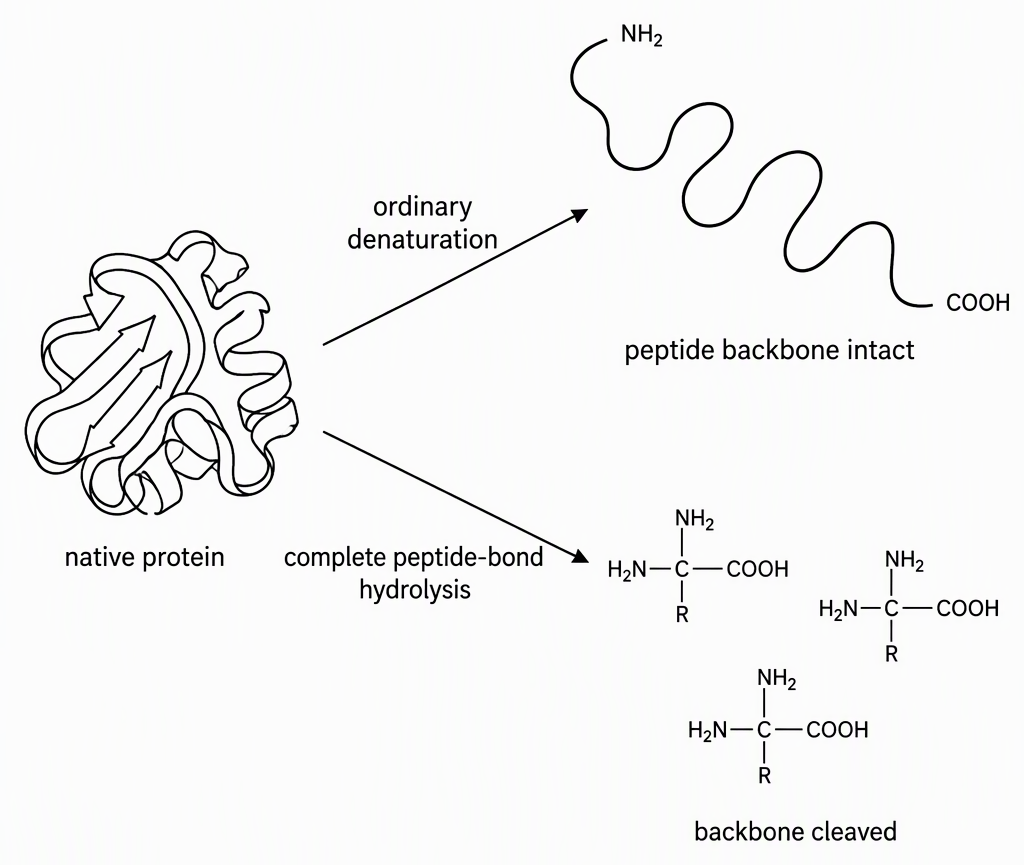
Option A confuses denaturation with hydrolysis. B wrongly changes the primary sequence, while D turns possible refolding into a guarantee. Denaturation need not be reversible.
Question 5: C. Vitamin C.
Vitamin C deficiency causes scurvy. The distractors are tempting if you recognise deficiency diseases but mix up their vitamin associations.
- Vitamin A: Night blindness.
- Vitamin B1: Beriberi.
- Vitamin D: Rickets in children.
Question 6: D. DNA contains 2-deoxyribose and characteristically thymine; RNA contains ribose and characteristically uracil.
A swaps the sugars, B swaps the characteristic bases, and C incorrectly gives both molecules ribose. At the sugar’s second carbon, ribose has a hydroxyl group, while 2-deoxyribose has hydrogen.
Cytosine is shared by both, so “pyrimidine” alone does not distinguish them. Do not replace these chemical distinctions with an absolute claim that all DNA is double-stranded or all RNA is single-stranded.
How should your mistakes decide the next practice source?
Choose the next resource from the mistaken distinction, not your total correct count. A correct option with an incorrect or absent reason remains unresolved understanding, not mastery. Write the false rule you used and its correction before attempting more questions.
- Missed a sugar question: Build a compact comparison of each sugar’s constituent monosaccharides, glycosidic linkage and reducing behaviour. Include whether an anomeric centre remains free. Check it against NCERT before attempting more carbohydrate questions.
- Confused denaturation with hydrolysis: Revisit the levels of protein structure. Identify the backbone bonds and the interactions supporting the fold, then state which each process affects.
- Missed the vitamin or nucleic-acid question: Retrieve the relevant distinctions from memory first. Check your written version against NCERT instead of repeatedly rereading the answer key.
- Got the letter right without a sound reason: Explain why the nearest distractor is wrong, then attempt a fresh question using the same concept.
Once the distinction is secure, attempt authentic chapter PYQs and check against the appropriate official key where available. Reject an alleged PYQ label without exam and year attribution: labelling cannot turn an original question into an exam question. Do not convert these six editorial responses into a predicted rank, percentile or chapter score.
When should you move from chapter questions to a full mock?
Move to a full paper when you can explain the repaired distinctions without looking them up. Chapter practice checks local understanding; a full paper also tests switching between topics and subjects. A mock serves a different purpose from another Biomolecules worksheet.
JEEnius offers full-length mocks, with free tests included: 75 questions, 300 marks and 180 minutes, with a scored per-subject breakdown. Those full-paper figures describe JEE Main, not a fixed JEE Advanced pattern.
Use the mock to examine how you handle a mixed paper, not to seek a guaranteed number of Biomolecules questions. Before your next full paper, close the solutions and rewrite the reason behind every answer you missed or guessed.
Next step: full-length mock tests on JEEnius and sit a full 75-question, 300-mark, 180-minute paper and get a scored per-subject breakdown (free tests included).
If that step was the hard part, work through Limit, Continuity and Differentiability JEE 2026: Key Audit.
Frequently asked questions
Should I start Biomolecules practice with NCERT or JEE PYQs?
Start with NCERT if terms such as glycosidic linkage and peptide bond are unfamiliar. If you have revised the chapter, attempt the six worked questions closed-book to identify gaps, then repair those concepts using NCERT. Move to authentic PYQs once you can explain the underlying distinctions.
Are these Biomolecules questions actual JEE Main PYQs?
No. These are six original JEE Main-oriented editorial MCQs, each with one correct option and a worked explanation. They are not official exam questions or an official difficulty benchmark.
Why is fructose a reducing sugar even though it is a ketose?
In alkaline conditions, fructose can tautomerise through an enediol intermediate to aldoses and show reducing behaviour. Being a ketose therefore does not make a sugar non-reducing under the usual alkaline tests.
Does protein denaturation break peptide bonds?
Ordinary protein denaturation disrupts native higher-order structure without cleaving the primary peptide backbone. The amino-acid sequence remains intact, although biological activity commonly changes. Cleavage of peptide bonds is hydrolysis, not ordinary denaturation.
Is solving six Biomolecules questions enough for JEE preparation?
No, this set samples selected concepts and cannot certify JEE readiness or predict marks. Use incorrect answers and weak explanations to guide targeted NCERT revision, then attempt authentic chapter PYQs. Move to a full paper when you can explain the repaired distinctions without looking them up.