
Which free Polymers practice should I start with for JEE?
For free Polymers practice questions for JEE, use the original questions on this page to diagnose gaps, relevant textbook exercises to repair fundamentals, and historical JEE questions to test application after revision. First, check the official syllabus for your intended exam and year, checking JEE Main and JEE Advanced separately. An old JEE-labelled question does not establish current syllabus relevance.
This article does not establish whether Polymers is included in your target syllabus. For Main, consult jeemain.nta.nic.in; for Advanced, consult the official JEE Advanced website. Do not allocate chapter revision time simply because an old book contains many questions.
How do original drills, textbook exercises and historical JEE questions compare?
Use original drills to identify misconceptions, textbook exercises to rebuild definitions, and historical JEE questions to test application after revision. Choose for your next task, not question volume: each route has different requirements for feedback and syllabus checking.
- Best use
- Original on-page drills: Expose misconceptions about monomers, repeat units, reactions and properties.
- Relevant textbook exercises: Rebuild definitions and monomer–polymer relationships.
- Historical JEE questions: Test application through actual past phrasing.
- Prerequisite knowledge
- Original on-page drills: Basic familiarity with the chapter; uncertainty helps identify gaps.
- Relevant textbook exercises: Read the corresponding explanation and examples first.
- Historical JEE questions: Understand the chemistry well enough to explain an answer.
- Feedback quality
- Original on-page drills: Explanatory answers follow, including the trap behind a tempting wrong option.
- Relevant textbook exercises: Answer coverage and worked solutions depend on the publication and edition.
- Historical JEE questions: An official key establishes the accepted answer, but does not necessarily explain the reasoning.
- Syllabus checking
- Original on-page drills: Check the tested concepts against your intended exam’s syllabus.
- Relevant textbook exercises: A chapter’s presence in a textbook does not establish exam relevance.
- Historical JEE questions: Check each question’s exam, year and syllabus context.
- Access route
- Original on-page drills: Available directly below, without a download or signup.
- Relevant textbook exercises: Use legally available official digital textbook publications, including NCERT resources where the relevant material is available.
- Historical JEE questions: Use official exam papers and answer-key archives where available. Do not assume they provide chapterwise collections or worked solutions.
- Main limitation
- Original on-page drills: Teaching questions are not evidence of historical exam difficulty.
- Relevant textbook exercises: Coverage varies by edition and may not stretch application skills.
- Historical JEE questions: Older content can distract from the target syllabus; an answer-only key cannot repair every misconception.
Which route should Class 11, Class 12 and dropper students choose?
If you cannot pair common polymers with their monomers, revise the relevant textbook material before attempting a large PYQ collection. If you remember names but confuse chain-growth polymerisation, condensation and cross-linking, start with the diagnostic and use each error to choose a revision task.
- Class 11: Practise after the topic has been taught or deliberately assigned. A searchable JEE chapter is not automatically an immediate task.
- Class 12: Use the diagnostic to separate recall gaps from reasoning gaps. Repair syllabus-relevant weak concepts before attempting historical questions.
- Droppers: Check Polymers questions in an older chapterwise book against the target-year syllabus before reserving revision time.
- Main-only students: Inclusion in an Advanced resource is not a reason to prioritise the chapter.
- Advanced-targeting students: Do not infer Advanced relevance from a Main resource or assume that the exams share a syllabus.
If you can explain every diagnostic answer without guessing, move to syllabus-relevant historical questions rather than repeating elementary recall drills. Check that you can reject the wrong options too.
Can I try free Polymers questions before choosing a question bank?
The questions below are original concept diagnostics, not PYQs or a replica of either exam’s paper pattern. Each has one correct answer, with explanations in the following section.
Mark every response reasoned, guessed or unknown. A correct guess does not establish understanding.
1. Which monomer forms PTFE by addition polymerisation?
- A. Chloroethene
- B. Tetrafluoroethene
- C. Ethene
- D. Hexafluoropropene
2. Which pairing of polymer and starting material is correct?
- A. Nylon-6: hexamethylenediamine and adipic acid; nylon-6,6: caprolactam
- B. Nylon-6: caprolactam; nylon-6,6: ethylene glycol and terephthalic acid
- C. Nylon-6: caprolactam; nylon-6,6: hexamethylenediamine and adipic acid
- D. Nylon-6: adipic acid alone; nylon-6,6: hexamethylenediamine alone
3. Ethylene glycol reacts with terephthalic acid to form PET. Which description is correct for this preparation route?
- A. Condensation forms ester linkages and eliminates water.
- B. Condensation forms amide linkages and eliminates water.
- C. Condensation forms ester linkages and eliminates hydrogen chloride.
- D. Addition across carbon–carbon double bonds forms the polymer without eliminating a small molecule.
4. The following segment belongs to an addition polymer. Which monomer produces it?
- A. Ethane
- B. Ethanol
- C. Chloroethene
- D. Ethene
5. Why can polythene be remoulded on suitable heating, while cured Bakelite cannot?
- A. Polythene is more densely covalently cross-linked than cured Bakelite.
- B. Polythene chains can move relative to one another on heating; cured Bakelite has a covalently cross-linked network.
- C. Heating converts polythene completely into ethene, which then forms a new object.
- D. Cured Bakelite contains no covalent bonds between its atoms.
6. What is the main structural role of sulfur during vulcanisation of rubber?
- A. It removes every carbon–carbon double bond and converts rubber into polythene.
- B. It acts only as a lubricant between rubber chains.
- C. It forms cross-links between chains, restricting their relative movement.
- D. It breaks the chains into smaller molecules so they flow more easily.
What are the answers, and which misconceptions do they expose?
The correct options are 1 B, 2 C, 3 A, 4 D, 5 B and 6 C. Check your reasoning, not just your option: explain the relevant bond change or structure–property relationship. Use each repair category below to choose what to revise.
1. B: Tetrafluoroethene forms PTFE.
During addition polymerisation, the carbon–carbon double bond becomes a single bond as new bonds connect successive monomers. This creates the saturated polymer backbone.
The monomer has a double bond; the repeat unit has single bonds along the backbone and connections to neighbouring units. Trap: D also names a fluorinated alkene, but its extra carbon gives a different repeat structure. Repair category: monomer recall.
2. C: Caprolactam gives nylon-6; the diamine–diacid pair gives nylon-6,6.
Caprolactam is a cyclic amide with six carbon atoms. Ring-opening polymerisation produces nylon-6; the number refers to the six-carbon starting unit, not six monomer molecules joining.
Hexamethylenediamine has six carbon atoms, and adipic acid also has six, including its carboxyl carbons. Their reaction forms amide linkages and eliminates water, giving nylon-6,6. Trap: A swaps two familiar preparations. Repair category: monomer recall, supported by checking carbon counts.
3. A: This PET route forms ester linkages and eliminates water.
The hydroxyl groups of ethylene glycol react with the carboxyl groups of terephthalic acid. The product contains the following ester linkage.
For these stated starting materials, linkage formation eliminates water. Trap: C confuses a carboxylic acid route with an acid-chloride route, where hydrogen chloride can be eliminated. Repair category: polymerisation chemistry.
4. D: Ethene gives the displayed polythene segment.
An addition-polymer repeat unit is not an unchanged monomer molecule. The double bond becomes a single bond, and new bonds connect successive units.
Trap: A mistakes a saturated polymer backbone for evidence of a saturated starting molecule. Ethane lacks the double bond needed for this addition process. Repair category: structural interpretation.
5. B: Cross-linking explains the contrast.
Polythene is thermoplastic: on suitable heating, its chains gain enough mobility for reshaping. Cured Bakelite is thermosetting because covalent cross-links tie its chains into a network that cannot flow as separate chains.
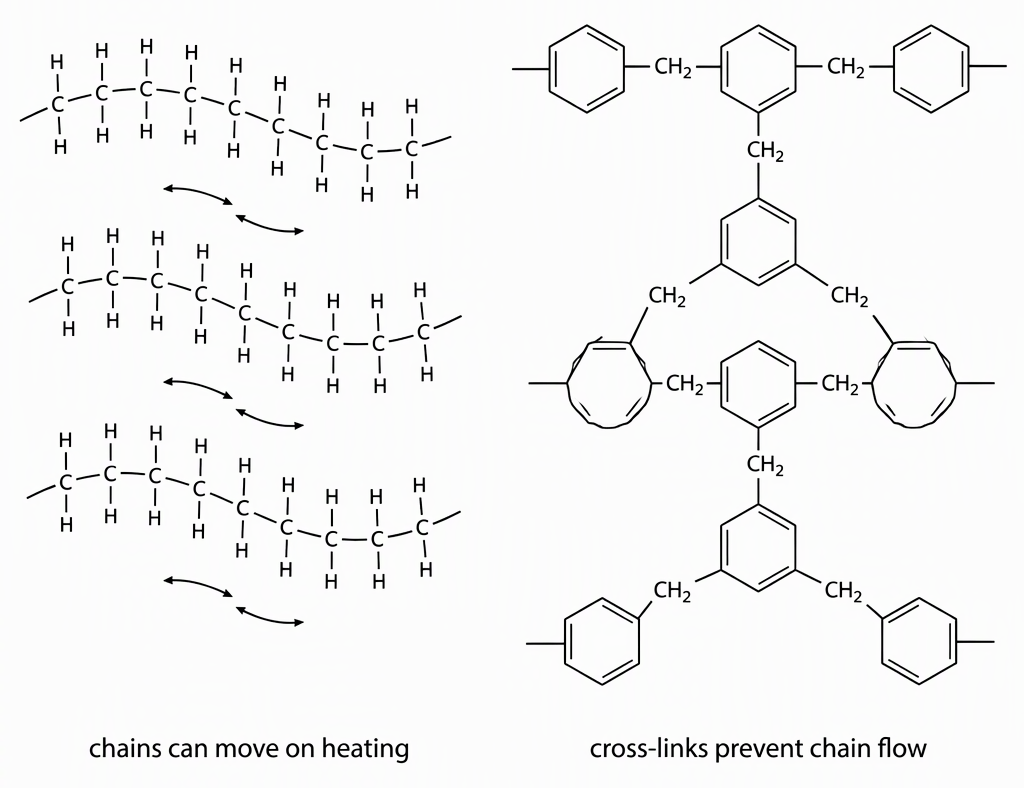
Stronger heating does not simply make cured Bakelite remouldable; it eventually causes degradation. Trap: C wrongly treats softening as complete conversion back into monomer. Repair category: structure–property reasoning.
6. C: Sulfur introduces cross-links between rubber chains.
These links limit chain slippage and can improve elastic recovery and resistance to permanent deformation. Vulcanisation changes the connections between chains rather than turning rubber into an unrelated polymer.
Trap: B treats sulfur as a physical lubricant rather than a participant in chemical cross-linking. More cross-linking does not improve every property: excessive cross-linking can reduce flexibility. Repair category: structure–property reasoning.
What should I practise next, and when should I stop?
Repair the specific error before collecting more questions. Stop elementary drills when you can justify the correct answer, reject the distractors and handle a differently worded question on the same concept without guessing. Use this workflow only for content that belongs in your intended exam plan.
- Repair monomer recall. Make a compact monomer–polymer–linkage revision sheet. Include both nylons separately so their starting materials do not blur together.
- Repair structural interpretation. Draw the monomer and repeat unit side by side. Check the changed bond, substituents and bonds connecting neighbouring units.
- Repair polymerisation chemistry. Write the relevant transformation. Identify whether a small molecule is eliminated in that example, and name it.
- Repair structure–property reasoning. Explain how chain mobility and cross-links affect heating behaviour or elastic recovery. Avoid the shortcut that more cross-links always means better properties.
- Retest without the explanations. Redo every guessed or incorrect question, then attempt a different question testing the same concept.
- Move to historical questions after repair. Check their exam, year and target-syllabus relevance. Move on once your explanations hold up, rather than chasing a large completion count.
Chapter diagnosis and whole-paper readiness are different tasks. When you need to assess the latter, JEEnius includes free full-length Main mocks: 75 questions, 300 marks and 180 minutes, with a scored per-subject breakdown. Use that separate check to identify where your next revision effort belongs.
Next step: full-length mock tests on JEEnius and sit a full 75-question, 300-mark, 180-minute paper and get a scored per-subject breakdown (free tests included).
Related on JEEnius: How to Study Quadratic Equations JEE: Tools, Roots and Signs.
Frequently asked questions
Where can I practise Polymers questions for JEE for free?
This page provides six original diagnostic questions with explanatory answers, without a download or signup. Use relevant textbook exercises to repair gaps, then attempt historical questions from official exam archives where available. Check all practice material against your target exam's syllabus.
Are these Polymers questions actual JEE PYQs?
No. These are original concept diagnostics, not previous-year questions or replicas of either exam's paper pattern. They test monomer recall, repeat-unit interpretation, polymerisation chemistry and structure–property reasoning.
Is Polymers in the current JEE Main or JEE Advanced syllabus?
This article does not establish whether Polymers is included in your target syllabus. Check the official syllabus for your intended year separately on jeemain.nta.nic.in and the official JEE Advanced website. An old JEE question or a textbook chapter does not establish current exam relevance.
When should I move from basic Polymers questions to PYQs?
Move on when you can justify the correct answers, reject the distractors and solve differently worded questions on the same concepts without guessing. First repair any gaps in monomer recall, structural interpretation, polymerisation chemistry or structure–property reasoning. Then attempt historical questions after checking their exam, year and target-syllabus relevance.