
What should I check before using the quadratic formula?
- Check that the equation is actually quadratic. For quadratic equations for JEE, root formulas apply only when the leading coefficient is nonzero. Identify the unknown and the parameters before calculating.
The unknown is what you solve for; a parameter controls the coefficients. If a parameter can make the leading coefficient zero, examine that value separately. The resulting equation may be linear, inconsistent or an identity.
- Translate the demand into a tool. Choose from the condition in the question, not the appearance of the equation. Calculate individual roots only when the question needs them.
- Real or distinct roots: start with the discriminant.
- Sums, products or symmetric root expressions: start with Vieta’s relations.
- Roots inside an interval or quadratic inequalities: use the parabola and signs.
- Build the minimum toolkit and connect it to the graph. Use the discriminant to test reality and Vieta’s relations to work with roots without finding them.
The completed-square form gives the vertex directly. Treat it as a way to read the graph, not another formula to memorise.
- Combine conditions instead of replacing one with another. Two positive real roots, counting a repeated root twice, require all three tests:
For distinct roots, make the discriminant condition strict. A positive product alone also permits two negative roots.
For interval questions, normalise first so the parabola opens upwards. This works even when the original leading coefficient is negative.
Both roots lie in the open interval, with repeated roots allowed, exactly when all four conditions hold:
For inequalities, distinct real roots give this sign chart:
With a repeated root, the normalised quadratic is zero there and positive elsewhere. With a negative discriminant, it is positive everywhere. Do not copy the distinct-root chart into these cases; reverse signs when returning to an original quadratic with a negative leading coefficient.
- Intersect restrictions, then audit boundaries. Check zero roots, repeated roots, excluded interval endpoints, zero denominators and a vanishing leading coefficient. Write the intersection explicitly rather than choosing whichever condition looks strongest.
Use this study order: algebra and factorisation → discriminant and Vieta → graph and signs → parameter restrictions and root location. Each stage supplies a tool needed by the next.
How do I evaluate a root expression without finding the roots?
Use Vieta when the expression is symmetric in the roots. Original teaching example 1, not a previous-year JEE question: find the reciprocal-square sum for the roots of the equation below. Swapping the roots leaves the expression unchanged, which is the cue to try sums and products first.
Read the sum and product directly. Check that the product is nonzero before taking reciprocals.
Both reciprocals therefore exist. Combine the fractions before substituting:
Finding the individual roots is valid, but squaring their reciprocals introduces radicals that cancel anyway. I would choose Vieta because it keeps the algebra shorter and makes the denominator check visible.
Sums of squared roots, reciprocal sums and transformed-root equations all reuse this sum–product toolkit. For a focused follow-up, JEEnius daily practice problems provide a fresh ten-question topic set every day, with free sets daily.
How do I find parameter values for two positive real roots?
Intersect reality, sum and product conditions after checking whether the equation becomes linear. Original teaching example 2, not a previous-year JEE question: find all real parameter values giving two positive real roots, counting a repeated root twice.
First examine the value that cancels the quadratic term. A linear equation cannot supply the required two roots.
This parameter value does not qualify. For every other value, apply the three conditions.
Reality:
Positive sum:
Positive product:
Use numerator and denominator signs for the last two inequalities. Never multiply by the denominator without determining its sign, because a negative multiplier reverses the inequality.
Intersect all three restrictions. A value must pass every test, not just the positive-product test.
Audit each boundary in the original equation:
- At negative two: the constant term vanishes, giving a zero root. Exclude it because positive means strictly above zero.
- At one: the equation is linear. Exclude it.
- At two: the equation has a repeated positive root, so include it.
If the demand changes to distinct positive roots, only the discriminant boundary changes. The repeated-root case is then excluded:
How do I put both roots strictly inside an interval?
Require real roots, a vertex inside the interval and positive endpoint values for an upward-opening parabola. Original teaching example 3, not a previous-year JEE question: find all real parameter values for which both roots lie strictly between zero and three, counting a repeated root twice.
The vertex sits midway between the roots. Keeping it inside prevents both roots from sitting on the same side of the interval; positive endpoint values then keep the endpoints outside the root pair.
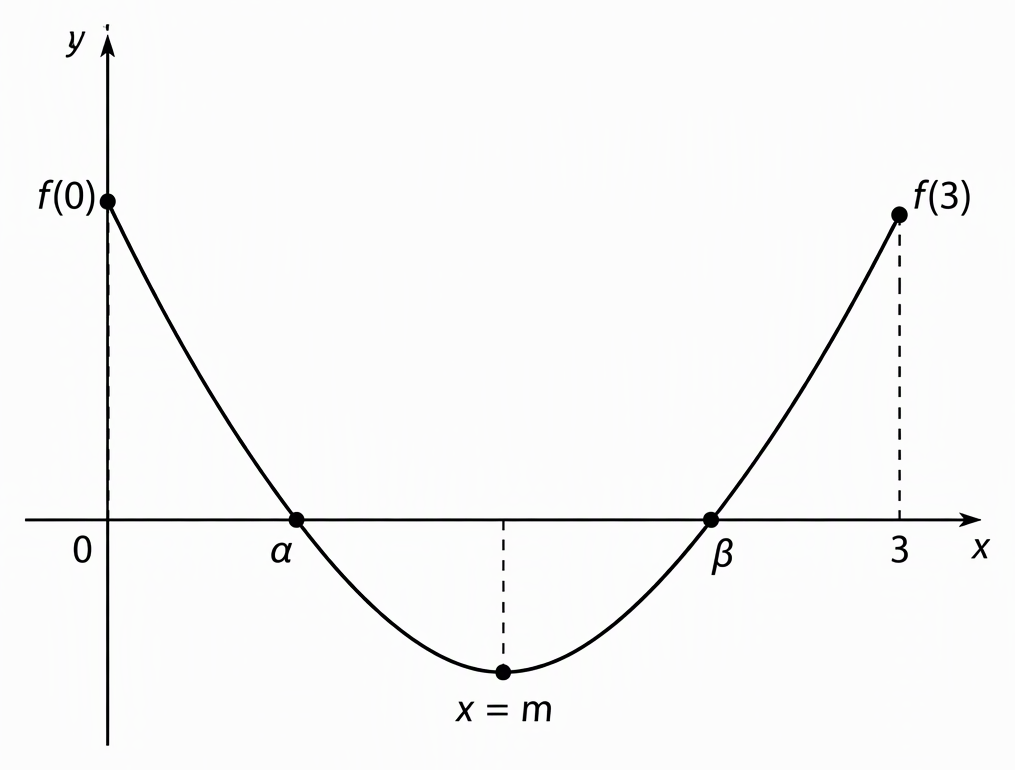
Real roots:
Vertex inside:
Endpoint tests:
Intersect the restrictions. Keep only values that satisfy reality, vertex location and both endpoint tests.
The internal boundaries are allowed because their repeated roots lie strictly inside the interval. The outer boundaries are excluded because a root reaches zero or three.
Neither reality nor the vertex test is optional. This value passes the vertex and endpoint tests but has no real roots:
Conversely, this polynomial has real roots and positive endpoint values, but both roots are beyond the interval. The vertex test rejects it.
Do not extend the result to closed intervals by casually replacing every strict inequality with a non-strict one. Recheck endpoint-root cases directly.
What should I practise next if I keep missing conditions?
Choose practice by the failed step, not by how familiar a question looks. First practise discriminant calculations, Vieta identities and quadratic sign charts separately. Then mix them in parameter questions so choosing the tool becomes part of the task.
Next, practise these applications:
- Transformed-root equations: use the sum–product method from example 1.
- Common-root problems: use elimination and substitution checks. A candidate must satisfy both original equations.
- Root location: combine the graph conditions from example 3.
For JEE Main, use chapter-wise previous-year questions to practise tool selection and boundary checks. For JEE Advanced, progress to combinations of root location, parameters and additional constraints. These are practice priorities, not exclusive syllabuses.
Keep four error-log categories:
- Wrong tool: record which wording should have guided your choice.
- Missing condition: identify what your solution failed to guarantee.
- Algebra/sign error: redo the exact expansion or sign split.
- Endpoint/degeneracy error: test the boundary in the original equation.
Manually redo the failed question from a blank page, then attempt an unseen question testing the same condition. Readiness means explaining why every condition is needed and reproducing the solution unaided, not recognising its answer.
Keep those manual reattempts separate from unseen practice. For the latter, JEEnius practice mode offers topic sets that skip questions you have already seen, with free sets included.
Next step: practice mode on JEEnius and practise a topic in sets that skip questions you have already seen (free sets included).
Keep going with 3D Coordinates JEE 2023: Quadrilateral Area Solution.
Frequently asked questions
In what order should I study quadratic equations for JEE?
Start with algebra and factorisation, then study the discriminant and Vieta’s relations. Next, connect these tools to graphs and sign charts before tackling parameter restrictions and root location. Practise individual tools first, then mix them so choosing the method becomes part of the task.
How do I evaluate expressions involving roots without finding the roots?
For symmetric expressions, start with Vieta’s relations: S = α + β = -b/a and P = αβ = c/a. For example, 1/α² + 1/β² = (S² - 2P)/P². Check that P is nonzero before using reciprocal expressions.
What are the conditions for two positive real roots?
For ax² + bx + c = 0 with a nonzero, require D ≥ 0, -b/a > 0 and c/a > 0 together. These conditions allow a repeated positive root; use D > 0 if the roots must be distinct. If a parameter can make a zero, examine that value separately because the equation is no longer quadratic.
How do I check whether both quadratic roots lie inside an interval?
For f(x) = ax² + bx + c with a nonzero, normalise to g(x) = f(x)/a so the parabola opens upwards. Both roots lie strictly inside (L, U), allowing repeated roots, exactly when D ≥ 0, L < -b/(2a) < U, g(L) > 0 and g(U) > 0. Intersect all four conditions and exclude parameter values that put a root at either endpoint.