
What seven steps should I use before choosing a probability formula?
- Check the prerequisites, not every difficult P&C problem. To study Probability for JEE, start with sets, intersections, unions, factorials and combinations. You need these tools before advanced arrangement puzzles.
Choosing two objects ignores order; arranging two objects counts both possible orders separately:
- Write the random experiment precisely. State what is selected, whether order matters, whether replacement occurs and what information is given. “Draw two balls” is incomplete: replacing the first ball changes the second draw.
Separate the physical experiment from your counting method. Sequential draws can sometimes be counted as unordered selections, provided numerator and denominator use the same convention.
- Define the target event and sample space. Translate the requested result into a condition an outcome must satisfy. Use favourable outcomes divided by total outcomes only after justifying equal likelihood:
For two fair dice, ordered face pairs are equally likely. Their sums are not: seven has more supporting pairs than two.
- Choose direct counting or the complement. Count whichever event has fewer cases. “At least one” often makes “none” easier:
This is a workload decision, not an automatic rule. Choose direct counting when it is shorter.
- Use given information to restrict the experiment. The condition becomes your new sample space. Remove outcomes that the information rules out:
Count directly inside the conditioning event when its elementary outcomes remain equally likely.
- Use branches for stages or hidden sources. Multiply along a path using the probability appropriate to that stage. Do not assume the next stage is independent:
Add mutually exclusive successful paths. For an unknown source, calculate total observation probability first, then use Bayes to reverse the direction of conditioning.
- Audit the model and answer. Check that the answer lies between zero and one, ordered and unordered counts are not mixed, and independence is justified. Mutually exclusive events with nonzero probabilities are not independent: their intersection has zero probability, but the product of their probabilities is positive.
Study in this sequence: counting and event algebra → complements and conditional probability → independence → total probability and Bayes → repeated independent trials. Recognise the binomial model only when the trial count is fixed, trials are independent and success probability stays unchanged.
For exactly the stated number of successes:
How do I solve “at least one” questions without replacement?
Use the complement when “none” is a single case and the requested event splits into several cases. Here, counting all-red selections avoids separately counting one, two and three blue balls. The denominator counts selections of individual balls, not colour patterns.
Original teaching example 1, not a JEE previous-year question: Three balls are drawn uniformly without replacement from a bag containing five red and three blue balls. Find the probability of at least one blue ball.
The experiment gives equally likely unordered selections of three individual balls. Even balls of the same colour are distinct objects:
Count the complement by selecting all three balls from the five red balls. Subtract its probability from one:
Verify the same model sequentially. After each red draw, both the red count and total count decrease:
The tempting wrong calculation keeps the red probability unchanged:
That expression assumes replacement, or independent draws with unchanged probabilities. Changing the phrase to “with replacement” makes it correct.
Transferable cue: Without replacement, update branch probabilities or count complete selections. Do not keep the first-draw probability unchanged.
Why does given information change the denominator?
Given information removes outcomes before you calculate the requested probability. For fair, distinguishable dice, the surviving ordered pairs remain equally likely. Your conditional denominator counts those surviving pairs, not all 36 pairs from the original experiment.
Original teaching example 2, not a JEE previous-year question: Two fair, distinguishable dice are rolled. Given that at least one die shows six, find the probability that their sum is eight.
Define event A as “sum is eight” and event B as “at least one six”. Count the conditioning event by including pairs with the first die six and pairs with the second die six:
The subtraction removes the double-counted pair:
Only two surviving outcomes give the required sum. Divide their count by the number of outcomes in the conditioning event:
Now change the information to “the first die shows six”. Six eligible outcomes remain, and only one succeeds:
There is no contradiction. “At least one six” leaves uncertainty about which die showed six; “first die six” fixes that position.
Write this diagnostic question beside your work: “Which outcomes are still possible after I use the given information?”
For focused repetition, JEEnius daily practice problems provide a fresh ten-question topic set every day, with free sets daily. Keep the model statement beside each answer.
How do I use a probability tree before applying Bayes?
Calculate how each source produces the observation, then compare its successful path with all successful paths. Bayes is this comparison written as a conditional probability. A tree keeps the source choice separate from the dependent draws.
Original teaching example 3, not a JEE previous-year question: Choose bag A or bag B with equal probability. Bag A contains four red and two blue balls; bag B contains two red and four blue balls. Draw two balls without replacement. Given that both are red, find the probability that bag A was chosen.
Define event E as “both draws are red”. The initial source probabilities are equal:
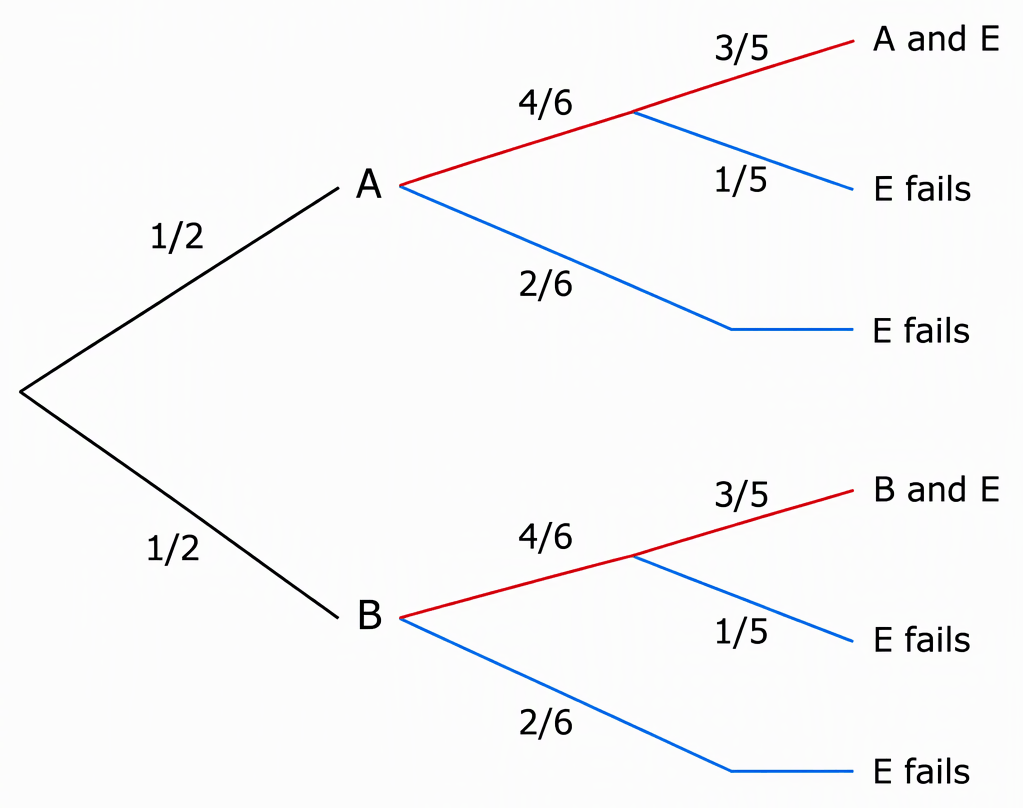
Update the contents after the first red draw. Multiply the two draw probabilities for each bag:
Include the source probability to get each successful path. Add these mutually exclusive paths to get the total observation probability:
The required share comes from bag A:
This is not the same quantity as:
The first asks which bag was chosen after observing red-red. The second asks how likely red-red is from a known bag.
For a third draw, use the updated bag probabilities and remaining contents. Bag A has two red balls among four; bag B has none:
Do not reuse the original equal source probabilities. Red-red is stronger evidence for bag A.
What should I practise next to fix mistakes before adding speed?
Practise paired variations before unrelated mixed questions. Change one phrase, explain how the model changes, then calculate. This tests whether you can choose the model rather than recognise a familiar solution.
Use this order:
- Equally likely counting and event algebra.
- Complements and replacement.
- Conditional probability and independence.
- Total probability and Bayes.
- Repeated independent trials.
- Mixed problems.
Pair these variations:
- With replacement versus without replacement.
- “At least one six” versus “first die six”.
- Observation given source versus source given observation.
For an immediate self-check, repeat example 1 with replacement:
Keep a separate error log with four labels:
- Sample-space error: Outcomes were missing, duplicated or wrongly treated as equally likely.
- Event-translation error: Words such as “at least”, “exactly” or “given” became the wrong event.
- Conditioning/dependence error: You kept the old denominator or assumed unchanged probabilities.
- Counting/algebra error: The model was correct, but counting or simplification failed.
Record the incorrect assumption, not merely the correct solution. “I treated colour patterns as equally likely” tells you what to repair.
Begin untimed. Move to mixed practice when you can state the experiment, target event, denominator or branch structure, and independence assumptions without consulting a solution.
Use topic-wise JEE Main previous-year questions first, then JEE Advanced problems combining ideas. Neither exam should be treated as having a fixed probability question type or chapter weightage.
Time mixed sets only after modelling becomes reliable; a universal seconds-per-question target is unhelpful. JEEnius practice mode offers topic sets that skip questions already seen, with free sets included: use unseen questions to test transfer, and re-solve your mistakes separately.
Next step: practice mode on JEEnius and practise a topic in sets that skip questions you have already seen (free sets included).
Related on JEEnius: Periodic Table Practice Questions JEE: 6 Explained Drills.
Frequently asked questions
What should I study before probability for JEE?
Start with sets, intersections, unions, factorials and combinations. Understand when order matters and how choosing differs from arranging. You do not need to finish every difficult permutation and combination problem before starting probability.
What is the best order to study probability for JEE?
Study counting and event algebra first, followed by complements and conditional probability, independence, total probability and Bayes, and repeated independent trials. Move to mixed problems once you can state the experiment, target event and probability model without consulting a solution.
How do I solve at least one probability questions without replacement?
Use the complement when counting none is shorter than counting all successful cases. Without replacement, update the probabilities after each draw or count complete, equally likely selections. Do not keep the first-draw probability unchanged.
Why does the denominator change in conditional probability?
Given information restricts the sample space to outcomes consistent with that information. For two fair, distinguishable dice, knowing that at least one shows six leaves 11 equally likely ordered pairs, not 36. Two of those pairs sum to eight, so the conditional probability is 2/11.
How should I practise probability questions for JEE?
Begin untimed with paired variations, such as draws with and without replacement, and explain how each change affects the model. Log the incorrect assumption behind each mistake under sample space, event translation, conditioning or dependence, or counting and algebra. Use topic-wise JEE Main previous-year questions before JEE Advanced problems combining ideas, and time mixed sets only after modelling becomes reliable.