
How should I study Polymers for JEE without wasting time?
Study Polymers for JEE only after checking your target syllabus. If standalone Polymers is absent, do not prioritise memorising its catalogue for that exam. If it is included, connect names, monomers, structures and classifications on one recall sheet instead of learning disconnected lists.
- Check the official Chemistry syllabus for your exact exam and attempt year. For JEE Main, use the syllabus published at jeemain.nta.nic.in; for JEE Advanced, consult its own official syllabus. Do not assume identical coverage. The supplied material does not establish current Polymers coverage, so an included-or-deleted verdict would be unverified. An old NCERT chapter or coaching module is not proof of current scope. Keep any board-exam requirement separate from JEE preparation.
- Refresh only the prerequisites used here. Practise carbon counting and identifying functional groups at both ends of a monomer. Recognise these structural features before attempting repeat-unit questions:
- Build one recall sheet with five columns. Use polymer name, monomer or monomers, repeat unit or structural motif, polymerisation route, and relevant classification. Enter only the examples required by your scope. For a cross-linked material, record its network motif rather than inventing a linear repeat unit.
- Reverse simple vinyl addition polymerisation structurally. Locate the two backbone carbons in one repeat unit. Restore their carbon-carbon double bond while keeping each substituent attached to its original carbon. Do not remove a halogen merely because it looks like a leaving group from another organic reaction.
- Reverse common condensation structures through their linkages. Identify the amide or ester linkage, then reconstruct the appropriate functional groups on the parent monomers. For common acid-based examples, restore carboxyl and amino groups across an amide linkage, or carboxyl and hydroxyl groups across an ester linkage. Check the preparative route separately: an amide-containing polymer can also come from ring opening.
- Keep the classification axes separate. Addition or condensation describes formation. Homopolymer or copolymer describes monomer composition. Elastomer, fibre, thermoplastic or thermosetting describes material behaviour. Answer each axis independently; one label does not automatically determine the others.
- Cover alternating columns and retrieve both ways. Go from name to monomer, then monomer to name; next hide the structure and rebuild it. Structure checks many answers, but common names and some named monomer pairs still need memorisation. Prefer this method to rereading because it exposes exactly which connection you cannot recover.
How do I recover PVC and PTFE monomers from their repeat units?
Restore a double bond between the two backbone carbons without changing their substituents. For these simple vinyl addition polymers, polymerisation changes carbon-carbon bonding, not elemental composition. You can reconstruct the monomer even if you cannot recall the polymer’s name.
Original practice question: Identify the monomers corresponding to these repeat units:
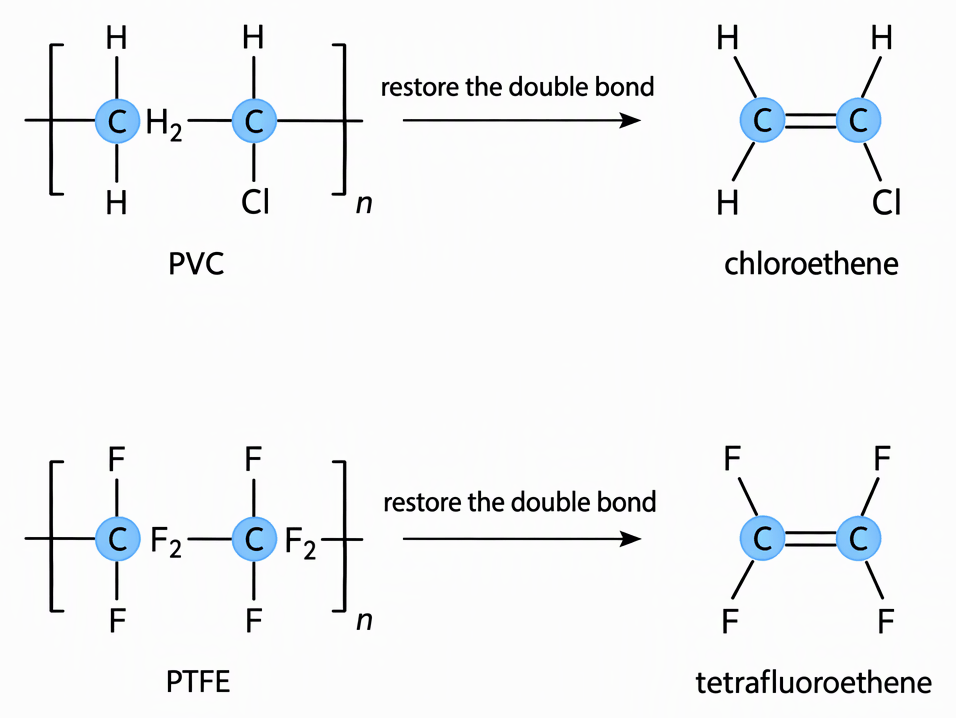
For PVC, select the two-carbon backbone fragment and restore its double bond:
The monomer is vinyl chloride, also called chloroethene. Chlorine stays attached to the second carbon.
Apply the same operation to PTFE:
The monomer is tetrafluoroethene. All four fluorine atoms remain attached; neither chlorine nor fluorine is removed because this reverses addition, not small-molecule elimination.
Both products are addition homopolymers, each made from one monomer species. Having different elements in a repeat unit does not make a copolymer.
Reusable check: For these simple vinyl addition examples, the monomer and repeat unit have the same elemental composition.
How can I distinguish nylon-6 from nylon-6,6 using their structures?
Count the carbons in each monomer-derived segment, then check the preparative route. Both nylons contain amide links, so that linkage alone cannot distinguish them.
Original practice task: Assign these structures to nylon-6 and nylon-6,6 and identify their usual preparative monomers:
A is nylon-6. Its repeat contains five methylene carbons and one carbonyl carbon:
Its usual preparative monomer is caprolactam, through ring-opening polymerisation. Nylon-6 can alternatively be prepared by condensation of 6-aminohexanoic acid:
Keep those routes separate. Small-molecule elimination is not compulsory for every route to a polyamide.
B is nylon-6,6. Its monomers are hexamethylenediamine and adipic acid:
The diamine has six carbons. Adipic acid also has six, not four, because both carboxyl carbons count:
Thus, 6,6 names the carbon counts of the two monomers, not six repeats or one six-carbon repeat. Both structures contain the amide linkage:
Worked numerical check: Count the carbon atoms in ten copies of the displayed nylon-6,6 repeat, excluding end groups:
For syllabus-relevant retrieval, JEEnius daily practice problems provide a fresh ten-question topic set every day, with free sets daily. Explain the carbon counts before checking an answer.
How do I classify Buna-S and Bakelite without mixing up the categories?
Buna-S is an addition copolymer with elastomeric behaviour. Bakelite is a phenol–formaldehyde condensation material whose cured, cross-linked network is thermosetting. Treat monomer composition, formation and material behaviour as separate answers.
Original classification task: State the monomers, formation type and material behaviour of Buna-S and Bakelite. Then evaluate the two statements below, working through each recall-sheet column separately.
- Monomers and composition: Buna-S uses 1,3-butadiene and styrene, so it is a copolymer. Bakelite uses phenol and formaldehyde. Monomer identity does not by itself tell you how a material responds to heat.
- Formation: Buna-S forms by addition copolymerisation. Bakelite forms through condensation chemistry. “Copolymer” does not mean “condensation polymer”; Buna-S disproves that shortcut.
- Behaviour: Buna-S is an elastomer. Cured Bakelite is thermosetting because covalent cross-links connect its chains into a network.
“Every addition polymer is a thermoplastic” is false. Buna-S is classified as an elastomer, despite its addition route. Do not transfer the formation label into the behaviour column.
“A thermosetting polymer can be repeatedly softened and remoulded by heating” is also false. Cured Bakelite’s cross-links prevent the chain flow needed for repeated melting and remoulding; excessive heating causes degradation instead.
For Bakelite, record phenol–formaldehyde cross-linked network as the structural motif. Do not force that network into a simple linear repeat-unit drawing.
What should I practise after making my polymer recall sheet?
Start with retrieval, then move to unseen structure and statement questions, only within your verified syllabus or separate board-exam needs. Judge your recall with the sheet closed, not by whether an option looks familiar.
- Recall in both directions. Practise name-to-monomer and monomer-to-name questions before looking at options.
- Reconstruct repeat units. Restore vinyl double bonds, identify linkages and count every carbon, including carbonyl carbons.
- Mix the classification axes. Answer formation, composition and behaviour separately, then tackle statements that confuse them.
- Diagnose each wrong answer. Label it name recall, carbon count, linkage recognition or classification-axis confusion. Repair that weakness rather than rereading the whole chapter.
Use older PYQs only after filtering them against your target syllabus. Their existence does not prove present-day inclusion.
Revisiting a missed concept is not repeating a memorised question. Redraw the failed relationship or explain it aloud, then test it on an unseen example. Your exit criterion is reconstructing the key relationships with the sheet closed and explaining why the alternatives are wrong.
For that unseen-question step, JEEnius practice mode offers topic sets that skip questions already seen, with free sets included. Repair one failed relationship, then use a fresh question to check the repair.
Next step: daily practice problems on JEEnius and get a fresh ten-question set on a topic every day (free sets daily).
Related on JEEnius: Parabola Practice Questions JEE: 6 Worked Solutions.
Frequently asked questions
Is Polymers included in the JEE syllabus?
Check the official Chemistry syllabus for your exact exam and attempt year: JEE Main and JEE Advanced need separate checks. An old NCERT chapter, coaching module or PYQ does not establish current inclusion. If standalone Polymers is absent, do not prioritise memorising its catalogue for that exam; keep board-exam requirements separate.
How do I memorise polymers and their monomers for JEE?
Make a five-column sheet covering polymer name, monomers, repeat unit or structural motif, polymerisation route and relevant classification. Include only syllabus-relevant examples, then cover columns and practise recalling names, monomers and structures in both directions. Structure helps check answers, but common names and some named monomer pairs still need memorisation.
What is the difference between nylon-6 and nylon-6,6?
Nylon-6 has six carbons in its repeat unit and is usually prepared by ring-opening polymerisation of caprolactam. Nylon-6,6 is prepared from hexamethylenediamine and adipic acid, each containing six carbons. Its displayed repeat unit contains twelve carbons, including both carbonyl carbons.
Are all addition polymers thermoplastics?
No: Buna-S is an addition copolymer classified as an elastomer. Addition describes the formation route, while thermoplastic and elastomer describe material behaviour. Keep formation, monomer composition and behaviour as separate classification axes.