
How should I start studying Properties of Matter for JEE?
Study Properties of Matter for JEE in this order: elasticity, hydrostatics and buoyancy, surface tension and capillarity, viscosity, then continuity and Bernoulli. Learn each formula’s conditions before using it on an unseen problem.
- Step 1: Set the scope. Here, Properties of Matter means mechanical properties of solids and fluids: elasticity, hydrostatics and buoyancy, surface tension, viscosity and fluid flow. Some students include thermal properties under this name. Keep those as a separate study track. Thermal Properties of Matter: Body Radiation is a companion example for radiation, not coverage of the entire thermal chapter.
- Step 2: Check the prerequisites. Draw a free-body diagram for a submerged object, calculate pressure from force per area, and apply conservation of energy to a moving body. Repair any gaps before attempting mixed fluid problems.
- Step 3: Work through the study order above. Force balance supports capillarity and terminal motion; pressure supports the later flow problems. For every block, use the same loop: read the concept and assumptions, reconstruct one derivation, study one solved example, then close the solution and solve an unseen question.
How do I choose the right formula in Properties of Matter?
Choose the system and physical regime first: deformation, static equilibrium, steady flow or terminal motion. Then select a governing law whose conditions match the problem. A familiar symbol is not enough to justify a formula.
Step 4: Identify the system, sketch its geometry and name the regime. Build formula cards with three fields: equation, validity condition and common trap.
- Wire extension: Uniform wire, linear elastic regime. Trap: using radius instead of cross-sectional area.
- Hydrostatics and buoyancy: Constant-density static fluid; pressure increases with downward depth. Buoyancy equals displaced-fluid weight. Trap: using the object’s entire volume when only part is submerged.
- Surface pressure: Spherical liquid drop or thin soap bubble, with negligible gravitational distortion. Trap: forgetting that the bubble has two interfaces.
- Stokes drag: Slow creeping flow around a sphere, with negligible wall effects. Trap: applying it to any speed or shape.
- Flow: Continuity requires steady incompressible flow. Elementary Bernoulli also neglects viscous losses and applies along a streamline. Trap: treating either equation as unconditional.
Step 5: Write the force balance or conservation equation symbolically before substituting. Distinguish radius from diameter, and convert areas and volumes consistently into SI units.
Step 6: Challenge the answer. Check dimensions, sign and limiting behaviour. Label an error as model selection, missing force or interface, geometry or units, or algebra, rather than writing “careless mistake”.
How do I find the extension of two wires joined end to end?
Add the extensions, not the radii or moduli. Series segments transmit the same tensile force, but the thicker segment stretches less because its area is larger.
Illustrative problem, not a previous-year JEE question: Two light, uniform wire segments have the same material and length. They are joined end to end and loaded axially as follows:
Step 4, select the model: Treat each segment as a separate system. Neglect wire weight and joint effects; both segments remain in the linear elastic regime. The tensile force is equal in both, while their cross-sectional areas differ.
Step 5, write and solve:
Step 6, check:
Doubling radius quarters extension, rather than halving it. The result is positive under tension, has dimensions of length and tends to zero with the load. Establish what stays equal in the arrangement before combining formulas.
How do I derive capillary rise without forgetting a factor?
Balance the signed vertical surface-tension force against the weight associated with the liquid-level displacement. Circumference enters the surface force; cross-sectional area enters the liquid volume. That distinction gives the correct radius dependence.
Illustrative problem, not a previous-year JEE question: Find the equilibrium height in a vertical capillary with these quantities:
Step 4, select the model: Apply static force balance to the displaced liquid column in a narrow circular tube, neglecting meniscus-volume correction and gas density. Measure contact angle through the liquid and height upward from the reservoir level.
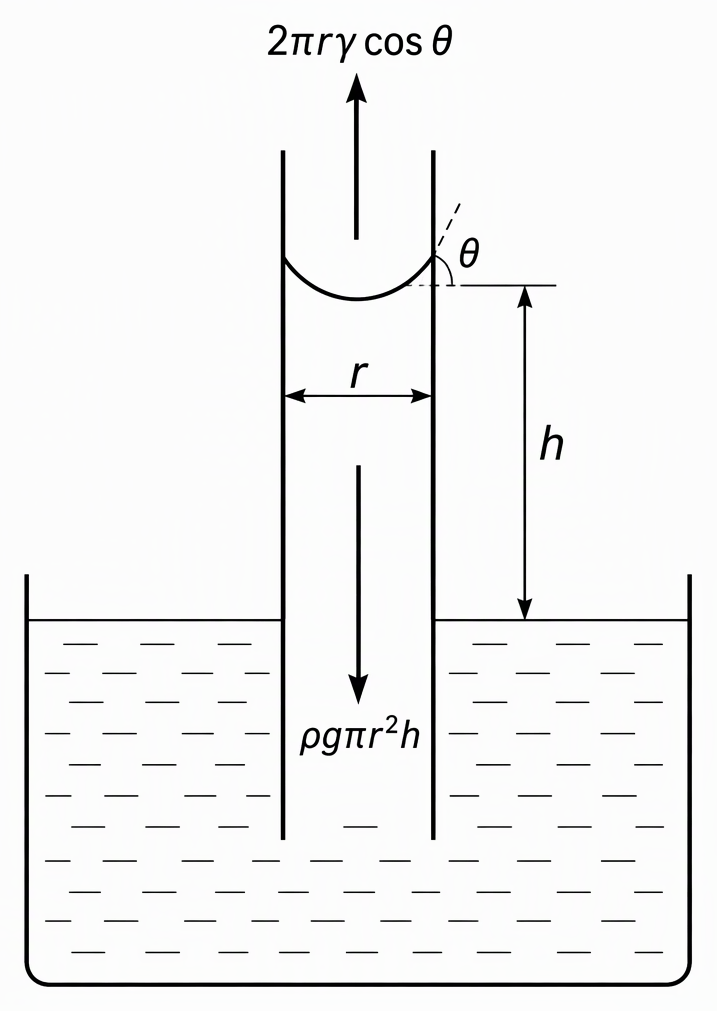
Step 5, balance forces:
For a numerical variant, take:
Step 6, check: The answer has units of length. Doubling the radius halves the height at fixed liquid and contact angle.
Negative height means depression below the reservoir. This is a contact-line force balance, not a soap-bubble pressure problem: importing the bubble’s two-interface factor is wrong.
How do I calculate terminal speed without missing buoyancy?
At terminal speed, weight balances buoyancy plus viscous drag. Zero acceleration does not mean zero velocity. The sphere continues moving while its net force is zero.
Illustrative problem, not a previous-year JEE question: A sphere falls through a large, initially still viscous liquid. Derive its terminal speed using:
Step 4, select the model: Choose the sphere as the system. Assume terminal motion, creeping-flow conditions suitable for Stokes drag and negligible wall effects.
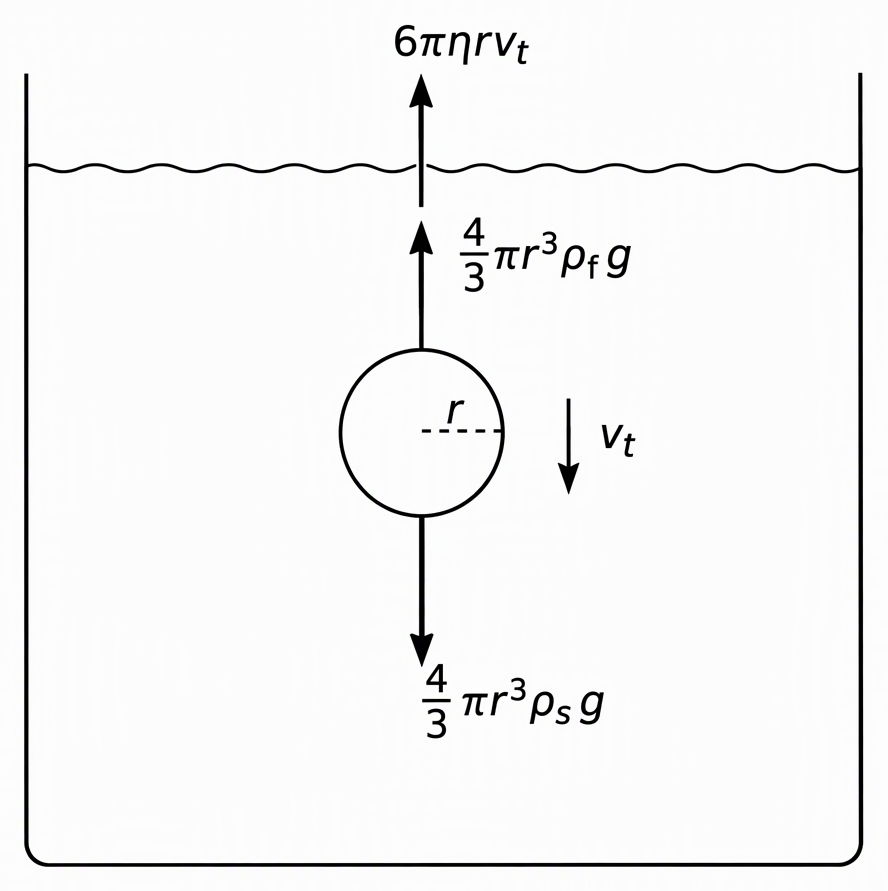
Step 5, balance forces: Taking downward as positive gives:
Step 6, check: The dimensions are those of speed, and the answer is positive downward. Greater viscosity lowers terminal speed; matching the two densities gives zero gravitational settling speed.
A second sphere with twice the radius would have four times the terminal speed only if Stokes-flow assumptions still hold. Increased size and speed can invalidate creeping flow. Omitting buoyancy is a model error, specifically a missing force, not an algebra error.
What should I practise next to handle unfamiliar JEE questions?
Start with single-model problems, then use contrast pairs to expose wrong assumptions. Judge progress by whether you can select and defend a model without notes, not by pages completed.
- Start with single-model problems:
- Stress–strain graphs and wire extension. With stress vertical and strain horizontal, the linear-region slope gives Young’s modulus.
- Pressure at depth and floating bodies.
- Drops, bubbles and capillaries.
- Terminal speed.
- Continuity and Bernoulli.
- Solve contrast pairs:
- Series versus parallel wires.
- Drop versus soap bubble.
- Capillary rise versus depression.
- Terminal versus accelerating motion.
State what changes before calculating.
- Cover horizontal pipe constrictions. For steady incompressible flow, continuity gives greater speed in the narrower section. Along a streamline, with negligible viscous losses, Bernoulli gives:
The narrow section has lower pressure under these assumptions, not automatically higher pressure. Area alone is not a pressure law.
- Move from topic-wise JEE Main previous-year questions to relevant JEE Advanced problems that couple laws or demand closer assumption checks.
- Repair each error: Write the wrong assumption beside the corrected governing equation. Redo the problem without its solution, then test the repair on an unseen variant.
You are ready to progress when you can choose the law, state its conditions and explain the answer’s sign or scaling without notes. Use that test before moving to mixed problems.
For the next practice block, JEEnius daily practice problems provide a fresh ten-question set on a topic every day, with free sets daily. Practice mode offers topic sets that skip questions already seen, with free sets included. Choose the topic linked to your latest error.
Next step: daily practice problems on JEEnius and get a fresh ten-question set on a topic every day (free sets daily).
Frequently asked questions
In what order should I study Properties of Matter for JEE?
Study elasticity first, followed by hydrostatics and buoyancy, surface tension and capillarity, viscosity, then continuity and Bernoulli. Before starting, check that you can draw free-body diagrams, calculate pressure and apply conservation of energy. Keep thermal properties as a separate study track.
How do I choose the right formula in Properties of Matter?
Identify the system, sketch its geometry and decide whether the problem involves deformation, static equilibrium, steady flow or terminal motion. Choose a governing law whose validity conditions match that regime. Write the force balance or conservation equation symbolically before substituting values, then check dimensions, sign and limiting behaviour.
How do I derive the capillary rise formula?
For a narrow circular tube, balance the signed vertical surface-tension force, 2πrγ cosθ, against ρgπr²h, neglecting meniscus-volume correction and gas density. This gives h = 2γ cosθ/(ρgr), with the contact angle measured through the liquid and height measured upward from the reservoir level. An angle above 90° gives negative height, meaning capillary depression.
Do I need to include buoyancy when calculating terminal velocity?
Yes: for a sphere settling in a liquid, terminal motion requires weight to balance buoyancy plus viscous drag. Under creeping-flow conditions with negligible wall effects, Stokes drag gives v_t = 2r²(ρ_s − ρ_f)g/(9η). Zero acceleration at terminal speed does not mean zero velocity.