
How should I study parabola for JEE?
- Check the prerequisites, not the whole coordinate-geometry syllabus. To study parabola for JEE, choose the representation before choosing the formula. Check these tools where you use them:
- Completing the square locates the vertex.
- Point-to-line distance handles focus-directrix conditions.
- Quadratic roots and discriminants handle intersections and tangency.
- Perpendicular slopes connect tangents to normals.
- Reduce to standard form and sketch the geometry. For a right-opening parabola, use:
Its basic features are:
For a translated vertex, change coordinates:
A negative coefficient gives the left-opening version. Interchanging the coordinates gives vertical parabolas, with the coefficient’s sign deciding upward or downward opening. Keep the original and shifted coordinates separate.
- Build one compact parameter-based formula sheet. Set the vertical coordinate as follows, then substitute into the parabola:
The point, tangent and normal use the same contact parameter:
Differentiating the standard equation connects the slopes:
At zero parameter, the tangent is vertical and the normal horizontal:
The normal formula follows by using the perpendicular slope through the parameter point. Derive it from that point rather than memorising an unrelated identity.
- Choose the representation before calculating. Match the method to what the question asks:
- Use geometry for focus/directrix questions.
- Use a parameter for an unspecified point on the curve.
- For line intersections or chord endpoints, substitute the line into the parabola and solve the resulting quadratic.
- For tangency, require a repeated intersection root.
- If only sums or products of endpoint parameters are needed, use Vieta rather than calculating each endpoint.
- Check original coordinates and exceptional cases. Translate answers back before checking them in the original equation. The finite-slope tangent form has a restriction:
It does not represent the vertical vertex tangent:
Follow this study order: standard forms and geometry, parametric points, line intersections and tangents, then normals and mixed constraints. The three examples below are original teaching problems, not attributed JEE previous-year questions.
How do I find the geometry of a translated parabola?
Complete the square to read the vertex, focus and directrix from standard form. Sketch the opening direction and shifted axis before finding endpoints: this keeps shifted coordinates from slipping into the final answer. The method-selection cue is geometric features, so a tangent formula has no role here.
Problem: Find the vertex, focus, directrix and latus rectum endpoints of:
Completing the square gives:
The parabola opens rightward. Its features in the original coordinates are:
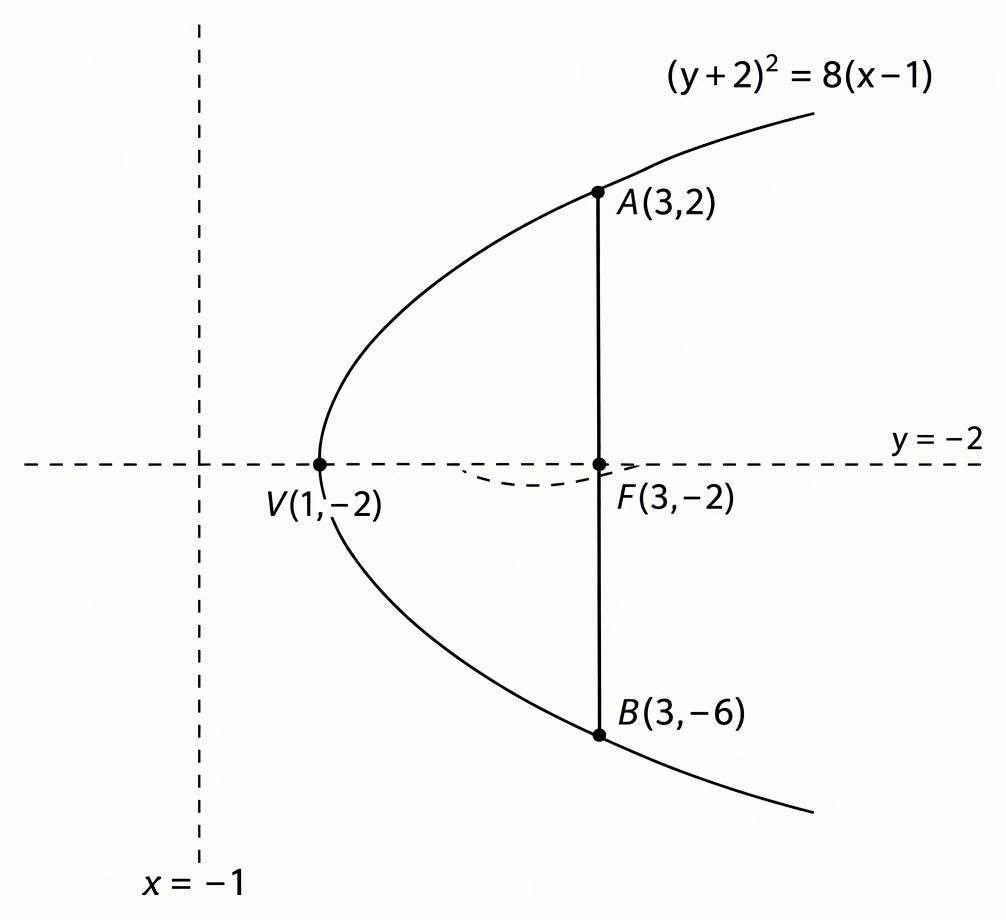
The latus rectum passes through the focus and is perpendicular to the axis. Set its horizontal coordinate accordingly:
The endpoints and length are:
Check the upper endpoint in the original equation:
The vertex must also lie midway between the focus and the directrix along the axis. Check using their intersection:
How do I find every tangent through a point, including a vertical tangent?
Solve for the contact parameter, rather than starting with slope form. The parameter equation retains the vertex tangent, while a finite-slope equation cannot describe a vertical line. Here, keeping the zero root is the difference between finding one tangent and finding both.
Problem: Find all tangents to the following parabola through the given point, with their points of contact:
Use the parameter tangent and impose passage through the point:
Substitute each root into both the tangent equation and the contact-point formula:
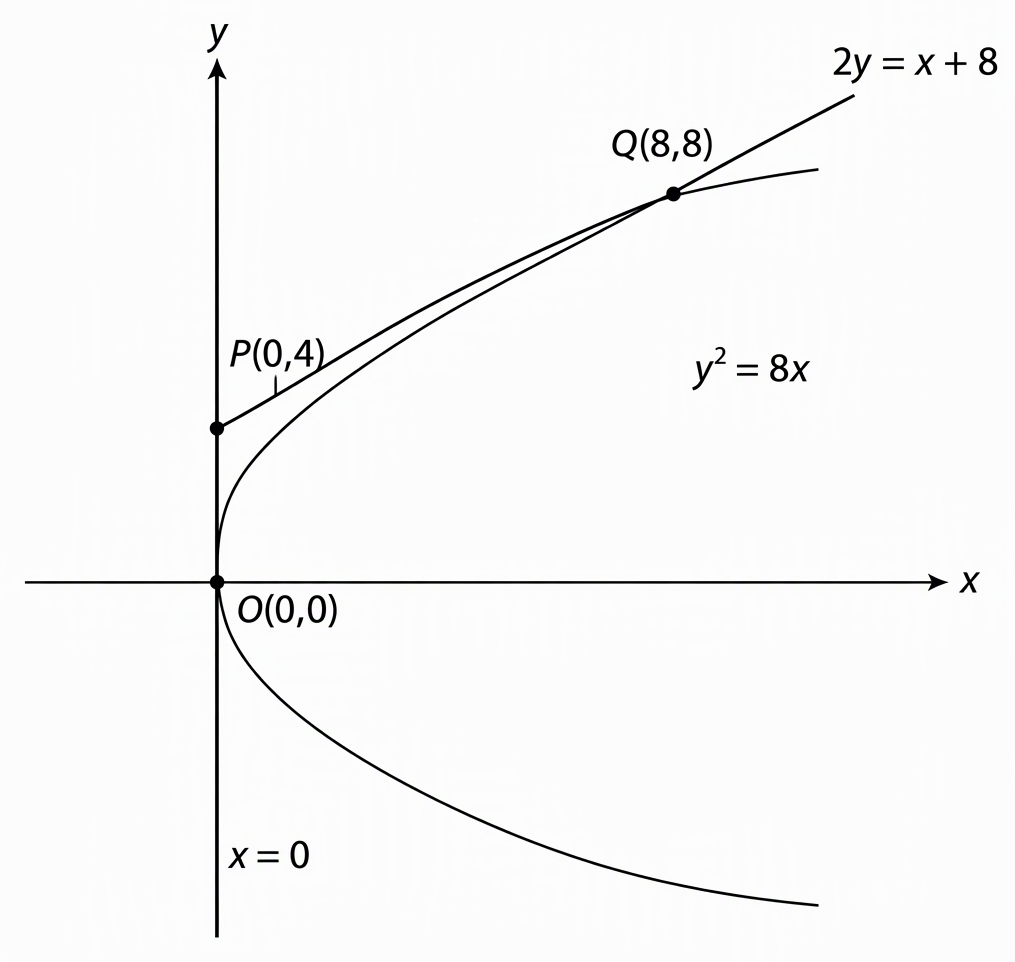
Both lines pass through the given point:
Both contact points lie on the parabola:
Slope-only working produces:
This finds only the oblique tangent. The vertical tangent is valid, not an extra root to discard.
Dividing the parameter equation by its parameter would also lose the zero root. When a tangent must pass through a given point, solve for its contact parameter and preserve zero roots.
How do I find all normals to a parabola through a given point?
Substitute the given point into the parameter normal, then solve the resulting cubic. Each real parameter supplies a contact point and a normal line. Keep zero roots, and check vertical-horizontal pairs separately because their perpendicularity cannot be tested by multiplying two finite slopes.
Problem: Find all normals to the following parabola through the given point, together with their points of contact:
Write the normal and substitute the point:
Do not divide by the parameter. Using the same contact-point formula as before gives:
All three lines pass through the supplied point:
The contact points lie on the parabola:
At the nonzero parameters, check perpendicularity:
At zero parameter, pair the vertical tangent with the horizontal normal:
Three normals are possible here because the contact-parameter condition is cubic, unlike the quadratic tangent condition in the previous example. A cubic need not have three distinct real roots, so not every point has three distinct real normals.
The same parameter identifies contact for both tangents and normals. Once that connection is secure, JEEnius daily practice problems offer a fresh ten-question set on a topic every day, with free sets daily.
What should I practise next, and how should I revise mistakes?
Practise geometry first, line conditions next, and combined constraints last. Move on when you can choose the method without notes, not after an arbitrary question total. For revision, classify the error and redo the failed problem before attempting a fresh one.
- First, secure the coordinates. Practise standard-form conversion, every opening direction, focus/directrix identification and parametric points. Move on when you can work without the formula sheet and produce a correct sketch.
- Next, secure line conditions. Practise intersections, discriminant-based tangency, tangents through a point and chord questions using Vieta. Deliberately include a vertex tangent, not just finite-slope examples.
- Then, combine constraints. Attempt normals through a point, repeated parameter roots, and mixed conditions involving chords or perpendicular lines. Introduce these only after the parameter method is secure.
Use JEE Main previous-year questions to test standard setups. Choose selected JEE Advanced previous-year questions for combined constraints rather than treating every difficult algebra exercise as useful preparation.
For each failed problem, record one error type: standardisation, representation choice, algebra, or a lost exceptional case. Redo it without notes before seeking another new question.
Fresh questions expose gaps; previously missed problems still need a separate redo. For unseen practice, JEEnius practice mode provides topic sets that skip questions already seen, with free sets included.
Next step: practice mode on JEEnius and practise a topic in sets that skip questions you have already seen (free sets included).
Related on JEEnius: Mole Concept Practice Questions JEE: 4 Worked Solutions.
Frequently asked questions
What prerequisites do I need before studying parabola for JEE?
Check completing the square, point-to-line distance, quadratic roots and discriminants, and perpendicular slopes. These tools handle standardisation, focus-directrix conditions, intersections, tangency and normals. You do not need to revise the entire coordinate-geometry syllabus first.
In what order should I study parabola for JEE?
Start with standard forms and geometry, then study parametric points, line intersections and tangents, followed by normals and mixed constraints. Move on when you can choose the method without notes, rather than after an arbitrary question total. Use JEE Main previous-year questions for standard setups and selected JEE Advanced questions for combined constraints.
How do I avoid missing a vertical tangent to a parabola?
For y² = 4ax, use the parameter tangent ty = x + at² and substitute the point through which the tangent must pass. Solve for t without dividing by it: t = 0 gives the vertical vertex tangent x = 0. The finite-slope form y = mx + a/m cannot represent this line.
How do I find all normals to a parabola through a point?
For y² = 4ax, substitute the given point into the parameter normal y = -tx + 2at + at³. Solve the resulting cubic and use each distinct real parameter to obtain the contact point (at², 2at) and its normal line. Preserve zero roots; a cubic does not always have three distinct real roots, so not every point has three distinct real normals.