
What should I memorise before solving periodic table questions?
For Periodic Table JEE questions, memorise the table’s structure and selected facts; derive comparisons where a sound trend applies; explicitly learn exceptions. Memorising every element’s details before attempting comparisons is the wrong priority.
Step 1: Reconstruct the map. On a blank page, mark group numbers 1 to 18, periods 1 to 7 and the positions of the s, p, d and f blocks. Place the first 36 elements as a manageable starting exercise, not as a syllabus boundary.
Check your reconstruction against NCERT’s Classification of Elements and Periodicity in Properties chapter. Correct misplaced elements before adding more names. Mnemonics can recover a sequence of names, but they cannot explain a property order.
Step 2: Connect position to the neutral atom’s ground-state configuration. For the main-group examples here, the highest occupied principal shell identifies the period, while the valence configuration identifies the group. For chlorine:
Its highest occupied shell is the third, so chlorine belongs to period 3. Its seven valence electrons give group 17, and its differentiating electron enters a p subshell, placing it in the p-block.
Keep element position and ion configuration separate. Chlorine’s position comes from the neutral atom. A chloride ion has gained an electron, so write its configuration separately when comparing ionic properties.
How do I choose the right rule for a periodic comparison?
Choose the rule from the actual species and property, not from positions alone. Identify the electron configuration, choose the controlling factor, then check the property-specific exception.
Step 3: Underline the exact task. Distinguish:
- Neutral atom or ion, and atomic or ionic radius.
- First ionisation enthalpy or successive ionisation enthalpy.
- Signed electron gain enthalpy or energy released.
Step 4: Choose the controlling factor.
- Many down-group size comparisons: an extra occupied shell usually increases size.
- Many same-period comparisons: increasing effective nuclear attraction generally contracts the electron cloud.
- Isoelectronic species: at fixed electron count, greater nuclear charge means smaller radius.
Effective nuclear attraction reflects nuclear charge and shielding by other electrons. It is not simply atomic number.
For ions, account for charge instead of copying the neutral configuration. For transition-metal cations, remove electrons in this sequence:
Step 5: Check subshell and pairing effects, then write the requested direction. Exceptions are property-specific, not universal.
Make a recall sheet with three columns: general trend, controlling reason, and exception or warning. Include:
- Size: generally decreases across a period; stronger effective attraction; do not mix noble-gas van der Waals radii uncritically with covalent radii.
- First ionisation enthalpy: generally increases across a period; stronger electron binding; check Be/B and N/O.
- Electron gain enthalpy: often becomes more negative towards the halogens across a period; attraction competes with electron repulsion; check F/Cl.
Exothermic electron addition has negative electron gain enthalpy. “More negative” does not mean “numerically greater”.
Use this answer format: species/configuration → controlling factor → exception check → requested order. For focused drills, JEEnius daily practice problems provide a fresh ten-question set on a topic every day, with free sets daily.
How do I rank oxide, fluoride, sodium and magnesium ions by size?
The oxide ion is largest and the magnesium ion smallest because all four species have the same electron count, but different nuclear charges. This illustrative practice problem is not a claimed JEE previous-year question: arrange the following ions in decreasing ionic radius.
Species/configuration: count electrons explicitly, using nuclear charge and ionic charge.
Each has 10 electrons and the same configuration:
Controlling factor: increasing nuclear charge pulls this fixed-electron-count cloud inward. The nuclei contain 8, 9, 11 and 12 protons respectively.
Exception check: no different occupied shell or subshell filling overrides the isoelectronic comparison here. The decreasing-radius order is:
The tempting wrong approach is to use the neutral atoms’ periods, or immediately apply “size decreases across a period”. Sodium and magnesium atoms occupy period 3, but these cations have lost their third-shell electrons. Whenever ions appear together, check for an isoelectronic set before doing anything else.
How do I rank boron, beryllium, nitrogen and oxygen by first ionisation enthalpy?
For increasing first ionisation enthalpy, the order is boron, beryllium, oxygen, nitrogen. All four species are neutral period-2 atoms, but two local reversals interrupt the general left-to-right increase.
Species/configuration: write the relevant configurations with the common core understood:
Controlling factor: increasing effective nuclear attraction gives the broad rising trend. Exception check: identify the particular electron being removed.
Boron loses a higher-energy, less penetrating 2p electron. Beryllium loses a more tightly held 2s electron, so boron requires less energy despite lying to the right.
Nitrogen has three singly occupied 2p orbitals. Oxygen has one paired 2p orbital, and removing a paired electron relieves pairing repulsion.
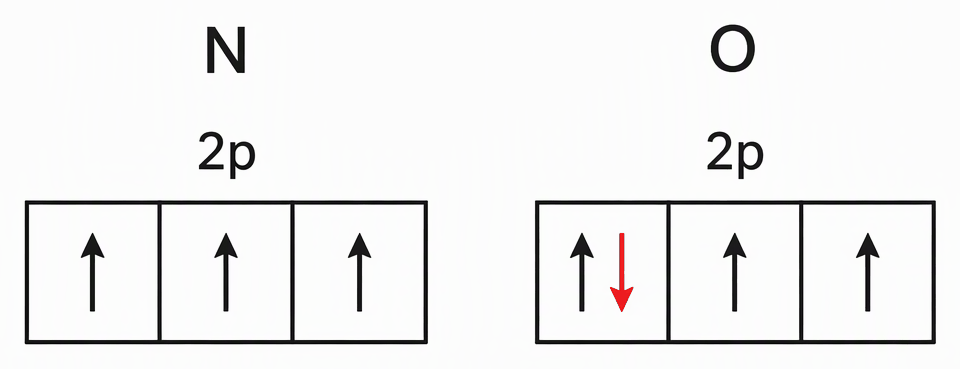
Combining the overall trend with these two reversals gives the requested increasing order:
Blind left-to-right ordering reverses both exceptional pairs. Require a physical reason for each: subshell energy and penetration for Be/B; pairing repulsion for N/O. “Half-filled stability” alone is not an explanation.
Does fluorine or chlorine have the more negative electron gain enthalpy?
Chlorine has the more negative first electron gain enthalpy and releases more energy on electron addition. Fluorine’s smaller size does not settle this comparison because repulsion within the orbital receiving the electron also matters.
The property refers to the first electron-addition process for isolated gaseous atoms:
Species/configuration: fluorine receives the incoming electron in its compact 2p subshell. Chlorine receives it in the larger 3p subshell.
Controlling factor and exception check: fluorine’s compact 2p region produces stronger electron–electron repulsion. This makes electron addition less exothermic than in chlorine.
The requested signed-value order is:
Read that as chlorine is more negative, not “chlorine releases less energy”. More energy released corresponds to a more negative enthalpy change.
Fluorine remains more electronegative. Electronegativity describes attraction for electrons in a bond; electron gain enthalpy describes electron addition to an isolated gaseous atom. Do not transfer an order from one property to the other.
What should I practise after learning these comparisons?
Begin with closed-book recall: redraw the table skeleton and reproduce the trend–reason–exception sheet, then correct both against NCERT. Practise in this sequence before mixing properties:
- Electronic configuration and group, period and block identification.
- Same-period and same-group size comparisons.
- Isoelectronic ionic-radius comparisons.
- First ionisation enthalpy exceptions.
- Signed electron gain enthalpy comparisons.
For every question, write the controlling reason before checking the answer. A guessed order is not mastery.
Use these transfer checks, covering the answers until you have written your reason:
- Decreasing ionic radius: all four ions have 18 electrons; increasing nuclear charge contracts the cloud.
- First ionisation enthalpy: aluminium loses a higher-energy 3p electron, while magnesium loses a 3s electron.
- First electron gain enthalpy: sulfur is more negative because its larger 3p subshell has less crowding than oxygen’s compact 2p subshell.
Label each mistake configuration, controlling rule, missed exception or sign/order. Redo missed questions from a blank page rather than rereading their solutions.
After focused drills, attempt chapter-relevant JEE Main and JEE Advanced previous-year questions. Keep writing reasons even when options let you guess the order.
Unseen sets test transfer; your own error log supplies deliberate repeats. JEEnius practice mode offers topic sets that skip questions already seen, with free sets included. Use those for fresh comparisons, then return to your error log and solve each missed comparison without looking at its earlier solution.
Next step: daily practice problems on JEEnius and get a fresh ten-question set on a topic every day (free sets daily).
Related on JEEnius: Nuclei Practice Questions JEE: 4 Worked Drills and PYQs.
Frequently asked questions
What should I memorise in the periodic table for JEE?
Memorise the table structure, selected facts and property-specific exceptions rather than every element's details. Reconstruct groups 1–18, periods 1–7 and the s, p, d and f blocks, then place the first 36 elements as a starting exercise, not a syllabus boundary. Check your recall against NCERT and build a sheet linking each trend to its controlling reason and exceptions.
How do I compare ionic radii in JEE questions?
Count electrons first and check whether the ions are isoelectronic. For species with the same electron count, greater nuclear charge means a smaller radius. Thus, the decreasing ionic-radius order is O²⁻ > F⁻ > Na⁺ > Mg²⁺; using the neutral atoms' periods would give the wrong reasoning.
Why are Be/B and N/O exceptions to the ionisation enthalpy trend?
Boron loses a higher-energy, less penetrating 2p electron, while beryllium loses a more tightly held 2s electron, so boron has lower first ionisation enthalpy. Oxygen loses a paired 2p electron, relieving pairing repulsion, whereas nitrogen has three singly occupied 2p orbitals. The increasing first ionisation enthalpy order is B < Be < O < N.
Why is chlorine's electron gain enthalpy more negative than fluorine's?
Fluorine receives an electron in its compact 2p subshell, where electron–electron repulsion is stronger than in chlorine's larger 3p subshell. Electron addition is therefore more exothermic for chlorine, giving it a more negative first electron gain enthalpy. Fluorine remains more electronegative because electronegativity concerns electrons in a bond, not electron addition to an isolated gaseous atom.
How should I practise periodic table questions for JEE?
Start with closed-book recall of the table skeleton and your trend–reason–exception sheet, correcting both against NCERT. Practise configurations and positions, neutral-atom size comparisons, isoelectronic ionic radii, first ionisation enthalpy exceptions and signed electron gain enthalpy comparisons in that order. Write the controlling reason before checking each answer, classify mistakes and redo missed questions from a blank page. Then attempt chapter-relevant JEE Main and JEE Advanced previous-year questions.