
What is the human-body radiation question from JEE Advanced 2017?
C alone is correct in this thermal properties of matter question from JEE Advanced 2017: the body emits approximately 524 J in one second, while the calculation near 60 J gives net energy lost. This Physics question appeared in JEE Advanced 2017, Paper 1. It uses a multiple-correct format, with one correct choice here, and is tagged medium in this question bank.
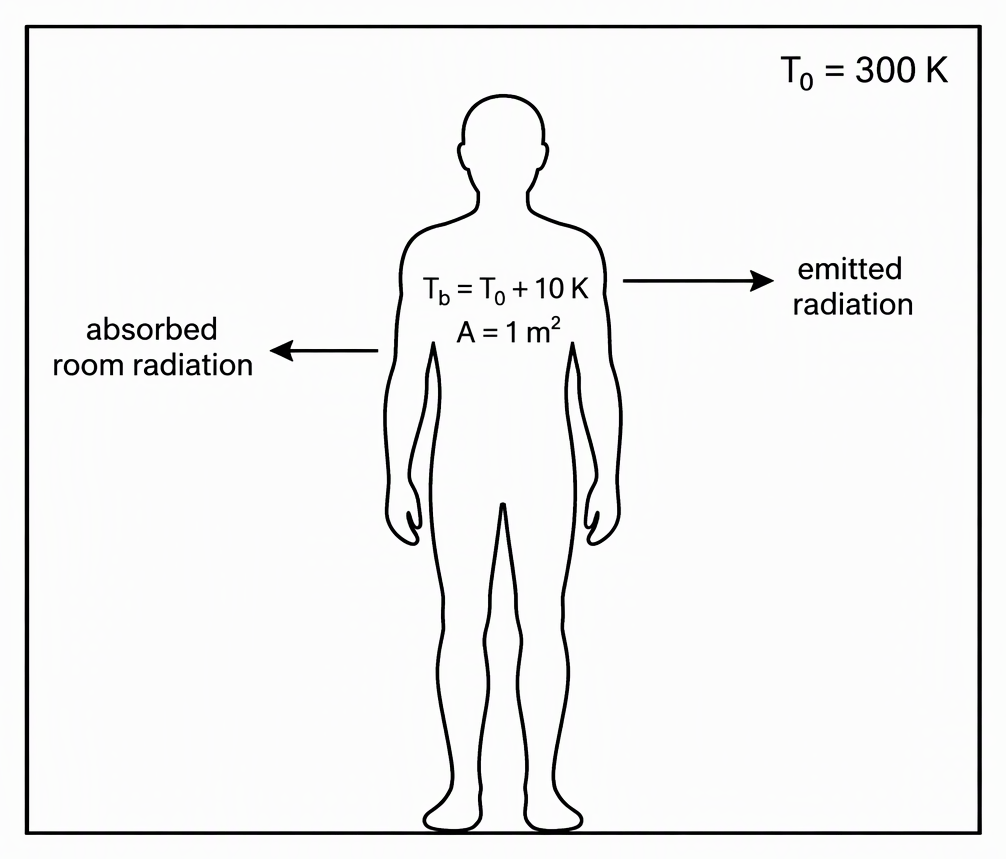
A human has approximately 1 square metre of exposed surface. The surrounding room is at 300 K, and the body is 10 K warmer.
The supplied reference value is:
Which statements are correct?
- A: The body emits roughly 60 J in one second.
- B: If the room cools slightly while body temperature stays fixed, the body emits additional energy per unit time:
- C: Curling up reduces exposed area, allowing the same body temperature with less radiative loss.
- D: Raising body temperature significantly shifts the emission peak to longer wavelengths.
Why is option A wrong when the body emits energy for one second?
The emitted energy is approximately 524 J, not 60 J. Follow the supplied solution’s Stefan–Boltzmann model and calculate outward emission first. The room’s radiation is a separate incoming contribution, so do not subtract it when an option asks only for energy emitted by the body.
First obtain the absolute body temperature:
The emitted power is:
Use the given reference flux rather than inserting a separate numerical value of the Stefan–Boltzmann constant:
Following the official solution’s rounding:
Power becomes energy after multiplication by time:
Watts measure energy transferred per second; joules measure energy. A is incorrect because it asks for emitted energy, not emitted energy minus absorbed energy.
Why does cooling the room not make option B correct?
At fixed body temperature and exposed area, emitted power stays unchanged. Cooling the room reduces the radiation absorbed by the body, increasing net loss instead. B claims additional emission, so its wording matters.
In the same idealised model:
Define the colder room temperature using a positive temperature drop:
Since emission is unchanged, the increase in net loss equals the decrease in absorption:
The small-change condition lets us neglect second- and higher-order terms:
Therefore:
For the specified 1 square metre area, this corresponds to B’s expression. It describes additional net loss, not additional emission.
Following the official interpretation, B is incorrect. The fixed-temperature body emits the same power but receives less radiation from its surroundings.
Why is C correct and D incorrect?
Curling up reduces net radiative loss; raising body temperature shifts the peak to shorter wavelengths. C therefore agrees with the radiation model, while D reverses Wien’s law. Check the area change at fixed temperatures before considering the temperature change separately.
For C:
At fixed temperatures:
Curling up reduces exposed area in the question’s model. Net radiative loss therefore decreases, allowing the same body temperature with less energy lost by radiation. C is correct.
For D, Wien’s displacement law gives:
Thus:
A hotter body peaks at a shorter, not longer, wavelength, so D is incorrect. The final answer is C only.
Why does a calculation near 60 J give the wrong answer to A?
The mistake is calculating net radiative heat loss when the option asks for gross emitted energy. Subtracting absorbed radiation is physically valid, but it answers a different question.
Using the rounded emitted power:
That means approximately 64 J is lost in one second. The small-temperature-difference approximation gives the near-60 result:
For the specified 1 square metre area:
This corresponds to approximately 61 J in one second. The 64 W value comes from direct fourth-power evaluation with the official rounding; 61.3 W comes from the first-order approximation. Neither is gross emission, so neither supports A.
Use this check before substituting:
- Name the requested quantity: emitted power, absorbed power or net loss.
- Decide whether incoming radiation must be subtracted.
- Substitute numbers only after that decision.
How can I practise the distinction between emission and net loss?
Use area, room temperature and emitter temperature changes to test which quantity changes. These are original related practice questions, not additional verified PYQs. Attempt each before reading its worked answer, using the same idealised radiation model.
Question 1: At the original temperatures, exposed area falls from 1 square metre to 0.5 square metres. What happens to net radiative loss?
At fixed temperatures, net loss scales directly with area. Using the rounded 64 W baseline:
Question 2: The room cools from 300 K to 299 K while body temperature and area stay fixed. How do emission and net loss change?
Emission stays unchanged. Reduced absorption increases net loss by the following first-order estimate:
Question 3: A hypothetical ideal thermal emitter of fixed area warms from 310 K to 620 K. Find its emitted-power ratio and peak-wavelength ratio. This is not a realistic human-body temperature change.
Apply Stefan–Boltzmann and Wien separately:
Next step: the past-paper archive on JEEnius and search every JEE Main paper from 2002 and every Advanced paper from 2007, by year, subject or chapter, each with a worked solution (free).
Read next: How to Study Probability JEE: A Seven-Step Method.
Frequently asked questions
What is the correct answer to the JEE Advanced 2017 human-body radiation question?
C alone is correct. In the question’s model, curling up reduces exposed area and therefore reduces net radiative loss at fixed body and room temperatures. A and B confuse emission with net loss, while D reverses Wien’s law.
Why is the emitted energy 524 J and not 60 J?
Using the supplied reference flux, emitted power is 460 × (310/300)^4, approximately 524 W with the solution’s rounding. The body therefore emits approximately 524 J in one second. A result near 60 J comes from subtracting absorbed room radiation and estimates net energy lost, not gross emission.
Does cooling the room increase the radiation emitted by the body?
Not if body temperature and exposed area remain fixed in this model. Cooling the room reduces the radiation absorbed by the body, so net radiative loss increases while emitted power stays unchanged. This distinction makes option B incorrect.
Does a hotter body emit peak radiation at a longer wavelength?
No. Wien’s displacement law states that peak wavelength multiplied by absolute temperature is constant. Increasing body temperature therefore shifts the emission peak to a shorter wavelength, making option D incorrect.