
What does the thermodynamics JEE 2015 question ask?
The required integer is 1, because acetic acid ionization absorbs energy that would otherwise heat the solution and calorimeter. This thermodynamics JEE 2015 solution concerns JEE Advanced 2015, Paper 2, Chemistry: a single-digit integer-answer question classified as medium difficulty by the question bank, not by the exam authority.
The original interrogative is not visible in the supplied source. The numerical task below is reconstructed from the verified worked solution, not presented as the original wording.
Two runs neutralize hydrochloric acid and acetic acid separately with sodium hydroxide. Both use the same solution heat capacity and calorimeter constant; the solution and calorimeter absorb the released heat.
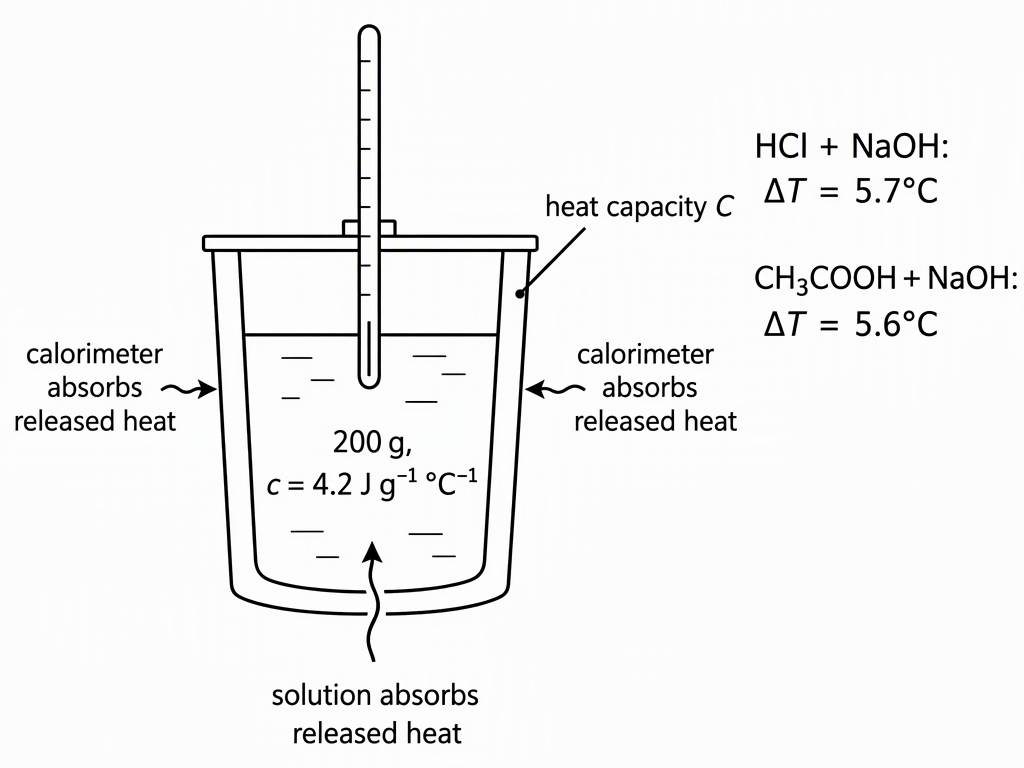
The supplied acid volume and concentration give the amount neutralized:
The solution properties and measured temperature rises are:
Strong-acid neutralization releases:
Find the molar enthalpy of ionization of acetic acid in kilojoules per mole, expressed as the required integer.
How do you use HCl neutralization to find the calorimeter constant?
Subtract the solution’s heat uptake from the known heat release, then divide by the temperature rise. This gives a calorimeter constant of 160 joules per degree Celsius. Calibrate with the HCl run first, then use that constant for the acetic acid run.
The strong-acid reaction is:
The amount neutralized follows from the acid volume and concentration:
Here, the heat-release variable denotes the positive magnitude of heat released, not the signed reaction enthalpy. The reaction itself is exothermic.
The solution absorbs:
The remaining energy heats the calorimeter, with heat loss to the surroundings neglected in this calculation:
Both the solution and calorimeter undergo the measured temperature rise. Therefore:
The calorimeter constant is the heat capacity of the whole calorimeter. The supplied solution value is a specific heat capacity, meaning heat capacity per gram:
Multiply the solution’s specific heat capacity by its mass. Do not multiply the calorimeter constant by mass again.
How much heat does the acetic acid run release?
The acetic acid run releases 5600 joules, found by adding the heat absorbed by the solution and calorimeter. Its measured temperature rise applies to both heat sinks. Keep the solution mass, specific heat capacity and calibrated calorimeter constant unchanged.
The reaction is:
Use the measured rise for both heat-uptake calculations:
The solution absorbs:
The calorimeter absorbs:
Therefore, the total heat released is:
Ignoring the calorimeter would discard a real heat sink, not simplify an irrelevant detail. The thermometer records the shared temperature rise; it does not measure how much heat went into each part separately. The sum remains a positive heat-release magnitude, not a signed reaction enthalpy.
Why is the ionization enthalpy positive and the integer answer 1?
The weak-acid run releases less heat because ionization consumes energy in this calculation. Compare equal amounts of acid before converting the difference into a molar quantity. Both experiments neutralize the same amount, so their heat-release difference gives the sample’s ionization energy.
For the strong and weak acids respectively:
The energy absorbed in ionizing the experimental sample is:
Convert this sample heat into heat per mole:
The ionization process is:
Its positive enthalpy means energy is absorbed. The resulting hydrogen ions then undergo exothermic neutralization.
As a sign check, the measured weak-acid neutralization enthalpy is:
Adding ionization and strong-acid neutralization gives:
The integer answer is 1. Do not enter the sample heat: the experimental difference is 100 joules, whereas the question requires the molar quantity in kilojoules per mole.
What method mistake gives the wrong integer 0?
Assigning the strong-acid neutralization enthalpy to both runs erases the ionization energy. The supplied record identifies an integer-answer question and contains no verified option list. Zero is a wrong entry to analyse, not an official distractor.
The faulty assumption produces:
The strong-acid value describes neutralization of available hydrogen ions by hydroxide ions. The weak-acid reaction also includes ionization of acetic acid.
The measurements reject the assumption. The combined heat capacity is:
If the second run also released the strong-acid heat, this heat capacity would give:
That is not the observed rise:
Use the measured rise to calculate the weak-acid heat release. Do not overwrite it with the strong-acid value.
Which three practice questions check this heat-accounting method?
Check the combined heat capacity, signed neutralization enthalpy and effect of omitting the calorimeter. These are practice follow-ups built from the same data, not additional authenticated PYQs. Attempt each calculation before reading its answer.
- What is the combined heat capacity of the solution and calorimeter?
Add the solution’s total heat capacity to the calorimeter constant. Both absorb heat through the same temperature rise.
- What molar enthalpy of neutralization follows from the acetic acid run?
Use a negative sign because the reaction releases heat. Divide the sample heat by the amount neutralized.
- What ionization enthalpy would you infer by omitting calorimeter heat uptake from the temperature-difference calculation?
The incomplete calculation counts only the solution’s heat difference:
This gives 0.84 instead of 1 kilojoule per mole. Rounding to an integer could conceal the incorrect method, so check the unrounded result and account for both heat sinks before entering your answer.
For another worked heat-accounting problem, continue with Thermodynamics JEE 2016: Why the Net Heat Is 588 J.
Frequently asked questions
What is the answer to the thermodynamics JEE 2015 acetic acid question?
The required integer is 1, corresponding to an ionization enthalpy of +1 kJ/mol. The HCl and acetic acid runs release 5700 J and 5600 J respectively for 0.1 mol, so the molar difference is 100/0.1 = 1000 J/mol.
How do you calculate the calorimeter constant from the HCl run?
The HCl run releases 5700 J, while the solution absorbs 200 × 4.2 × 5.7 = 4788 J. The remaining 912 J heats the calorimeter through 5.7°C, giving C = 912/5.7 = 160 J/°C.
Why is the ionization enthalpy of acetic acid positive in this question?
The acetic acid run releases less heat because ionization absorbs energy in this calculation. The enthalpy balance is +1 + (−57) = −56 kJ/mol: endothermic ionization followed by exothermic neutralization.
What happens if I ignore the calorimeter in this question?
Using only the solution's heat capacity gives a heat difference of 200 × 4.2 × 0.1 = 84 J for 0.1 mol. This yields 0.84 kJ/mol instead of 1 kJ/mol. Rounding could hide the error, so include both the solution and calorimeter before entering the integer.