
What is the answer to the equation of a line JEE 2023 question?
Option 4 is correct: the line parameter cancels, but the distance is not zero. This equation of a line JEE 2023 solution is from JEE Main Mathematics, 31 January 2023, afternoon shift, Three Dimensional Geometry. Hard is the question bank’s difficulty tag, not an official exam classification.
Find the separation between this line and parallel plane, given that the plane’s y-axis intercept is positive one:
The separation is measured perpendicular to the plane, not along the line or a coordinate axis. A perpendicular from any point on this parallel line gives that separation.
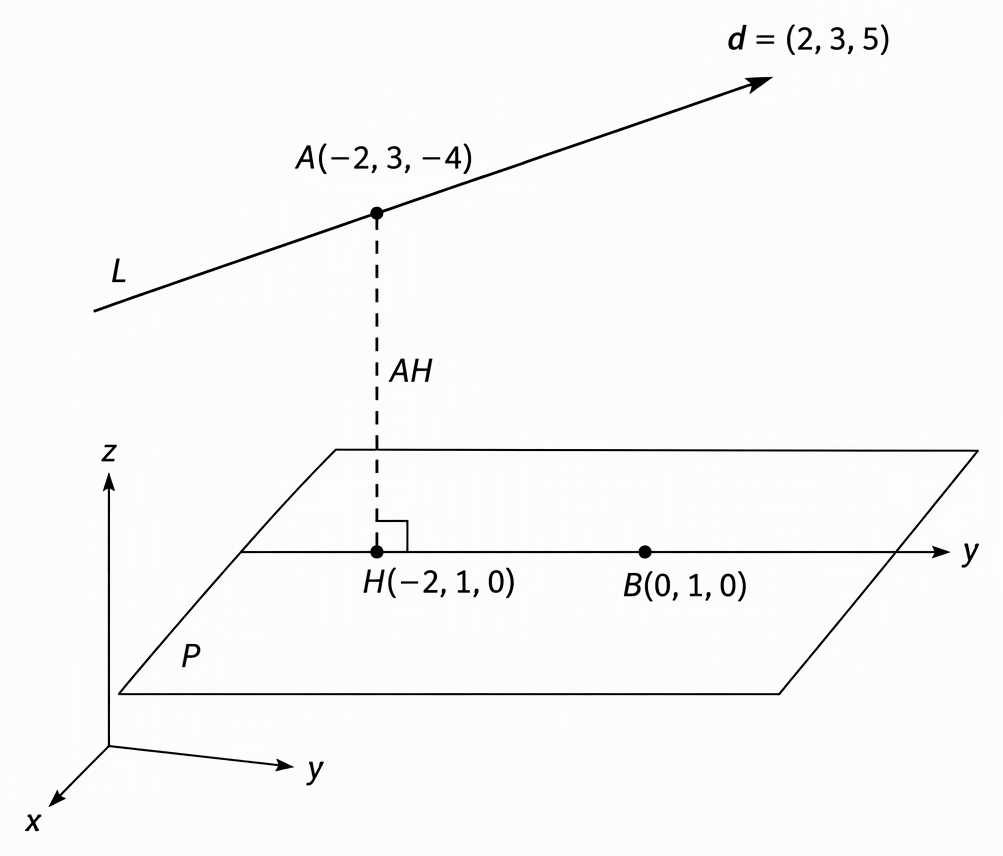
Answer check: option 4, with distance
The numeral 4 is the option index, not the distance. The supplied data does not include the four option texts, so no option list is reconstructed here.
How does the y-intercept fix the first plane coefficient?
The intercept fixes the first unknown coefficient at negative twelve. Start with the supplied solution’s direction-vector and intercept method: read the line’s direction from its denominators and the plane’s normal from its coefficients.
The normal is a vector, not the scalar expression on the left of the plane equation. A y-axis intercept of positive one means this point lies on the plane:
Substitute its coordinates:
The intercept is a coordinate, not the coefficient of y. Use it to locate a point, then substitute that point.
How does parallelism fix the second plane coefficient?
The second coefficient is four because the line’s direction is perpendicular to the plane’s normal. These vectors need not be proportional: proportionality would make the line perpendicular to the plane, not parallel to it.
Use the zero dot product:
Expand and solve:
The recovered plane is
Keep this coefficient form for the main distance calculation. It follows the supplied solution and makes the cancellation easy to check.
Why does the distance simplify to the square root of fourteen?
The absolute value of the numerator is fifty-six, and the denominator is four times the square root of fourteen. Retain the line parameter until after expansion: its cancellation shows why every point on the line gives the same distance.
A general point on the line is
Apply the point-to-plane distance formula:
Expand the expression inside the absolute value first:
The denominator is
Hence
This confirms option 4. Check it by choosing the zero parameter:
At that point, the expression inside the absolute value is again
Dividing the entire plane equation by four gives an equivalent plane and the identical distance:
The supplied solution’s intermediate claim that the expression becomes zero for some parameter value is an arithmetic error. Its vector–intercept–distance method and final answer remain unchanged.
Why does cancelling the parameter not make the distance zero?
Cancellation removes variation along the line, not the constant plane value. The wrong result of zero comes from dropping the surviving constant along with the parameter-dependent terms:
A zero dot product establishes a constant signed plane value along the line. It does not establish that any point on the line satisfies the plane equation.
For an intersection, substitution would require which is impossible. The line therefore remains outside the plane.
Keep the two checks separate for a general plane:
- Direction check: the line direction is parallel to the plane when
- Point check: a chosen line point lies in the plane when
If both checks pass, the whole line lies in the plane. Zero is a wrong result here, not a verified listed distractor, because the wrong-option texts are absent.
Which two practice questions test the same reasoning?
Use one intercept problem and one containment problem to check the method. These are original companion questions, not additional verified PYQs.
How do you recover a plane from its intercept and a parallel direction?
Substitute the intercept point first, then use direction orthogonality. In Question 1, determine both unknown coefficients of this plane, which is parallel to a line with the given direction vector:
The intercept point gives
Parallelism then gives
Thus the completed plane is
Does this parallel line lie inside the plane?
Yes, this line is contained in the plane, so its distance is zero. In Question 2, determine containment and distance by checking both the direction and point conditions:
The direction check passes:
Substituting the general point also gives zero for every parameter value:
Therefore
Question 2 leaves a zero constant; the original leaves negative fifty-six. Direction orthogonality alone cannot distinguish containment from positive separation: substitute one point before deciding.
Next step: the past-paper archive on JEEnius and search every JEE Main paper from 2002 and every Advanced paper from 2007, by year, subject or chapter, each with a worked solution (free).
For a worked example of the same idea, see Solutions JEE 2016: Molarity, Molality and Mole Fraction.
Frequently asked questions
What is the answer to the equation of a line JEE 2023 question?
For the JEE Main 31 January 2023 afternoon-shift question discussed here, option 4 is correct: the line-to-plane distance is √14 units. The numeral 4 is the option index, not the distance.
How do you find the unknown plane coefficients in this question?
The positive unit y-intercept means (0, 1, 0) lies on the plane 8x + α₁y + α₂z + 12 = 0, giving α₁ = −12. Since the line is parallel to the plane, its direction (2, 3, 5) has zero dot product with the normal (8, −12, α₂). Thus 16 − 36 + 5α₂ = 0, giving α₂ = 4.
Why is the distance not zero when the line parameter cancels?
Substituting the general line point into the recovered plane expression gives −56 + 0t, not zero. Parameter cancellation shows that the plane expression is constant along the line; it does not show that the line lies in the plane. Dividing |−56| by the normal's magnitude, 4√14, gives a distance of √14 units.
How do you check whether a line lies in a plane?
First check that the line direction has zero dot product with the plane normal. Then substitute one point from the line into the plane equation. If that point satisfies the equation, the whole line lies in the plane; otherwise, it is parallel to and separated from the plane.