How do you solve the 3D Coordinates JEE 2023 quadrilateral question?
Option [2] is correct in this 3D Coordinates JEE 2023 problem: add the two positive triangle areas, not their signed cross-product vectors. This is the JEE Main Mathematics question from 24 January 2023, morning shift. “Hard” is the question bank’s tag, not an official NTA difficulty rating.
The task is to find the area enclosed by quadrilateral ABCD using the four vertices below. Diagonal AC divides it into triangles ABC and ADC, so calculate their areas separately and then add them.
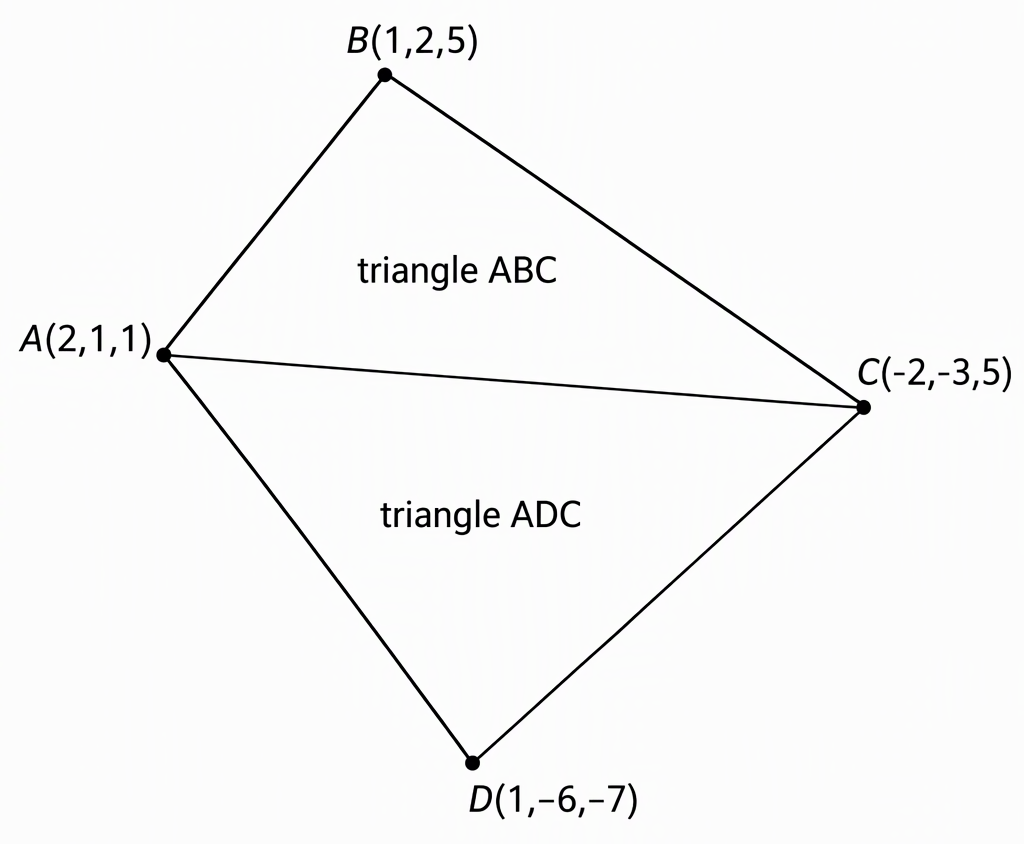
Only option [2] is explicitly identified in the supplied material, with this exact value:
The missing options cannot be reconstructed from that information.
How do you calculate the area of triangle ABC?
Use two vectors starting at A, take their cross product, and halve its magnitude. The cross-product magnitude gives a parallelogram’s area, not a triangle’s area. For two side vectors from a common vertex:
Subtract the starting point’s coordinates from the endpoint’s coordinates. Keep that order in every component:
Expand the determinant along its first row. The middle cofactor carries a minus sign:
The middle bracket evaluates to positive twelve, but the cofactor sign makes the component negative. Take the magnitude, then apply the triangle factor:
How do you calculate the area of triangle ADC?
Reuse AC and calculate the vector from A to D. Following the supplied solution, take the cross product with AD first and AC second, then halve its magnitude. The normal’s opposite direction does not require any sign correction.
Keep the same determinant layout, with AD in the second row and AC in the third. Expand the brackets before collecting components:
Here the middle bracket is negative, so the cofactor minus produces a positive component. The magnitude is positive regardless of the vector’s orientation:
What is the total area, and how do the normals confirm coplanarity?
Adding the two positive triangle areas gives option [2]. Keep the answer exact rather than replacing it with a rounded decimal:
The two cross-product vectors also check the geometry:
These are nonzero parallel normals, so the triangles’ planes are parallel or identical. Both planes contain the shared line AC. Therefore, the triangles lie in the same plane, not in separate parallel planes.
The negative multiplier records opposite orientations for the two chosen cross products. It does not make either triangle’s area negative. Its magnitude gives the area ratio:
Why are signed-vector addition, a missing half-factor and 54 incorrect?
Signed-vector addition cancels part of the area here, while omitting the half-factor doubles the correct area. Neither calculation explains 54. The supplied solution identifies 54 as a previously keyed wrong value but gives no reproducible calculation that produces it.
- Adding the supplied vectors before taking a magnitude is invalid here. Their opposite orientations cause cancellation:
This subtracts one triangle’s contribution from the other instead of adding their positive areas. Add the magnitudes separately when using these two cross products.
- Forgetting both triangle factors counts two parallelograms, not two triangles:
The supplied claim that forgetting the half-factor explains 54 is false. That mistake gives:
- The value 54 has no supported error diagnosis. The supplied material gives neither the full distractor list nor an arithmetic chain reaching 54. The two wrong results derived above are method checks, not verified answer options.
What two related Three Dimensional Geometry questions should you solve next?
Use the same vertices to find the area of triangle ABD and the plane containing ABCD. Both are original follow-up exercises, not additional verified PYQs. Attempt each before reading its worked answer.
What is the area of triangle ABD?
The area equals that of triangle ABC. Start both side vectors at A and calculate their cross product:
The vector matches the first cross product. Its magnitude and triangle area therefore match too:
What is the equation of the plane containing ABCD?
The required plane is:
To obtain it, reduce the first normal by its common factor. Scaling a normal by a nonzero number preserves its direction:
Use this normal and substitute A into the point-normal form:
Expanding gives the stated equation. Verify D directly:
Next, solve Equation of a Line JEE 2023: Distance From a Plane, keeping the plane’s normal separate from a line’s direction vector.
Frequently asked questions
What is the answer to the 3D Coordinates JEE 2023 quadrilateral question?
The area is 8√38 square units, corresponding to option [2] in the JEE Main 24 January 2023 morning-shift question. Diagonal AC divides the quadrilateral into triangles ABC and ADC, whose areas are 2√38 and 6√38 square units.
How do you find a triangle's area using 3D coordinates?
Subtract coordinates to form two side vectors starting at the same vertex. The triangle's area is half the magnitude of their cross product; the full magnitude gives the corresponding parallelogram's area.
Why can't I add the two cross products before taking the magnitude?
In this solution, AB × AC and AD × AC point in opposite directions, so adding them first cancels part of the area. Half the magnitude of their sum gives 4√38, not the quadrilateral's area. Add half of each cross-product magnitude separately to get 8√38 square units.
What is the equation of the plane containing ABCD?
The plane containing the four given vertices is 5x − 3y + 2z = 9. The cross product AB × AC = (20, −12, 8) gives the reduced normal (5, −3, 2), and substituting A(2, 1, 1) fixes the constant as 9.