
What are the two paths in the thermodynamics JEE 2016 question?
The thermodynamics JEE 2016 question gives 588 J of net heat supplied: internal energy depends on the endpoints, while work and heat depend on the path. This is a single-correct MCQ from JEE Advanced 2016, Paper 2, Physics. The expected solving time is 150 seconds, based on this question bank’s medium difficulty rating.
A gas occupies a cylinder closed by a movable frictionless piston. Two alternative routes connect the same initial and final states: a quasi-static adiabatic route, and a two-step route consisting of constant-pressure expansion followed by constant-volume cooling.
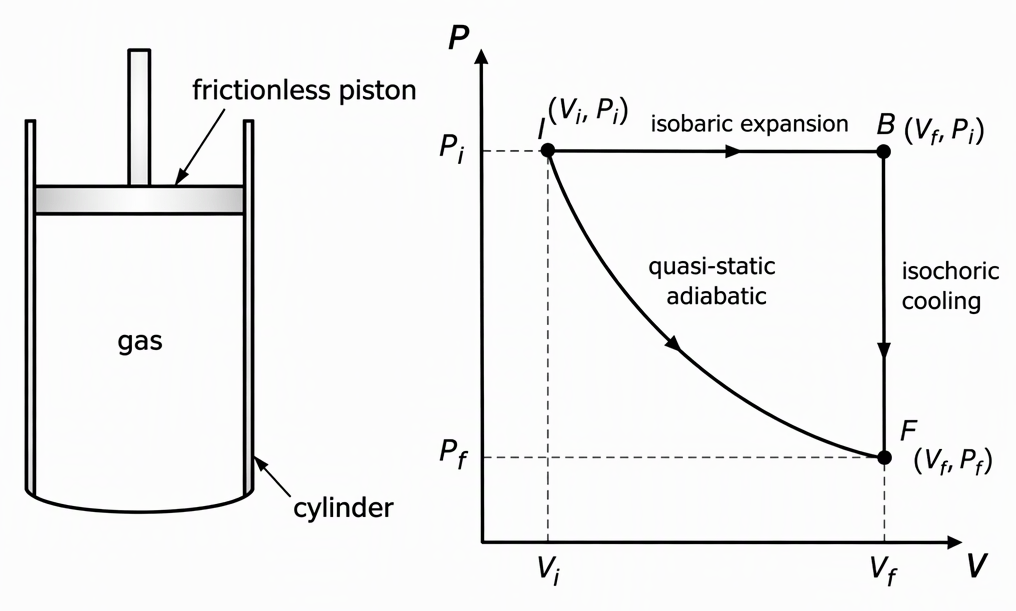
The initial and final states are:
The adiabatic route obeys:
The requested route expands at the initial pressure, then changes pressure at the fixed final volume. Find the approximate net heat supplied along this two-step route.
How do you extract gamma from the adiabatic relation?
Taking the cube root gives an adiabatic exponent of five-thirds. This determines the gas’s internal-energy relation in the ideal-gas treatment used by the official solution; it does not make the requested two-step process adiabatic.
Compare this with the quasi-static adiabatic ideal-gas relation:
This corresponds to monoatomic-gas behaviour in that treatment. The zero-heat condition belongs only to the given adiabatic route:
Use the adiabatic information to determine the gas’s properties. Calculate work and heat separately for the path actually requested.
How much work does the gas do on the two-step path?
The gas does 700 J of work during expansion and zero work during constant-volume cooling. Take work done by the gas as positive, and heat entering it as positive. The first law is then:
On the isobaric leg:
On the isochoric leg:
Therefore:
This is the area under the horizontal segment of the pressure–volume path. The vertical segment adds no area. Work along the adiabatic curve is not a substitute for work along this route.
Why is the change in internal energy negative?
The final pressure–volume product is smaller than the initial one, so the gas finishes with less internal energy. Calculate this change from the endpoints, not from the shape of either path. The official ideal-gas treatment uses:
Write final minus initial before inserting numbers:
The initial product is:
The final product is:
Pressure multiplied by volume has units of energy:
Hence:
For the same amount of ideal gas, a lower pressure–volume product means a lower temperature and therefore lower internal energy. Both routes have this same internal-energy change because their endpoints coincide. The negative sign records an energy decrease; retain it in the first-law calculation.
How does the first law give 588 J, option C?
The net heat supplied is 587.5 J, approximately 588 J, option C. Add the signed internal-energy change to the work:
The gas does 700 J of work while its internal energy falls by 112.5 J. That stored-energy loss supplies part of the work output, so the net heat input is less than 700 J.
This is net heat over both legs, not just the heat absorbed during isobaric expansion. The cooling leg releases heat.
How does a sign mistake produce 813 J?
Option D results if you replace the signed internal-energy change with the magnitude of its decrease while keeping the same first-law convention. That incorrect calculation gives:
Prevent this by writing final minus initial before inserting numbers. Retain the negative sign through the final addition:
Use an energy-balance check before choosing an option. When the gas loses internal energy, part of its positive work output comes from that loss. The net heat input must therefore be below 700 J here, which rules out 813 J.
Which three practice variations check the same method?
Use the same setup to calculate work on the adiabatic route, heat on each leg and the endpoint temperature ratio. These are practice variations using the same gas and states, not additional verified PYQs. Every value below is calculated from the supplied problem.
What work does the gas do along the original adiabatic route?
It does 112.5 J of work, because no heat is exchanged and its internal energy decreases. The first law gives:
Compare this with 700 J on the two-step route. Identical endpoints do not imply identical work.
How much heat is exchanged separately on the two legs?
The expansion absorbs 1750 J; the cooling releases 1162.5 J. At the intermediate state B:
For expansion:
For cooling, work is zero:
Their signed sum verifies the net heat supplied:
What is the final-to-initial temperature ratio?
The final absolute temperature is one-quarter of the initial value. For a fixed amount of ideal gas:
Now cover the answers and reproduce the calculation in order: adiabatic exponent, requested-path work, endpoint internal-energy change, signed heat balance.
Next step: photograph a doubt on JEEnius and photograph any question you are stuck on and get a step-by-step solution, with a free-body diagram when the question needs one (20 free).
Read next: How to Study Properties of Matter JEE: Order and Practice.
Frequently asked questions
What is the answer to the thermodynamics JEE Advanced 2016 heat question?
The net heat supplied along the constant-pressure expansion followed by constant-volume cooling is 587.5 J, approximately 588 J, option C. Using work done by the gas as positive, the first law gives Q = W + ΔU = 700 − 112.5 = 587.5 J.
How do you find gamma from P³V⁵ = constant?
Take the cube root to obtain PV^(5/3) = constant. Comparing this with the quasi-static adiabatic ideal-gas relation PV^gamma = constant gives gamma = 5/3. This describes the given adiabatic route, not the requested two-step route.
Why is the internal-energy change negative in this question?
The pressure–volume product falls from 100 J initially to 25 J finally. With gamma = 5/3, the ideal-gas relation gives ΔU = (3/2)(25 − 100) = −112.5 J. Both routes have this same change because internal energy depends only on the state.
Why is 813 J wrong in the JEE 2016 thermodynamics question?
The value 813 J comes from incorrectly adding the magnitude of the internal-energy decrease: 700 + 112.5 = 812.5 J. The signed change is −112.5 J, so the correct net heat is 700 − 112.5 = 587.5 J. Since the gas loses internal energy, its net heat input is less than its 700 J work output.