
Which P&C practice should you start with?
Choose permutations and combinations practice questions for JEE by your mistake, not by question-bank size. If you cannot explain why order matters or why cases do not overlap, start with concept drills. If your counting models are sound, use exam-specific previous-year questions (PYQs). If time allocation and question selection cause trouble, use full-length mocks.
This page contains six original free questions with worked solutions, followed by a route for choosing further practice. A full-paper mock tests decisions across subjects; it does not replace focused chapter practice.
How do concept drills, PYQs and full-length mocks compare?
Concept drills isolate counting mistakes, PYQs test transfer to actual exam wording, and mocks test selection and time allocation across subjects. Pick drills for a faulty model, PYQs for unfamiliar wording, and mocks for whole-paper decisions.
- Purpose
- Original concept drills on this page: Identify a faulty counting model.
- Official JEE previous-year papers: Apply methods to actual exam questions.
- Full-length mock tests: Practise selection and time allocation across subjects.
- Chapter targeting
- Drills: Every question here concerns counting.
- PYQs: Full papers may require manual extraction of P&C questions.
- Mocks: P&C coverage is not guaranteed.
- Solution support
- Drills: Worked reasoning and a plausible wrong approach.
- PYQs: Official keys verify answers, but are not worked solutions.
- Mocks: A scored breakdown is not a worked chapter explanation.
- Exam authenticity
- Drills: Original teaching questions, not actual JEE questions.
- PYQs: Questions from the relevant exam.
- Mocks: Practice papers, not official past papers.
- Timing practice
- Drills: Explain reasoning without rushing.
- PYQs: Use timed question sets or complete past papers.
- Mocks: Practise sustained whole-paper decision-making.
- Free-access scope
- Drills: All six questions and explanations are immediately available here.
- PYQs: Use official papers and keys where available.
- Mocks: For whole-paper timing practice, try JEEnius full-length mocks, with free tests included: 75 questions, 300 marks, 180 minutes, with a scored per-subject breakdown.
- Main limitation
- Drills: A diagnostic sample, not a complete chapter bank.
- PYQs: Remembered answers can hide weak reasoning.
- Mocks: Whole-paper results alone cannot identify a faulty P&C model.
Main PYQs and Advanced PYQs serve different exams. Advanced is not simply Main with larger numbers. Its question types and marking vary, so read each paper’s instructions.
Which option fits your current difficulty?
Choose by the weakness in your written working, not your class label. A dropper may need foundation drills; a Class 11 student who can justify standard models may benefit from exam questions. Use these situations to identify your next step.
- Class 11, learning counting: Choose drills if you count the same selected objects in different orders without explaining why those orders represent different outcomes.
- Class 12, comfortable with worked examples: Choose Main PYQs if unfamiliar wording stops you. Write what one outcome represents before calculating.
- Advanced aspirant with sound standard models: Choose Advanced PYQs. Examine interacting restrictions, exhaustive cases and overcounting instead of chasing intimidating arithmetic.
- Dropper who solves chapter sheets but leaves solvable mathematics questions: Use mocks to inspect selection and time allocation. Return to targeted chapter work when the difficulty is mathematical rather than strategic.
- Student recognising memorised PYQ answers: Try unseen original variants. Recalling a result does not show that you can construct its counting model.
Which six free P&C questions can you attempt now?
The six drills below test selection, repeated objects, digit restrictions, complement counting, circular symmetry and lower bounds. Attempt all six before checking the solutions. For each, write what counts as one outcome and whether changing order creates a new outcome.
Every question below is an original diagnostic drill, not an official PYQ or a verified predictor of Main or Advanced performance. These constructed problems sample six modelling choices; they do not cover the complete chapter.
What are the six questions to attempt first?
Start with the committee problem and work through to the integer-solution problem without checking answers. Keep your working, including abandoned approaches, so you can identify the first incorrect assumption rather than just mark an answer wrong.
- Question 1, original diagnostic drill: From four distinct boys and three distinct girls, select a committee of three containing at least two girls. How many committees are possible?
- Question 2, original diagnostic drill: How many distinct arrangements can be made using all the letters in BANANA?
- Question 3, original diagnostic drill: How many four-digit even numbers can be formed from the digits 0, 1, 2, 3 and 4 without repetition?
- Question 4, original diagnostic drill: Five distinct students stand in a row. Two named students, Asha and Bilal, must not stand next to each other. How many arrangements are possible?
- Question 5, original diagnostic drill: Seat six distinct people around a circular table. Treat rotations as identical but mirror images as different. How many seatings are possible?
- Question 6, original diagnostic drill: How many integer solutions satisfy the following conditions?
How do you solve the six questions without overcounting?
Define one outcome, then decide which changes create a different outcome. Compare that decision with your first line of working. A matching final answer reached through an unjustified division or overlapping cases still needs correction.
Question 1: 13 committees. The modelling choice is unordered selection. Split into exactly two girls and exactly three girls; these cases cannot overlap. In the first case, each choice of girls can be paired with any choice of boy.
Committee positions are not being assigned. Multiplying by a factorial to arrange the selected members would count the same committee repeatedly.
Question 2: 60 arrangements. The modelling choice is counting identical letters as indistinguishable. BANANA contains three As, two Ns and one B.
Swapping the As or swapping the Ns does not create a new visible word, so divide out those repeated counts. Using the factorial of six alone wrongly treats every letter copy as distinct.
Question 3: 60 numbers. The modelling choice is to split by the final digit, because zero behaves differently. A four-digit number cannot begin with zero.
If the final digit is zero, the first position has four choices, followed by three and two choices. If the final digit is two or four, there are two ending choices, three nonzero leading choices, then three and two remaining choices.
The cases are disjoint and cover every even ending. Giving every ending four leading choices wrongly allows a leading zero when the ending is two or four.
Question 4: 72 arrangements. The modelling choice is complement counting: subtract adjacent arrangements from all arrangements. Treat Asha and Bilal as one block, leaving four objects to arrange.
The factor of two allows Asha–Bilal and Bilal–Asha inside the block. Subtracting only one block order misses half the forbidden arrangements.
Question 5: 120 seatings. The modelling choice is identifying rotations but preserving reflections. Fix one person as an anchor and arrange the other five clockwise.
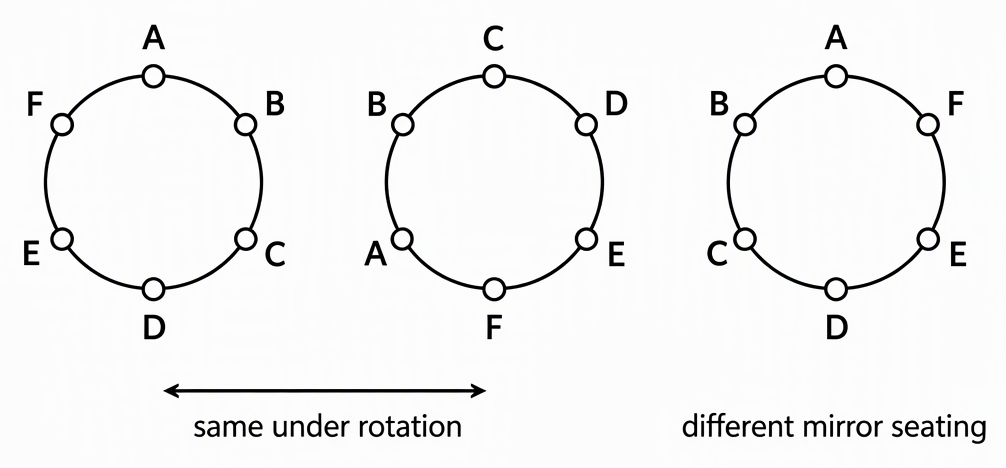
Using the factorial of six counts rotations repeatedly. Dividing by another factor of two is also wrong because the question explicitly treats mirror images as different.
Question 6: 21 solutions. The modelling choice is removing the lower bounds before distributing the remainder. Introduce three non-negative variables:
Each original solution corresponds to exactly one shifted solution. Stars and bars counts these by choosing two separator positions among five stars and two separators:
Applying stars and bars directly to a total of eight ignores the minimum amounts required in the first two variables. Shift those bounds first.
How should you use wrong answers to choose your next practice format?
Return to concept drills when you cannot justify the model. Move to exam-specific PYQs when your model is sound but unfamiliar wording causes trouble. Use mocks when the difficulty appears only under whole-paper constraints, such as spending too long on one question and missing easier work elsewhere.
- Question 1: Selection versus arrangement.
- Question 2: Identical objects and repeated counting.
- Question 3: Case splitting and leading-zero restrictions.
- Question 4: Complement counting and forbidden arrangements.
- Question 5: Rotational and reflection symmetry.
- Question 6: Lower-bound transformation before distribution.
Use this short error log:
- Question: Identify the problem.
- First incorrect assumption: Quote your faulty step.
- Corrected counting model: Define the outcome and valid cases.
- Related variant: State what changes if one restriction changes.
Require disjoint and exhaustive cases, a reason for each multiplication, and an explanation of every division by a factorial. These six drills are too narrow to support an “Advanced-ready” score threshold.
Choose your next question to test the corrected assumption. Repeating the same solution from memory does not test it.
Where can you get free PYQs and full-paper practice?
Use official NTA resources at jeemain.nta.nic.in for Main papers and answer keys where available, and the official JEE Advanced past-paper archive for Advanced. These sources provide actual exam questions. Because papers are generally organised by exam and year, expect to identify P&C questions yourself rather than receive a chapter-filtered bank.
Check the paper and final answer key together, matching the relevant paper and question. A verified final answer tells you the accepted result; a worked explanation must also justify the counting model. Neither an answer key nor an unexplained solution repairs a conceptual gap.
Advanced has two compulsory three-hour papers, with question types and marking that change from year to year. Do not use the Main mock format as an Advanced paper specification.
For full-paper practice, choose the relevant exam format and review skipped questions as well as wrong answers. A subject-level breakdown alone does not establish chapter-level P&C accuracy.
What should you settle before your next practice session?
Pick the counting model you need to practise and the error you need to correct. Do not set a question quota before deciding what the practice is meant to fix.
- How many questions should I solve daily? There is no universal quota. The useful unit is a correctly explained counting model plus correction of the previous error, not a count of familiar calculations.
- Are PYQs enough? They check exam transfer, but do not automatically repair conceptual gaps. Return to focused drills when the underlying model remains unclear.
- Is this practice actually free? All six questions and worked solutions are contained in this article. This makes no claim about external login requirements or unlimited platform access.
- What should I study next? Once you can count outcomes without duplication, use How to Study Probability JEE: A Seven-Step Method to apply that counting to probability.
For whole-paper practice, try JEEnius full-length mocks with free tests included: a 75-question, 300-mark, 180-minute paper with a scored per-subject breakdown. Use that breakdown to inspect subject allocation, then review individual attempts. A mathematics score does not establish chapter-level P&C accuracy.
Next step: full-length mock tests on JEEnius and sit a full 75-question, 300-mark, 180-minute paper and get a scored per-subject breakdown (free tests included).
Frequently asked questions
Where can I get free permutations and combinations questions for JEE?
This article contains six free original diagnostic questions with worked solutions covering six counting models. They are teaching drills, not official JEE questions. For actual PYQs, use official NTA resources for JEE Main papers where available and the official JEE Advanced past-paper archive.
Are PYQs enough for permutations and combinations in JEE?
PYQs test whether you can apply counting methods to actual exam wording, but they do not automatically repair conceptual gaps. Return to concept drills if you cannot justify your cases, multiplications or factorial divisions. If you remember a PYQ answer, try an unseen variant to test your reasoning.
How many permutations and combinations questions should I solve daily?
There is no universal daily quota. Choose questions that test a specific counting model and correct your previous error. A correctly explained solution is more useful than a tally of familiar calculations.
Should I practise P&C chapter questions or full-length mocks?
Use chapter drills when your counting model is faulty and exam-specific PYQs when unfamiliar wording causes trouble. Use full-length mocks when your difficulty is question selection or time allocation across subjects. Mocks do not replace focused chapter practice, and P&C coverage is not guaranteed.