
Should I start oscillations practice with worked drills, PYQs or mocks?
Start with worked drills when choosing oscillations practice questions for JEE if you cannot identify equilibrium, restoring force or initial phase independently. Move to chapter-wise previous-year questions (PYQs) when you can set up unfamiliar problems unaided. Use full-length mocks for selection, time allocation and retention across subjects, not as your main way to learn oscillations.
This comparison includes six original questions with complete solutions, free to read here without an external question bank. In physics, free oscillations means motion without external periodic driving; these drills use ideal, undamped SHM.
What does each practice format actually test?
Worked drills expose setup gaps, PYQs test interpretation, and full-length mocks test execution across a paper. Compare them by the knowledge they require, the feedback you need and where they fit in your preparation.
- Prerequisite knowledge
- Original worked drills here: Basic force, energy and trigonometry.
- Chapter-wise PYQs: Ability to form an SHM equation independently.
- Full-length mocks: Enough syllabus coverage to make meaningful paper-level choices.
- Main benefit
- Worked drills: Isolate one method and explain each step.
- PYQs: Reveal authentic exam wording and demands.
- Mocks: Expose selection, pacing and recall under mixed-subject pressure.
- Feedback needed
- Worked drills: Compare your setup with the derivation.
- PYQs: Check the original paper, answer key and reasoning.
- Mocks: Review attempted questions alongside subject scores.
- Limitation
- Worked drills: Reading solutions first can create an illusion of mastery.
- PYQs: Do not automatically diagnose missing prerequisites or teach them in sequence.
- Mocks: Cannot guarantee substantial oscillations coverage.
- Best place in your sequence
- Worked drills: Repair the method first.
- PYQs: Apply it to unfamiliar questions next.
- Mocks: Test it under paper-level pressure.
These drills are free to read. PYQ access depends on the source; do not assume every collection is free. When you reach mixed-paper practice, JEEnius includes free full-length tests.
Which practice format should I pick today?
Choose by what you can do without a solution, not by your class or coaching enrolment. Use these profiles to identify the skill you need to practise.
- Class 11, formula remembered but equilibrium unclear: If you know the spring-period formula below but measure displacement from the spring’s natural length, start with the vertical-spring and energy drills.
- Class 12, equation correct but wording unfamiliar: Attempt the diagnostic questions here, then use chapter-wise PYQs to practise translating language into a model.
- Dropper, old answers feel familiar: Choose unseen original variants. Explain the equilibrium and force equation before checking the result; recognition is not independent solving.
- Comfortable with chapter questions, rushed in mixed papers: Prioritise full-length mocks. Review oscillations errors separately rather than restarting all chapter theory.
- Advanced aspirant, direct substitution comfortable: Attempt the two modelling extensions, then move to genuine Advanced PYQs. This short set is not sufficient Advanced preparation.
The familiar spring formula is:
Can I solve four basic oscillations questions without seeing the method?
Attempt all four statements before scrolling to the solutions. Write the governing equation even when the answer looks familiar. Each question is original JEE-oriented practice, not a previous-year question or an official difficulty classification.
Drill 1: Initial conditions, original JEE-oriented practice
A particle performs SHM with positive amplitude and angular frequency. Its initial conditions and chosen representation are:
Find the phase in the stated interval and the first time it reaches equilibrium.
Drill 2: Energy, original JEE-oriented practice
An ideal SHM oscillator has the amplitude and angular frequency specified below. Find the fraction of total energy that is kinetic, and the speed magnitude, at the specified position. State whether this position fixes the velocity sign.
Drill 3: Vertical spring, original JEE-oriented practice
A mass hangs from an ideal massless spring in uniform gravity. It is pulled a small distance downward from equilibrium and released from rest. Find the equilibrium extension and period.
Drill 4: Time intervals, original JEE-oriented practice
An SHM particle starts at equilibrium with positive velocity. Compare the time to first reach half the positive amplitude with the subsequent time to reach the positive extreme.
How should I check my four drill solutions?
Check the sign, reference position and phase before checking the final expression. A matching answer reached through a wrong model is not a reliable solution. Compare your governing equation and reasoning with the steps below.
Drill 1 solution
Differentiate the chosen displacement equation and apply both initial conditions:
The cosine condition allows two phases in the interval. Negative initial velocity selects:
The next equilibrium crossing occurs when the increasing phase first reaches a right angle:
Error to avoid: Using position alone to select the phase. The velocity sign removes the second possibility.
Drill 2 solution
Take potential energy as zero at equilibrium. Conservation of energy gives:
Substitute the given position to find the kinetic-energy fraction:
The speed follows from the same energy equation:
Error to avoid: Assigning positive velocity because displacement is positive. The particle can pass this position in either direction.
Drill 3 solution
Choose downward as positive. At equilibrium, spring force balances weight; measure the oscillating displacement from that equilibrium, not from natural length.
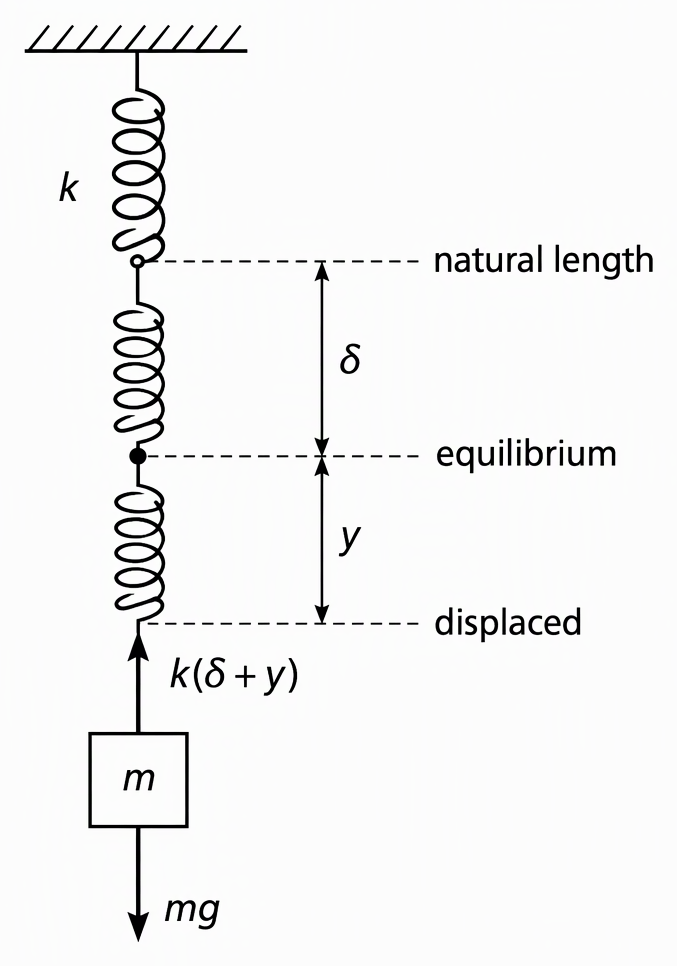
The static balance and equation of motion are:
The restoring force is proportional to displacement from equilibrium and acts against it. Thus:
Error to avoid: Keeping an uncancelled gravitational term after shifting the origin to equilibrium. Gravity changes the equilibrium extension, not this ideal spring’s period.
Drill 4 solution
The initial conditions select a sine representation. On the first outward journey:
Half amplitude and full amplitude occur at:
Subtract the arrival times to find the subsequent interval:
Error to avoid: Treating equal distances as equal times. Speed decreases as the particle approaches the extreme, so the second half takes longer.
Which two modelling questions should I try before harder PYQs?
Try the block between springs and the pendulum in an accelerating lift to test your restoring-force model. State the equilibrium and force model before using a memorised period formula. Both are original JEE-oriented modelling extensions, not official difficulty labels or proof of JEE Advanced mastery.
Question 5: A block between two springs
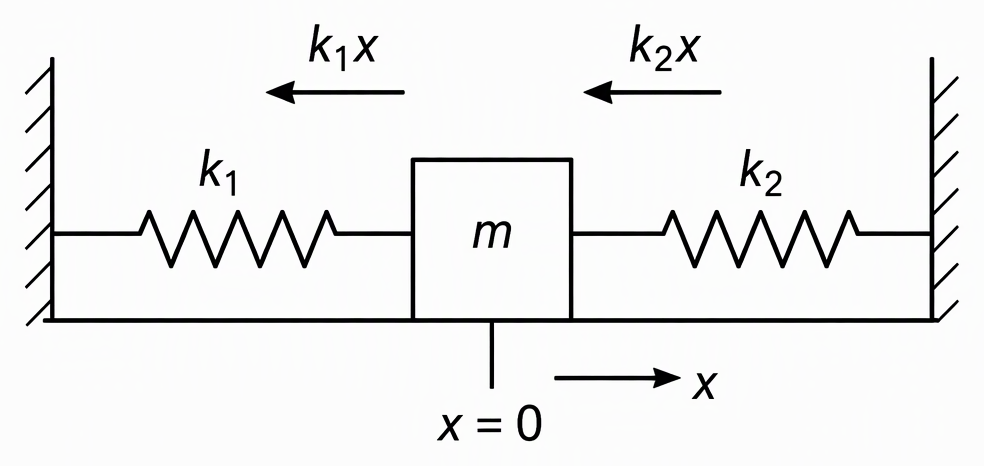
A block moves on a frictionless horizontal surface. Two ideal massless springs, attached to opposite sides of the block, have their other ends fixed to opposite walls. Derive the angular frequency and ordinary frequency.
Solution
Define displacement to the right from equilibrium. Constant spring forces cancel there, even if the springs are initially loaded. A rightward displacement changes each spring’s force in the leftward direction:
Adding the force changes gives the equation of motion and frequencies:
Error to avoid: Using the end-to-end series formula. Here both springs act directly on the moving block, and each changes length by the block’s displacement.
Question 6: A pendulum in an accelerating lift
A simple pendulum has a point bob and a massless, inextensible string. The lift accelerates upward at constant acceleration. Neglect resistance and derive the small-angle period.
Solution
In the lift frame, the pseudo-force acts downward alongside gravity. The bob’s equilibrium remains vertically below the support, with effective gravity:
For angular displacement from that downward vertical, the tangential restoring-force equation is:
For small angles measured in radians, this becomes an SHM equation:
The period is therefore:
Error to avoid: Subtracting the lift acceleration. Upward acceleration produces a downward pseudo-force in the lift frame.
What do my mistakes tell me to practise next?
A wrong setup needs worked examples; a correct independent setup needs PYQs; pressure-only errors need mixed timed practice. Six questions cannot establish a numerical readiness cutoff or predict a rank. Use your written work to distinguish a physics gap from an execution mistake.
- Wrong phase in Drill 1: Practise initial conditions using both displacement and velocity. More period formulas do not address the missing direction check.
- Wrong energy fraction or unjustified velocity sign in Drill 2: Rebuild the energy-position relation, then check direction separately.
- Wrong equilibrium in Drill 3 or effective gravity in Question 6: Draw the forces and derive the equation of motion before using a period formula.
- Equal-time assumption in Drill 4: Use phase-based timing and displacement-time graphs. Mark the first outward journey explicitly.
- Wrong spring combination in Question 5: Calculate each spring’s force change on the block. Do not classify the arrangement by appearance alone.
- Correct model, rushed algebra or missed wording: Reattempt without time pressure. If you can explain and solve it independently, focus on timed execution rather than relearning the chapter.
For subsequent PYQs, check the original paper and answer key. For JEE Advanced, check the relevant paper’s question types and marking scheme too, since they vary. Do not treat an unattributed question list as evidence of an official paper pattern.
Where does a full-length JEEnius mock fit in this plan?
Use a JEEnius full-length mock after you can set up chapter questions independently, to test whether that skill survives a mixed paper. The documented offering includes free tests: 75 questions, 300 marks and 180 minutes, with a scored per-subject breakdown. These numbers match JEE Main Paper 1, not JEE Advanced.
A Physics score alone cannot identify a phase error, a wrong equilibrium or a rushed sign. Manually revisit the relevant questions you attempted; substantial oscillations coverage is not guaranteed.
Before returning to the next mixed paper:
- Record the error type: physics setup, interpretation, algebra, timing or selection.
- Correct the governing equation and write why the original setup failed.
- Close the solution and reattempt the question independently.
If the setup still needs help, repair it with a worked drill before sitting another full paper.
Next step: full-length mock tests on JEEnius and sit a full 75-question, 300-mark, 180-minute paper and get a scored per-subject breakdown (free tests included).
Keep going with Trigonometric Identities JEE 2023: Cosine Product Solution.
Frequently asked questions
Should I start oscillations practice with solved examples or PYQs?
Start with worked drills if you cannot identify equilibrium, restoring force or initial phase independently. Attempt each question before reading its solution. Move to chapter-wise PYQs when you can set up unfamiliar problems without help.
Are these oscillations questions actual JEE PYQs?
No. All six are original JEE-oriented practice questions with complete solutions, not previous-year questions or officially classified difficulty levels. For subsequent PYQ practice, check the original paper and answer key.
Are six oscillations questions enough for JEE Advanced?
No. These six questions help diagnose setup gaps but cannot establish Advanced readiness or predict a rank. Attempt the two modelling extensions, then move to genuine JEE Advanced PYQs and check each paper's question types and marking scheme.
When should I use full-length mocks for oscillations practice?
Use full-length mocks after you can set up chapter questions independently. They test selection, pacing and recall across a mixed paper, but substantial oscillations coverage is not guaranteed. Review relevant attempted questions manually to separate physics errors from algebra, timing or selection mistakes.