
Which Circles questions should I practise first for JEE?
For Circles practice questions for JEE, start with targeted drills if centre-radius conversion or line-circle geometry is shaky; otherwise, make JEE Main PYQs your main source. Use JEE Advanced PYQs for linked reasoning after individual methods are stable, not because you are a dropper or have finished a lecture.
These are practice formats, not website rankings. The five free, original Circles questions below include fully worked solutions to help you choose your next set.
How do targeted drills, Main PYQs and Advanced PYQs compare?
Drills repair one method, Main PYQs test exam-level method selection, and Advanced PYQs test linked reasoning. Choose by the mistake you need to fix, not the exam label.
- Purpose
- Original topic-wise drills: Repair one named skill.
- JEE Main PYQs: Select a method within an authentic exam question.
- JEE Advanced PYQs: Connect geometric and algebraic conditions.
- Prerequisite knowledge
- Drills: The formula or idea being practised.
- Main PYQs: Stable basic methods.
- Advanced PYQs: Stable methods and practice deriving conditions.
- Topic control
- Drills: Precise control over the weak skill.
- Main PYQs: Chapter filtering helps, but methods can overlap.
- Advanced PYQs: Linked concepts can resist narrow filtering.
- Exam calibration
- Drills: Not calibrated to an exam.
- Main PYQs: Authentic Main demands when the source is checked.
- Advanced PYQs: Authentic Advanced demands when the source is checked.
- Solution review
- Drills: Find the faulty step.
- Main PYQs: Review why one method was preferable.
- Advanced PYQs: Justify conditions and every solution branch.
- Main misuse
- Drills: Repeating comfortable exercises.
- Main PYQs: Memorising answers.
- Advanced PYQs: Attempting linked problems before fixing basics.
The drills below are free and included here, but are neither past-paper questions nor a calibrated exam simulation. PYQ authenticity and worked-solution quality need separate checks.
Not every Advanced question is harder than every Main question. None of these formats guarantees marks.
Which route fits my current Circles mistakes?
Choose from what you can solve independently, not your class, coaching batch or number of attempts. Use these profiles to identify the failed decision rather than assign yourself a beginner or advanced label.
- You quote the circle equation but reverse the signs of the centre coordinates. A Class 11 student making these errors should use completing-the-square drills before a mixed PYQ set. Explain each coordinate instead of recalling a sign rule.
- You solve routine exercises but hesitate between substitution and perpendicular distance. Make Main PYQs the main source. A Class 12 student in this position should review the method choice, not just the final answer.
- You remember PYQ answers before solving. As a dropper, use fresh original variants to test reasoning, then unfamiliar or previously unattempted PYQs. Recognition is not an independent solution.
- You handle separate methods but struggle when conditions interact. For an Advanced target, use Advanced PYQs with full derivations, especially problems linking common points, tangency and parameters. Review how each condition restricts the possible answers.
Parents should look for independently justified solutions and repaired errors. A larger question pile is not evidence of improvement.
Can I try free Circles questions with worked solutions now?
Attempt the five questions below before reading the solutions. All are original teaching examples, not JEE PYQs; five is an editorial choice, not an exam-frequency claim. They check selected foundations and linked methods, not the whole chapter or Advanced readiness.
Write the reason for your chosen method beside each attempt. A correct answer reached through an unjustified step still needs review.
Question 1. Find the centre and radius:
Question 2. Find all real values of the parameter for which the line is tangent to the circle:
Question 3. Find the length of the chord cut by the line on the circle:
Question 4. Find the common chord, including its endpoints, of these circles:
Question 5. Find the circle through the two points and tangent to the given line:
How do I solve these five Circles questions?
Use completing the square for the first question, distance geometry for the next two, subtraction for the fourth, and a parameter condition for the fifth. Compare the decisive step with your own work. Matching answers are not enough: check signs and whether the claimed points or circle exist.
Solution 1: Complete the square. Group the horizontal and vertical terms separately. Account for the constants added inside the squares.
Likely error: Reading the centre directly from the linear coefficients and reversing its signs. Read the coordinates from the squared form instead.
Solution 2: Use perpendicular distance. Tangency requires the distance from the origin to the line to equal the radius. Convert the line to standard form first.
Likely error: Dropping the absolute value and keeping only the positive answer. Both signs matter because parallel tangents lie on opposite sides of the centre.
Solution 3: Use the perpendicular from the centre. It bisects the chord, creating a right triangle with the radius as hypotenuse. Find half the chord, then double it.
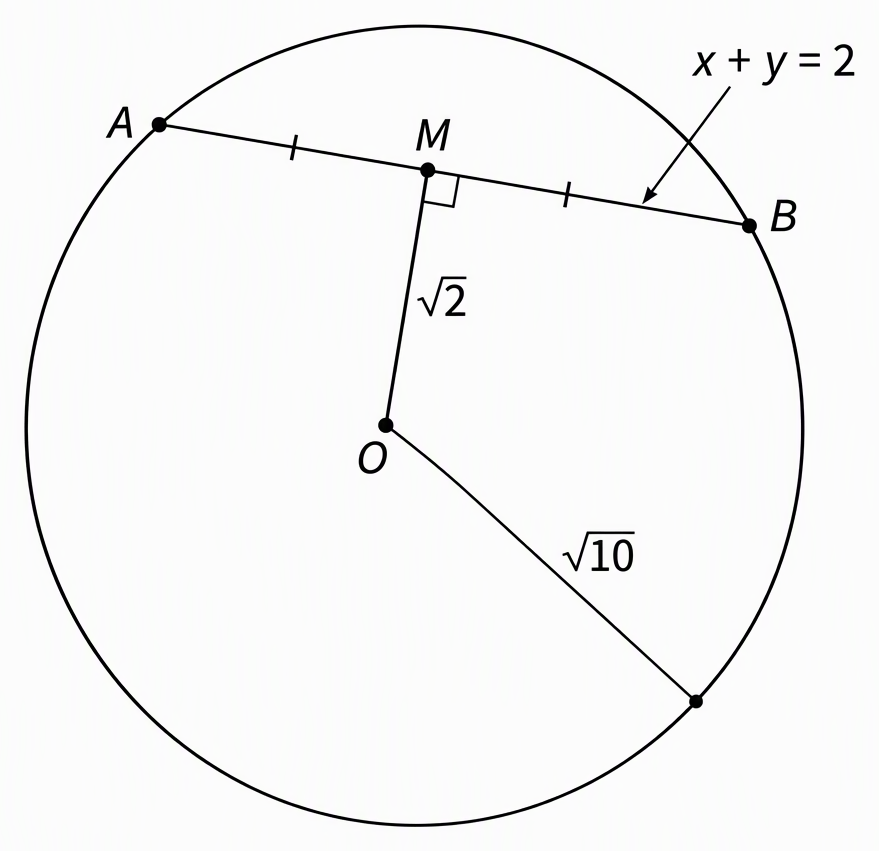
Likely error: Reporting the half-chord as the full length. State what the square root represents before doubling.
Solution 4: Subtract the circle equations. Expanding the second equation lets the quadratic terms cancel. Substitute into either circle to establish the actual intersection points.
The common chord lies on the line obtained by subtraction and joins these endpoints:
Likely error: Stopping after subtraction without checking real intersections. Subtraction gives the radical axis for arbitrary distinct circles with different centres; it is a common-chord line only when two real intersection points exist.
Solution 5: Build the circle from the point conditions. Passing through the origin removes the constant term, and the second point fixes the horizontal coefficient. This leaves one unknown coefficient.
Apply the centre-to-line distance condition:
The required circle is therefore:
Its centre is two units from the tangent line and its radius is two. Substitution verifies exactly one contact point:
Likely error: Assuming tangency forces the centre onto an axis. Derive the coefficient from distance, then verify the resulting circle.
How should my mistakes decide the next question set?
Choose the next set by the failed method, not your total correct answers. A conversion error needs a different repair from a failure to combine several sound methods. This small diagnostic does not establish chapter mastery.
- Centre-radius conversion failed: Practise completing the square before harder circle geometry. Check both centre coordinates and the radius.
- Tangency or chord reasoning failed: Revise perpendicular distance and the right triangle joining the centre, chord midpoint and endpoint. Use Equation of a Line JEE 2025: Why the Ratio Is 7 only as a straight-line refresher.
- The common-chord question failed: Practise subtracting circle equations, then checking whether real intersection points exist.
- Only the final linked problem failed: Use guided parameter problems before making Advanced PYQs your primary source. Practise translating each condition into an equation.
- Every solution was independent and justified: Move to Main PYQs. For an Advanced target, add appropriately chosen Advanced PYQs without treating this set as full preparation.
Keep an error log with four fields: question, failed decision, corrected method, result on a fresh variant. “Careless mistake” is too vague; “removed the absolute value and lost one tangent” tells you what to repair. Test the correction on a fresh variant: reproducing a solution you just read does not show that the error is fixed.
How do I check free PYQs and know when to leave chapter practice?
Check the question source and the explanation separately; move to mixed sets and full papers once chapter methods are stable. An authentic PYQ establishes what was asked, not whether a downloaded solution teaches it correctly.
For a claimed PYQ, check the exam, year, paper or shift, and question identifier where available. Cross-check the statement and key against corresponding official material; for Main, start at jeemain.nta.nic.in, and for Advanced use its official archive.
An official answer key gives the keyed answer, not a worked teaching solution that can diagnose a geometry error. Prefer explanations that justify the method, retain signs, check real intersections and consider degenerate cases.
Before committing to a resource, check that questions, solutions and downloads are accessible without payment. Access has not been verified here for other platforms.
Use mixed practice to test method selection across chapters, then full papers to test selection and time management. A whole-paper average does not create a rigid time limit for each Circles question.
For that full-paper step, JEEnius offers full-length JEE Main mock tests, including free tests: 75 questions, 300 marks, 180 minutes, with a scored per-subject breakdown. This is a Main specification, not Advanced, and does not establish a free JEEnius Circles question bank. Repair your diagnostic error first, then use a full paper to check whether the method holds under time pressure.
Next step: full-length mock tests on JEEnius and sit a full 75-question, 300-mark, 180-minute paper and get a scored per-subject breakdown (free tests included).
Frequently asked questions
Which Circles questions should I practise first for JEE?
Start with targeted drills if centre-radius conversion or line-circle geometry is shaky. Once basic methods are stable, make JEE Main PYQs your main source and review why you chose each method.
Are the five free Circles questions in this article JEE PYQs?
No. They are original teaching examples with fully worked solutions, not past-paper questions or a calibrated exam simulation. They test selected foundations and linked methods, not the whole chapter.
When should I start JEE Advanced Circles PYQs?
Start when individual methods are stable and you can derive the conditions a problem requires. If combining point, tangency and parameter conditions is still difficult, use guided parameter problems first. Solving the five examples alone does not establish Advanced readiness.
How do I check whether a Circles PYQ is genuine?
Check the exam, year, paper or shift, and question identifier where available, then cross-check the statement and key against official material. For JEE Main, start at jeemain.nta.nic.in; for JEE Advanced, use its official archive. Check worked-solution quality separately, because an official answer key does not explain the method.