
Which free Atoms practice questions for JEE should you start with?
Choose original Atoms practice questions for JEE if your method is shaky, authenticated PYQs if your basics are secure, and full-length mocks if you struggle inside a complete paper. Pick the format that addresses your error, not the largest question bank.
This page contains free original practice with worked solutions, not a downloadable bank or an authenticated PYQ collection. Here, Atoms means the Physics chapter, not the entire Chemistry Atomic Structure chapter.
How do original drills, authenticated PYQs and full-length mocks compare?
Drills isolate concepts, PYQs calibrate exam difficulty, and mocks test whole-paper execution. Compare the three formats by what you need to diagnose:
- Immediate use: Original drills: available below. Authenticated PYQs: use once the source and key are checked. Full-length JEE Main mocks: require a paper-length sitting.
- Prerequisite readiness: Original drills: useful while learning the method. Authenticated PYQs: best after independent basic solving. Full-length mocks: test preparation across subjects.
- Chapter focus: Original drills: isolate selected Atoms concepts. Authenticated PYQs: chapter-focused when correctly selected. Full-length mocks: no guaranteed Atoms question.
- Exam authenticity: Original drills: do not establish historical exam difficulty. Authenticated PYQs: actual-exam provenance only when paper identity and key are checkable. Full-length mocks: practice papers, not past exams.
- Solution provenance: Original drills: worked reasoning supplied here. Authenticated PYQs: distinguish the official key from third-party explanations. Full-length mocks: verified scoring does not establish worked-solution quality.
- Diagnostic value: Original drills: expose sign, assumption and scaling errors. Authenticated PYQs: test application in exam wording. Full-length mocks: test selection and execution across subjects.
- Chief limitation: Original drills: narrow coverage. Authenticated PYQs: remembered answers can hide gaps. Full-length mocks: a subject score cannot diagnose an Atoms misconception.
For whole-paper practice, use JEEnius 75-question, 300-mark, 180-minute full-length mocks with a scored per-subject breakdown, including free tests. That breakdown is not chapter-level diagnosis. No Atoms PYQ collection has been authenticated for this article.
Which option should Class 11, Class 12 students and droppers choose?
Choose from the error you can observe, not your class or attempt number. If you cannot distinguish an electron’s orbital energy from emitted photon energy, begin with worked chapter drills. Another full paper is not a direct repair for that distinction.
- Class 11: If you are studying Chemistry Atomic Structure, first check that Physics Atoms is the intended chapter. Shared atomic-model ideas do not make the question collections interchangeable.
- Class 12: If you can solve routine Bohr-model questions independently and explain each step, move to authenticated Main PYQs. Test whether you can select the method without a textbook-style prompt.
- Advanced aspirants: After the fundamentals, use authenticated Advanced questions. Complicated algebra does not make an original drill equivalent to an actual Advanced question.
- Droppers: If Atoms goes well in isolation but poorly during a complete paper, use mocks followed by manual question review. Check for delayed selection, rushed calculation or an unresolved concept.
A sign error calls for a sign check, not a “beginner” label. Being a dropper is not evidence that the basic model no longer needs checking.
Can you solve these free Atoms questions without looking at the solutions?
Attempt every stem before reading the worked answers. These original diagnostic drills check emission, ionisation, charge scaling and Rutherford scattering. They isolate prerequisites, not the complete chapter, and do not simulate either Main or Advanced.
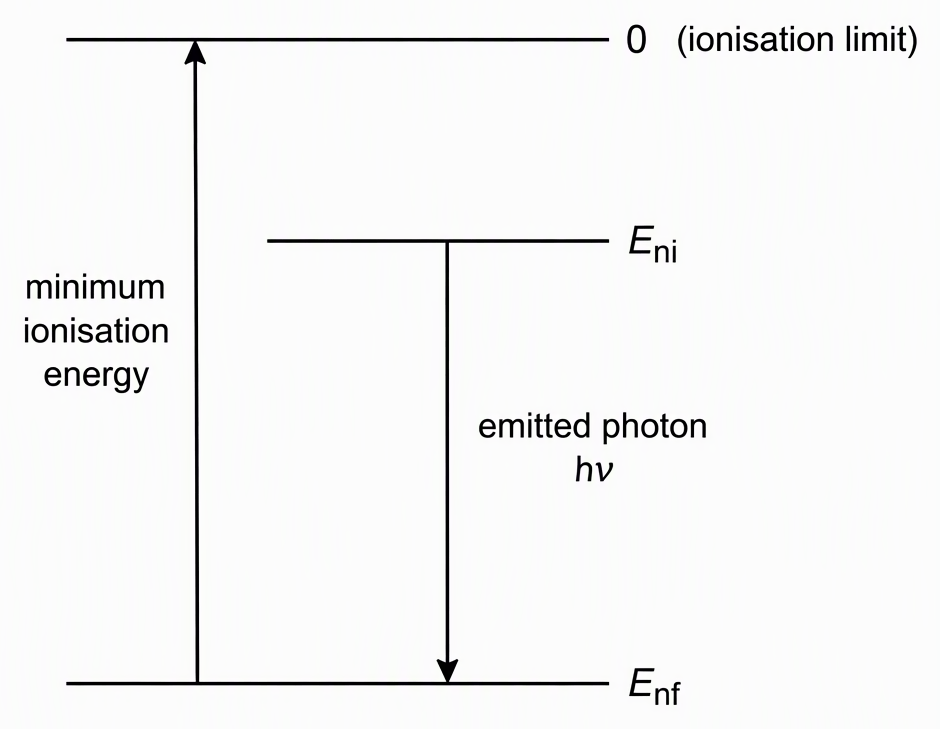
For the first three drills, assume an ideal one-electron, hydrogen-like species with a stationary nucleus. Ignore reduced-mass and relativistic corrections. Take zero energy at a free electron infinitely far from the nucleus:
The constants are positive. The remaining symbols specify the nuclear charge, occupied level and Planck’s constant:
Question 1: Original diagnostic drill, not a JEE PYQ. An electron emits a photon while moving from the initial level to the final level specified below. Find the photon frequency.
Question 2: Original diagnostic drill, not a JEE PYQ. Find the minimum energy supplied to ionise the species from the occupied level specified below. The electron should reach infinity with no kinetic energy.
Question 3: Original diagnostic drill, not a JEE PYQ. Two hydrogen-like ions, A and B, occupy the same principal quantum number. Their nuclear charge numbers are given below. Find the radius ratio and ionisation-energy ratio, taking A divided by B.
Question 4: Original diagnostic drill, not a JEE PYQ. In Rutherford scattering, most alpha particles pass through a thin foil with little deflection, but a small fraction undergo large-angle deflections. What does this support about the atom’s positive charge and structure? Does it establish quantised electron energies?
Worked solution 1: The photon receives the energy lost by the electron. Subtract final orbital energy from initial orbital energy, giving a positive result:
Trap: energy-sign reversal. The electron’s energy change is negative during emission; the emitted photon’s energy is positive.
Worked solution 2: Ionisation ends at the zero-energy limit, not another bound orbit. The minimum supplied energy is:
Trap: confusing excitation with ionisation. A transition to a higher finite level leaves the electron bound. Its energy gap is not the ionisation energy.
Worked solution 3: At the same principal quantum number, the common constants and level factors cancel. Keep A in the numerator throughout:
Trap: reversing charge scaling. Greater nuclear charge means a smaller orbit but a larger ionisation energy in this model.
Worked solution 4: Rare large deflections support a small, concentrated, positively charged nucleus rather than diffuse positive charge. The mostly undeflected particles support an atom that is largely empty space.
Trap: overclaiming what scattering establishes. These observations support nuclear structure; they do not, by themselves, establish quantised electron energies or explain atomic line spectra.
When should you move to PYQs, and how can you check them?
Move to PYQs when you can reproduce the method without looking at the solution. Recognising a boxed answer is not enough. Explain the energy reference, choose the subtraction order and justify the hydrogen-like assumption before using actual papers to calibrate difficulty.
For each purported previous-year question, check:
- Exam name: Main or Advanced, not simply “JEE”.
- Year: A traceable paper year.
- Session or paper: The session, shift or paper identifier where applicable.
- Identifiable question: Matching stem and options, not just a similar topic.
- Matching answer key: The key for that exact paper and question.
An official answer key establishes the keyed answer; it is not a third-party worked explanation. Check the explanation’s assumptions, signs and units separately. For Main paper information, use the official NTA site, jeemain.nta.nic.in.
Keep Main and Advanced collections separate. Read each Advanced paper’s actual instructions because question types and marking schemes vary.
Reject hydrogen-like solutions that apply the one-electron Bohr formulas unchanged to multi-electron atoms. A familiar formula does not make the physical model valid.
How should each mistake change what you practise next?
Match the next task to the first incorrect step, not just the final wrong answer. Record the model used, the first error and its correction. Do not copy the entire worked solution.
- Wrong physical model: Revisit the assumptions. Check whether the species has one electron and whether the question asks about a bound transition or complete removal.
- Wrong sign or scaling: Repeat a targeted drill. Explain why emission gives positive photon energy or why increasing nuclear charge reduces the radius.
- Correct method, arithmetic or unit error: Redo the calculation cleanly. Keep units attached to quantities and settle the symbolic expression before substituting.
- Difficulty selecting an approach: Attempt another authenticated question before reading its solution. Write what is given and which physical quantity is requested.
- Correct chapter work, poor full-paper execution: Use a mock and inspect individual Atoms attempts manually. A Physics total cannot tell you which assumption failed.
After an intervening study session, reattempt the missed question unaided. Then solve a related question with changed conditions, such as absorption instead of emission, or unequal principal quantum numbers in a comparison.
Use the changed conditions to check whether you learnt the method or recalled the answer. No drill count guarantees mastery. A full mock tests question selection and execution across subjects; it does not replace chapter repair.
Are Physics Atoms questions the same as Chemistry Atomic Structure questions?
No. The chapters overlap in atomic-model ideas, but their question collections are not interchangeable. Chemistry Atomic Structure includes quantum numbers, orbitals and electronic configurations. For that practice, use Atomic Structure Practice Questions JEE: 5 Solved Drills.
Do these drills prove that you are ready for Main or Advanced?
No. They check foundations, not exam readiness. Authenticated PYQs calibrate practice against actual exam questions, but do not replace repairing conceptual gaps. Use them once you can reconstruct these methods unaided.
Do you need a full mock to practise Atoms?
Not for the first diagnosis. Start with the stems above and repair the first incorrect step. Use a complete paper later to check execution across subjects rather than the chapter method alone.
For that whole-paper step, JEEnius includes free full-length mocks: 75 questions, 300 marks and 180 minutes, with a scored per-subject breakdown. Afterwards, inspect each attempted Atoms question yourself.
Next step: full-length mock tests on JEEnius and sit a full 75-question, 300-mark, 180-minute paper and get a scored per-subject breakdown (free tests included).
Frequently asked questions
Are these Atoms questions actual JEE PYQs?
No. These are four original diagnostic drills with worked solutions, not authenticated JEE previous-year questions. They check selected foundations and do not establish Main or Advanced exam readiness.
How do I calculate ionisation energy from the nth orbit?
For an ideal one-electron, hydrogen-like species, the orbital energy is E_n = -CZ²/n², with zero energy at infinity. The minimum ionisation energy is 0 - E_n = CZ²/n². Moving the electron to a higher finite orbit is excitation, not ionisation.
When should I start solving Atoms PYQs for JEE?
Start when you can reconstruct the basic methods without looking at solutions, including the energy reference, subtraction order and hydrogen-like assumptions. Authenticate each PYQ using its exam name, year, session or paper, identifiable question and matching answer key. Keep Main and Advanced collections separate.
Are Physics Atoms and Chemistry Atomic Structure the same?
No. They overlap in atomic-model ideas, but their question collections are not interchangeable. Chemistry Atomic Structure includes quantum numbers, orbitals and electronic configurations; the drills here focus on Physics Atoms.
Should I take a full mock to practise Atoms?
Not for the first diagnosis of a chapter-level problem; use targeted drills to locate and repair the first incorrect step. Use full mocks when your chapter work is sound but question selection or execution suffers in a complete paper. Review individual Atoms attempts manually because a subject score does not diagnose chapter misconceptions.