
What is the correct answer to the equation of a line JEE 2025 question?
The equation of a line JEE 2025 question has numerical answer 7, corresponding to option [4] in the supplied solution. Four is the option identifier, not the required ratio. This PYQ is from JEE Main Mathematics, 23 January 2025, afternoon shift, in Three Dimensional Geometry.
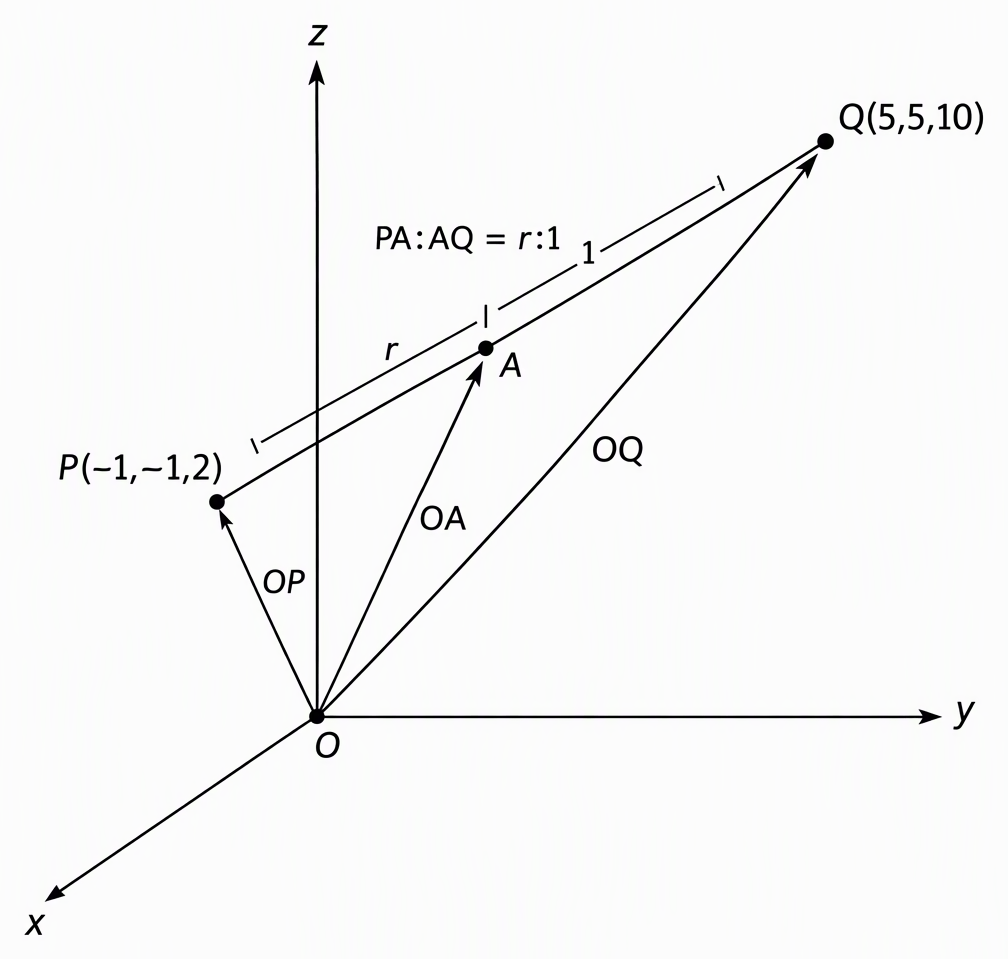
The segment joins endpoints P and Q. Point A lies strictly inside it, dividing the segment in the positive ratio specified below, and O is the origin.
Find the positive ratio parameter that satisfies:
The complete option list is not supplied. The solution below follows the supplied section-formula method and shows the lost quadratic term that produces 14.
How do you write the position vector of A without reversing the ratio?
The coefficient multiplying Q must be the ratio parameter: the section formula weights each endpoint by the length of the opposite part. A larger share assigned to PA means A is farther from P and closer to Q. Write the lengths in the stated order before inserting coordinates.
Substituting the endpoint coordinates gives:
Use these substitutions from the supplied solution:
Check the endpoints before continuing. As the ratio parameter approaches zero from above, A approaches P; increasing it moves A towards Q.
The denominator is strictly positive:
Multiplying by its square later therefore cannot introduce a zero-denominator case.
How do you calculate the dot product and squared cross-product magnitude?
For the dot product, multiply matching components and add. For the cross product, calculate all three components, then square and add them. The condition asks for the magnitude squared, not the magnitude, so no square root is needed.
The dot product is:
Expand the sum before substituting:
This gives:
Now expand the cross product component by component. Keep each subtraction visible, especially where a negative coordinate appears:
The first two components have opposite signs, but their squares add rather than cancel. The third component is zero because the first two coordinates of each vector are equal.
Simplify the repeated component:
Therefore:
How do you solve for the ratio and verify that seven is correct?
Substitution gives two algebraic roots, zero and seven. Only seven is allowed because A must be an interior point with a positive division ratio. Keep both quadratic contributions when collecting terms: dropping either one changes the positive root.
Insert the two vector-product results into the original condition:
Multiply by the square of the denominator and divide by ten:
Replace the denominator substitution and expand both sides explicitly:
Collect and factor:
The zero root puts A at P, not inside the segment, and violates the positive-ratio requirement. Reject it and retain:
Here, 4 identifies the option in the supplied solution, not the ratio. Verify the retained value in the original condition, not just the final quadratic.
Substitution into the coordinates and vector products gives:
The required check is:
Why does losing one quadratic term give the incorrect value 14?
Losing one quadratic contribution halves the quadratic coefficient and changes the positive root from seven to fourteen. Start from the last correct expanded equation:
Collecting terms on the right correctly gives:
Contrast that with the faulty equation:
This produces the incorrect value 14, mentioned as a previous key in the supplied solution. No particular option label can be assigned to it because the complete options are absent.
The mistake is losing one quadratic contribution while transferring and collecting terms. Calling it only a sign error does not identify the missing coefficient.
Use a two-part safeguard: group quadratic, linear and constant terms separately before factoring. Then substitute the retained root into the original condition.
What two related practice questions should you solve next?
Practise finding the whole line first, then selecting a point on its segment. These are original related practice questions, not additional verified PYQs. A direction vector describes the whole line, while an internal division ratio selects a particular point on its segment.
Question 1: Find the vector and symmetric equations of the line through the same endpoints P and Q.
Subtract the coordinates to obtain a direction vector:
Using the smaller direction vector gives:
The symmetric equation is:
Question 2: Find B dividing the same segment internally in the following ratio, and verify that it lies on the line from Question 1.
The section formula puts the coefficient two on Q:
Substitute into all three parts of the symmetric equation:
All three ratios agree, confirming that B lies on the line. Now redo the main question with the solution covered, writing the grouped quadratic terms before you factor.
Next step: the past-paper archive on JEEnius and search every JEE Main paper from 2002 and every Advanced paper from 2007, by year, subject or chapter, each with a worked solution (free).
Read next: The P-Block Elements JEE 2023: Matching Question Solved.
Frequently asked questions
What is the answer to the equation of a line JEE 2025 question?
The positive ratio parameter is r = 7 for the JEE Main Mathematics question from 23 January 2025, afternoon shift. It corresponds to option [4] in the supplied solution; 4 is the option identifier, not the ratio.
How do I apply the section formula when PA:AQ = r:1?
For internal division in the ratio PA:AQ = r:1, the position vector is OA = (OP + r OQ)/(r + 1). The coefficient r multiplies Q, so increasing r moves A towards Q. For P = (-1,-1,2) and Q = (5,5,10), this gives A = ((-1+5r)/(r+1), (-1+5r)/(r+1), (2+10r)/(r+1)).
Why is r = 0 rejected in this JEE 2025 question?
The algebra gives roots r = 0 and r = 7, but the question requires r > 0 and A strictly inside segment PQ. At r = 0, the section formula places A at endpoint P. Therefore, only r = 7 is admissible.
Why do I get 14 instead of 7 in this question?
The value 14 results from losing one quadratic contribution when collecting terms. The correct equation is 2r² - 14r = 0, not r² - 14r = 0. Group both quadratic terms before factoring, then verify the positive root in the original condition.