What is the answer to this three dimensional geometry JEE 2026 question?
Option D, 290, is correct for this three dimensional geometry JEE 2026 question, but the direction vector alone does not justify it. The working below establishes both intersection points first. The supplied source is JEE Main, January 2026, Slot 1; “hard” is the question bank’s classification, not an official exam rating.
The line L1 passes through P, and L2 passes through Q, with their points and directions specified below. L3 meets L1 at C and L2 at D. Find the squared length of segment CD, not the distance from the origin to either fixed point.
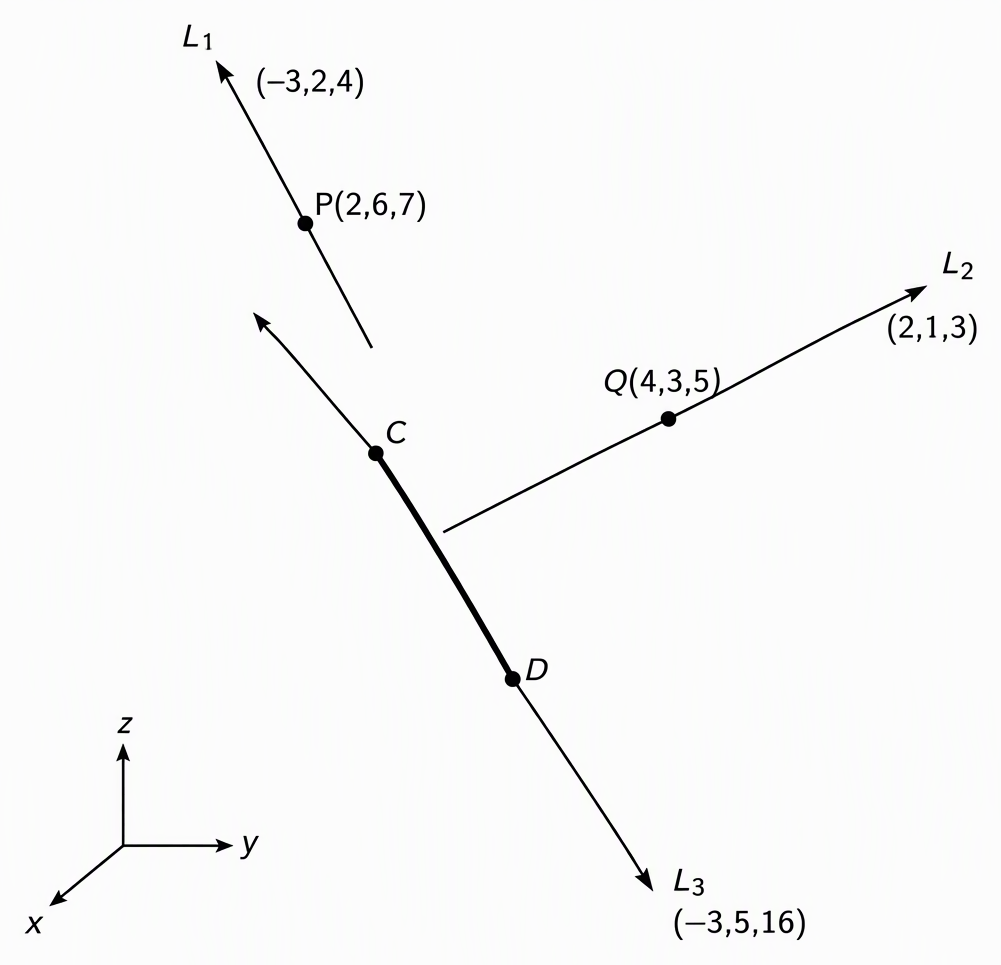
The supplied points and directions are:
The choices are:
Why do C and D need separate parameters?
C and D lie on different lines, so each needs its own parameter. Setting the parameters equal would impose a restriction that the question never gives. Follow the supplied solution: write both line equations, then subtract the coordinates to form the displacement.
For the first line:
For the second line:
The fixed triple in each line equation is a position vector. The vector multiplied by the parameter gives the line’s direction. Neither is automatically the displacement from C to D.
Subtract C from D, coordinate by coordinate:
How does the third line fix both parameters?
The displacement from C to D must be parallel to L3, so its components share one scale factor with the given direction. This supplies two independent equations for the two unknown parameters. Equate ratios, rather than equating each component directly to the corresponding direction component.
From the first two ratios:
From the last two ratios:
Use the second equation to substitute into the first:
Now recover the other parameter:
How do the endpoints prove that option D is correct?
Substitution gives C and D, whose difference is exactly the stated direction vector. That equality is now a checked result, not an assumption. Calculate the squared distance from these endpoints; do not take a square root, because the question asks for squared length.
Substitute the parameter values:
Check the displacement:
Hence:
Therefore, option D is correct. In general, parallelism only establishes:
Here, the endpoint calculation proves:
Squaring the direction vector at the start happens to give the answer. It is not a valid justification until its scale is established.
How can a position-vector mistake produce option A, 89?
Squaring the coordinates of P gives 89, but measures the wrong segment. It calculates the squared distance from the coordinate origin O to P, not from C to D. This is a demonstrable route to option A, not a claim about how the distractor was designed or how often students choose it.
The mistake is treating the fixed position vector in the line equation as the required displacement vector. In this solution, P is not C, and neither requested endpoint is specified as the origin.
Name both endpoints before applying a distance formula. Then form endpoint minus starting point, rather than squaring whichever vector appears first.
Which three practice questions check the same method?
Use these author-created practice questions based on the supplied problem, not additional verified PYQs, to check three distinct steps. Each answer appears immediately after its question.
- Question 1: Parameter meaning.
- Question 2: Direction scaling.
- Question 3: Intersection consistency.
What is the squared distance between parameter values 1 and −1 on L1?
Question 1, author-created practice: Find the squared distance between these two points. Answer: 116, because the parameter difference scales the direction vector, while the fixed position vector cancels.
Taking the displacement from the point at parameter −1 to the point at parameter 1:
What changes if L3’s direction vector is doubled?
Question 2, author-created practice: Keep L1 and L2 unchanged and double L3’s direction vector as below. Find the squared length of CD and the scalar multiplying this new vector.
Answer: 290, with scalar one-half. Doubling a direction vector does not change its direction, so the same proportionality conditions give the same C and D.
Do L1 and L2 themselves intersect?
Question 3, author-created practice: Test whether the two original lines meet. They do not: matching the first two coordinates produces parameter values that fail the third coordinate.
Equating the first two coordinates gives:
The remaining coordinate difference is:
Their direction vectors are not proportional, so the original lines are skew. Meeting a third line does not make them intersect each other: always check the remaining coordinate before declaring an intersection.
Next step: the past-paper archive on JEEnius and search every JEE Main paper from 2002 and every Advanced paper from 2007, by year, subject or chapter, each with a worked solution (free).
Read next: Redox Reactions and Electrochemistry JEE 2023: H2S Solution.
Frequently asked questions
What is the answer to this three dimensional geometry JEE 2026 question?
Option D, 290, is correct. Solving the line parameters gives C = (11, 0, -5) and D = (8, 5, 11), so CD squared is (-3)^2 + 5^2 + 16^2 = 290.
Why do points on different lines need separate parameters?
Each point has its own parameter because it lies on a different line. Setting the parameters equal would impose a restriction not given in the question. Here, the endpoint parameters are t = -3 and s = 2.
Can I square the direction vector to find the squared length of CD?
Not without establishing its scale relative to the displacement. Parallelism gives CD = lambda times (-3, 5, 16), so its squared length is 290 times lambda squared. The endpoint calculation proves lambda = 1 in this problem.
Does doubling the direction vector change the length of CD?
No, doubling a direction vector does not change the line's direction. With L1 and L2 unchanged, the endpoints remain the same, and CD equals one-half of (-6, 10, 32). Its squared length remains 290.