
What is the correct answer to the Atoms and Nuclei JEE 2020 circular-orbit question?
B and C are correct in this Atoms and Nuclei JEE 2020 problem: retain Bohr’s angular-momentum rule, but derive force and energy from the given potential. The source is JEE Advanced 2020, Paper 2, Physics, Atoms and Nuclei, not JEE Main.
A particle of fixed mass moves in circular orbits about the origin under a potential that increases linearly with distance. Use Bohr quantisation to select the valid nth-orbit relations for radius, speed and total energy.
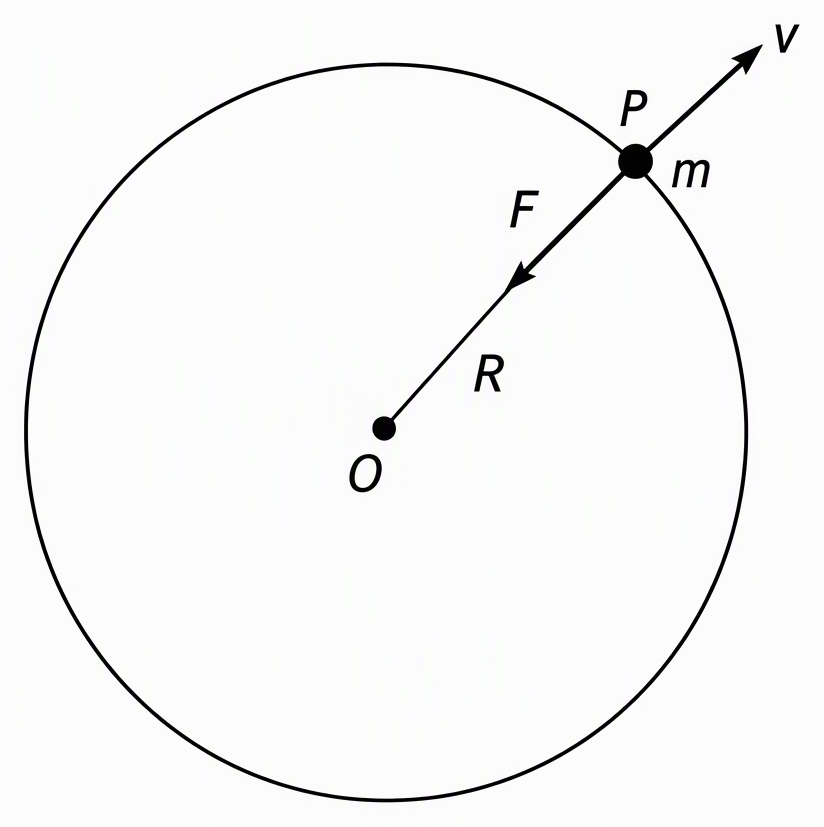
The potential and notation are:
For an orbit numbered by a positive integer, choose from:
- A)
- B)
- C)
- D)
More than one option can be correct. “Medium difficulty” and the 180-second practice target are question-bank tags, not official exam classifications.
How do you obtain the inward force and write Bohr’s condition?
The force is inward and has constant magnitude, even though the potential increases with radius. Differentiate the potential first, then use the force magnitude in the circular-motion equation.
The negative radial component means the force points towards the origin. Its magnitude is the positive constant given in the question.
For circular motion:
Bohr’s angular-momentum condition is:
These two equations determine the orbit. Retain quantisation, not memorised hydrogen results: the hydrogen radius relation below depends on a Coulomb force and does not apply to this constant-magnitude force.
How do you derive the radius and speed powers?
The radius grows with the two-thirds power of the orbit number, while speed grows with its one-third power. Square the angular-momentum equation and substitute the speed squared from circular motion to establish both powers.
Substitute:
Simplify, then isolate the radius:
For fixed mass and force magnitude, taking the cube root gives:
Use the circular-motion equation again for speed:
B is correct; A is incorrect. Check that the derived powers satisfy quantisation:
This verifies angular-momentum quantisation but does not replace the force equation. Option A also passes the product check, so that check alone cannot decide the answer.
How do you calculate total energy and confirm B and C?
Total energy is three-halves of the potential energy at the orbit, so C is correct. Start with kinetic and potential energy separately: the circular-motion equation is not itself an energy equation.
Using the force result and evaluating the potential at the orbit:
Add both terms:
Substitute the derived radius:
Combine the force factors:
C matches; D has the wrong coefficient. Positive potential and total energy cause no contradiction: inward attraction follows from the negative derivative of the potential, not from requiring energy to be negative.
Final multiple-correct answer: B and C.
How does dropping the one-half produce option D?
Omitting the one-half in kinetic energy produces option D exactly. Using the following expression instead of the correct kinetic energy makes the force relation look like an energy result:
Adding the potential energy then gives:
Multiplying the centripetal-force equation by the radius gives twice the kinetic energy, not kinetic energy. Keep the one-half visible when substituting:
For this particular linear potential, check both energy ratios before selecting an option:
Which two original Atoms questions check the same method?
An orbit-ratio exercise checks the derived powers; a quadratic potential checks whether you can repeat the force-to-energy calculation. These are original practice questions from the same chapter, not additional verified JEE PYQs.
For chapter-level preparation, see How to Study Atoms JEE: Models, Energy Gaps and Practice.
What are the eighth-to-first orbit ratios in the same linear potential?
The radius, speed and energy ratios are 4, 2 and 4, respectively. Question 1: for the same particle, unchanged positive force constant and circular Bohr orbits, find:
Apply the derived powers:
Total energy is proportional to radius, giving the third ratio:
How do the orbit relations change for a quadratic potential?
Radius and speed both grow as the square root of the orbit number; energy grows linearly. Question 2: retain circular Bohr orbits for a particle of fixed mass, replace the potential as below, and find the orbit-number dependence of radius, speed and total energy.
Differentiate, then apply circular motion:
Substitute into squared quantisation:
Finish with energy:
The energy ratio changes with the potential:
Before reusing any energy ratio, derive it again from the new force equation.
Next step: the past-paper archive on JEEnius and search every JEE Main paper from 2002 and every Advanced paper from 2007, by year, subject or chapter, each with a worked solution (free).
Frequently asked questions
What is the correct answer to the Atoms and Nuclei JEE 2020 circular-orbit question?
B and C are correct in this JEE Advanced 2020 Paper 2 Physics question. For V(r) = Fr, Bohr quantisation gives R proportional to n^(2/3), v proportional to n^(1/3), and total energy E = 3FR/2.
Why can't I use the hydrogen radius formula for V(r) = Fr?
The hydrogen result R proportional to n^2 depends on the Coulomb force, whereas V(r) = Fr gives an inward force of constant magnitude F. Retain Bohr's condition mvR = nh/(2π), but combine it with mv^2/R = F to derive the orbit relations again.
Why is option D wrong in the JEE 2020 linear-potential problem?
Option D results from incorrectly taking kinetic energy as mv^2 instead of mv^2/2. Since mv^2 = FR, the correct kinetic energy is FR/2 and total energy is 3FR/2, not 2FR.
How can a positive potential give an attractive force?
Force depends on the negative derivative of potential, not on the sign of potential energy. For V(r) = Fr with F positive, the radial force is -F, so it points towards the origin even though potential and total energy are positive.