
What is the answer to the Properties JEE 2020 train-and-tunnel question?
The properties jee 2020 train-and-tunnel answer is 9: both airflow speeds must be measured relative to the train. This is JEE Advanced 2020, Paper 1, Physics, from Properties of Solids and Liquids. The question bank rates it medium, with a bank target time of 120 seconds.
A train moves inside a long tunnel whose cross-sectional area is four times the train’s area. Almost all the air ahead returns through the gaps between the train’s sides and the tunnel walls. Relative to the train, this airflow is steady and laminar. Ambient air and the train interior have the same pressure, while the side-gap pressure is different.
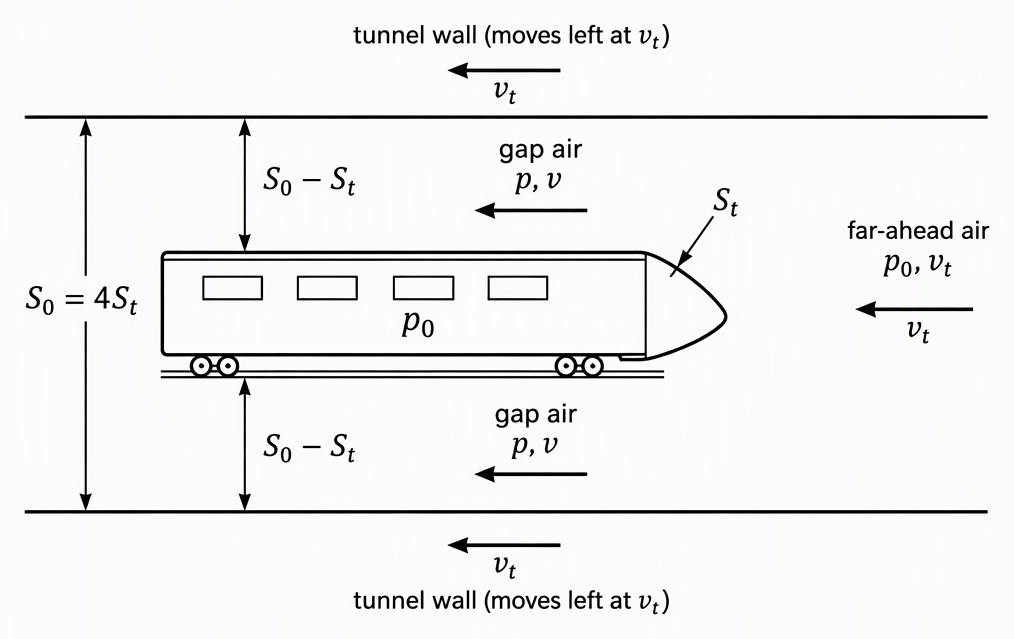
The given quantities and pressure relation are:
Find the numerical value of the dimensionless number:
This is a numerical-answer question, not an MCQ with supplied options. Calculate the pressure difference, then match its coefficient to the given expression.
How does continuity give the gap-air speed in the train frame?
The gap-air speed is four-thirds of the train speed, relative to the train, not the ground. Choose the train frame and keep it throughout the solution. The train is stationary in this frame, while far-ahead air approaches it at the train’s speed:
Define the gap-air speed:
The available flow area is the tunnel cross-section minus the train cross-section:
Following the official solution’s steady, incompressible-flow treatment, equal volume flow rates give:
Substitute the two areas:
Cancel the train-area factor and divide by three:
The inlet stream occupies the full tunnel cross-section in this frame. The train’s cross-sectional area is the obstruction, not the inlet airflow area. Using it as the inlet area gives the wrong volume flow rate before Bernoulli is even applied.
How do you apply Bernoulli without mixing reference frames?
Apply Bernoulli between the external air far ahead and the external air in the gap, using train-frame speeds at both locations. Choose points at the same elevation, so gravitational terms cancel. Do not apply it between cabin air and gap air: equal cabin and ambient pressures do not make those locations interchangeable.
The two external flow states are:
Bernoulli’s equation is:
Move the pressure terms to one side and kinetic terms to the other:
Substitute the continuity result:
The upstream kinetic-energy term must remain present. The pressure drop depends on the difference of squared speeds, not the gap speed alone.
Check the sign before proceeding. Gap flow is faster than upstream flow, so its pressure is lower:
This agrees with the positive pressure difference obtained above.
How does coefficient matching give the final answer 9?
Matching the calculated pressure drop with the given form gives 9, without numerical values for air density or train speed. Both expressions contain the same density and squared-speed factors:
Compare coefficients:
Final numerical answer:
Density times speed squared has pressure units, so the matched coefficient and the required number are dimensionless. The units check is:
Why is treating upstream air as stationary wrong here?
Setting upstream speed to zero while retaining the train-frame gap speed mixes two reference frames. The supplied problem has no answer options, so the calculation below is a worked incorrect numerical result, not an exam distractor.
Suppose you keep the correct continuity result but omit upstream kinetic energy:
Matching this incorrect coefficient gives:
The error is not squaring or fraction arithmetic. Upstream air is stationary in the ground frame, but its speed in the train frame is:
Repair the calculation by retaining the upstream kinetic-energy term:
Label both velocities “relative to train” before substituting. A speed measured relative to the ground cannot replace either train-frame speed in this equation.
How do changes in flow area and train speed affect pressure?
Halving the flow area doubles the flow speed by continuity; doubling the train speed makes the tunnel pressure drop four times as large under the unchanged model. These original practice questions, not additional verified JEE PYQs, test those two results within the same chapter.
Original practice question 1: For steady incompressible flow at equal elevations, use the following givens to find the outlet speed and pressure drop in terms of density and the inlet speed:
Continuity gives:
Bernoulli gives:
Original practice question 2: In the original tunnel problem, the train speed doubles. Geometry, density and modelling assumptions remain unchanged. How do the pressure difference and the required number change?
The pressure difference scales with speed squared:
The coefficient is unchanged, so:
Before finishing either check, verify:
- The inlet area belongs to the upstream airflow, not the obstruction.
- Both speeds are measured in the same reference frame.
- Bernoulli includes the upstream kinetic-energy term.
Next step: the past-paper archive on JEEnius and search every JEE Main paper from 2002 and every Advanced paper from 2007, by year, subject or chapter, each with a worked solution (free).
Keep going with How to Study Atomic Structure JEE: A Six-Step Plan.
Frequently asked questions
What is the answer to the JEE Advanced 2020 train-and-tunnel question?
The numerical answer is N = 9. Continuity and Bernoulli give the pressure drop as (7/18)ρv_t²; matching this with the given expression (7/2N)ρv_t² gives N = 9.
How do you find the air speed in the gap around the train?
In the train frame, upstream air enters through the full tunnel area 4S_t at speed v_t, while the gap area is 3S_t. Continuity gives 4S_t v_t = 3S_t v, so the gap-air speed relative to the train is v = 4v_t/3.
Why can't we take the upstream air speed as zero?
Upstream air is stationary in the ground frame, but it approaches at speed v_t in the train frame. Using zero upstream speed with the train-frame gap speed mixes reference frames and incorrectly removes the upstream kinetic-energy term from Bernoulli's equation.
Can we apply Bernoulli between the cabin air and the gap air?
No; apply Bernoulli between the external air far ahead and the external air in the side gap, using train-frame speeds at both points. The cabin and ambient pressures are equal, but that does not make cabin air interchangeable with the upstream external flow.