
How should I study Atomic Structure for JEE in six steps?
- Repair only the prerequisites you need. To study Atomic Structure for JEE, choose the physical model before the formula. Check scientific notation, rearranging equations, proportionality and wavelength and energy unit conversions, not all of Chemistry.
Practise converting nanometres to metres and electronvolts to joules. A correct equation with inconsistent units still gives a wrong answer.
- Study in dependency order. Begin with electromagnetic radiation and photon energy. Follow with the hydrogen spectrum and Bohr model, then matter waves and uncertainty, then quantum numbers, orbitals and electronic configuration.
Read atomic-model experiments and limitations beside the relevant model. Rutherford scattering explains why a nucleus is needed; Bohr’s treatment explains hydrogenic energy levels, but does not provide a general model for many-electron atoms.
- Build a four-family recognition sheet. Give each family three entries: identifying clue, governing relation and validity condition. Use these distinctions:
- Photon/spectrum: Frequency, wavelength or emitted light points to photon energy. For a spectral transition, use the magnitude of the level-energy difference.
- Hydrogen-like species: Nuclear charge and orbit number suggest Bohr scaling, valid for a one-electron species.
- Matter waves/uncertainty: Particle momentum gives de Broglie wavelength; position and momentum spreads require the uncertainty bound. The square-root momentum relation below assumes non-relativistic motion.
- Quantum numbers/configurations: Allowed states and electron filling require the restrictions and occupancy rules in Step 4, not a wavelength equation.
Photon energy is not the kinetic energy used to calculate a massive particle’s momentum. Classify the particle before choosing its energy relation.
- Learn constraints, not isolated answers. Retrieve the quantum-number restrictions from memory. Use them to derive orbital counts.
Apply Aufbau for ground-state filling, Pauli for occupancy and Hund for equal-energy orbitals. Learn the standard chromium and copper exceptions:
For transition-metal cations, remove electrons from the highest principal shell first, so the fourth-shell s electrons leave before the third-shell d electrons. Derive ratios and counts; recall restrictions and exceptions.
- Write the classification before substituting. Record the family, applicable model, known quantities and required quantity. Bohr formulae apply to hydrogen and singly ionised helium, not neutral helium. For an emitted or absorbed photon, use a positive energy:
- Check, then re-solve without looking. Check units, sign and scaling before accepting an answer. At fixed transition levels, hydrogenic scaling gives higher photon energy and shorter wavelength as nuclear charge increases.
Label each mistake concept, model selection, algebra/unit handling or recall. Close the solution and reconstruct it rather than treating recognition of the printed answer as understanding.
How can I compare hydrogenic spectral lines without inserting constants?
The two wavelengths in this example are equal. Compare the light emitted by singly ionised helium during a fourth-to-second-level transition with hydrogen during a second-to-first-level transition. Both are one-electron systems, so the same hydrogenic energy scale applies and cancels in a ratio.
Classify: Spectrum question using the Bohr model. The known quantities are nuclear charge and initial and final levels; the required quantity is the wavelength ratio.
Solve: For emission, the lower final level makes this difference positive:
For singly ionised helium:
For hydrogen:
The photon energies are equal. Since wavelength is inversely proportional to photon energy:
Check: No numerical physical constants were needed. Pick ratios over repeated substitution here: they expose the cancellation and reduce arithmetic.
“Larger nuclear charge means shorter wavelength” works only when the transition levels remain fixed. Here, those levels also change.
Diagnostic: A wrong answer calls for work on species recognition or transition scaling, not memorising more spectral formulae.
Why does quadrupling an electron’s accelerating potential only halve its wavelength?
A non-relativistic electron’s wavelength depends on the inverse square root of the accelerating potential. In this illustrative question, an electron starts from rest and is accelerated through a potential difference. Find its new de Broglie wavelength when that potential becomes four times larger.
Classify: This is a massive-particle question, not a photon question. The electron starts from rest and must remain non-relativistic at both potentials.
Solve: Using the magnitude of the electron’s charge:
Therefore:
A photon whose energy increases fourfold behaves differently:
Check: More electron momentum means a shorter wavelength. The kinetic-energy relation fixes the inverse-square-root dependence, not an inverse dependence.
For follow-up practice, JEEnius daily practice problems provide a fresh ten-question set on a topic every day, with free sets daily. For optional transfer beyond this chapter, use X-rays and X-ray Tube JEE 2020: Why A and C Are Correct to practise distinguishing accelerated-electron energy from emitted-photon energy.
Diagnostic: Choosing one-quarter of the original wavelength for the electron means you have confused photon energy with particle kinetic energy.
How many electrons can have principal quantum number three and magnetic quantum number zero?
The maximum is six electrons, not eighteen. The principal quantum number fixes the shell, while the magnetic quantum number excludes some of that shell’s orbitals. Count only the states that satisfy both restrictions before applying Pauli’s two-electrons-per-orbital limit.
The illustrative question fixes:
Classify: This is constrained state counting. No energy or wavelength model is needed.
Solve: The permitted subshell values are:
Each permits exactly one orbital with magnetic quantum number zero. Thus, three orbitals survive the restriction.
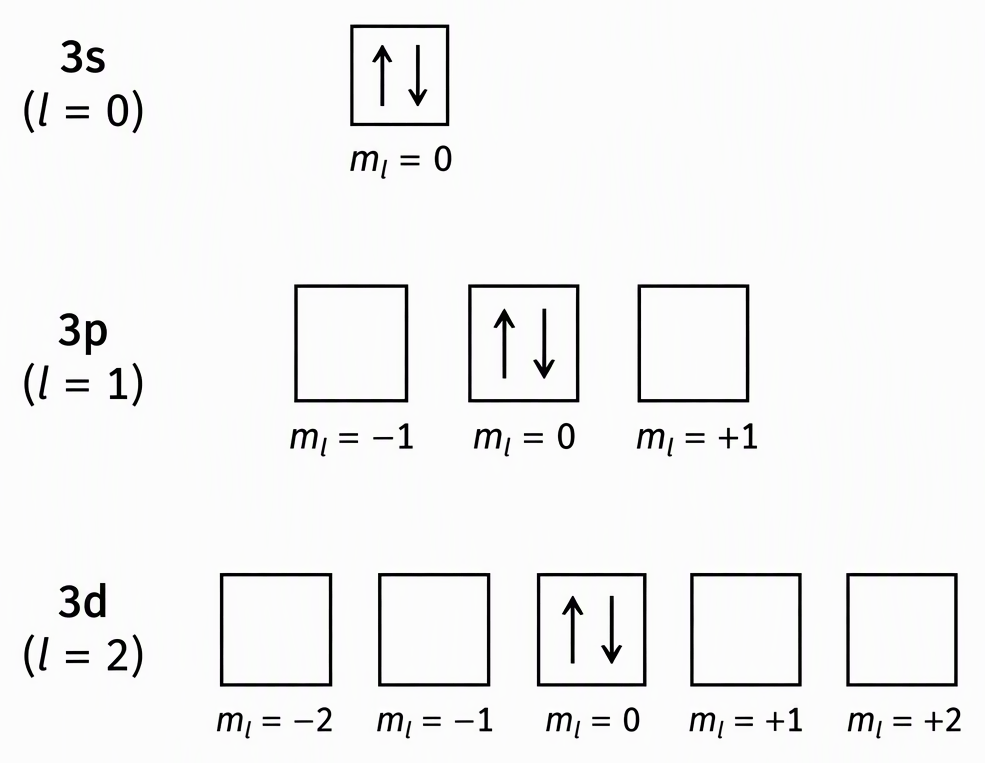
Each eligible orbital permits two opposite spin states:
Check the restriction, not just the shell:
- Principal quantum number alone:
- Principal and magnetic quantum numbers fixed:
- Principal and azimuthal quantum numbers fixed:
The shell-capacity formula counts every orbital in the shell. It cannot be applied unchanged after extra restrictions are imposed.
Diagnostic: A wrong count calls for listing allowed states and applying Pauli, not rote repetition of capacity formulae.
What should I practise next if I keep making Atomic Structure mistakes?
Reconstruct the four-family recognition sheet with your book closed. Check it against NCERT or class notes and repair specific gaps. Do not rewatch the full chapter just to repair one missing validity condition.
Choose the next set from your errors:
- Spectrum mistakes: Practise transition signs, one-electron species recognition and nuclear-charge scaling.
- Matter-wave mistakes: Practise finding momentum from kinetic energy and converting units before substitution.
- Uncertainty mistakes: Practise bound questions. Equality gives the minimum permitted uncertainty under the stated bound, not the exact uncertainty of every state.
- Quantum-number mistakes: List allowed states under multiple restrictions before counting electrons.
- Configuration mistakes: Write neutral-atom and ion configurations, count unpaired electrons and distinguish ground-state filling from merely allowed arrangements. An arrangement can satisfy Pauli yet fail to be the ground state.
Use this progression: single-family questions, mixed chapter questions, then JEE Main and JEE Advanced previous-year questions. Read each paper’s actual answer-selection and marking instructions; neither exam guarantees a particular chapter question type.
You are ready to move on when you can identify the model, explain why it applies, solve an unseen variation and check the result without the formula sheet. Speed alone does not demonstrate that.
Re-solve incorrect questions after a gap, without viewing the old solution. Revisiting errors tests whether the misconception was repaired; fresh questions test whether you can transfer the method.
For fresh topic sets, JEEnius practice mode skips questions you have already seen, with free sets included. Choose the topic from your error log, and keep your old incorrect questions separately for the next closed-book retry.
Next step: daily practice problems on JEEnius and get a fresh ten-question set on a topic every day (free sets daily).
Frequently asked questions
In what order should I study Atomic Structure for JEE?
Start with electromagnetic radiation and photon energy, then study the hydrogen spectrum and Bohr model. Follow with matter waves and uncertainty, then quantum numbers, orbitals and electronic configuration. Study each atomic model’s experiments and limitations alongside that model.
Can I use Bohr formulae for helium in JEE questions?
Bohr formulae apply to one-electron species, including hydrogen and singly ionised helium, He+. They do not apply to neutral helium, which has two electrons. Identify the species before using hydrogenic energy or radius scaling.
How many electrons can have n = 3 and m_l = 0?
The maximum is six electrons. For n = 3, the allowed subshells have l = 0, 1 and 2, and each contains one orbital with m_l = 0. These three eligible orbitals can each hold two electrons with opposite spins.
How should I practise Atomic Structure if I keep making mistakes?
Classify each mistake as concept, model selection, algebra or unit handling, or recall, then repair the specific gap. Progress from single-family questions to mixed chapter questions and then JEE Main and JEE Advanced previous-year questions. Re-solve incorrect questions after a gap without looking at the old solution, and use fresh questions to test transfer.