
What should I study first in aldehydes and ketones for JEE?
- Build a substrate–reagent–conditions sheet, not another reaction list. To study aldehydes and ketones for JEE, repair only the prerequisites this chapter uses: carbonyl polarisation, nucleophiles and electrophiles, resonance, inductive effects and alpha hydrogens. Do not restart all of GOC.
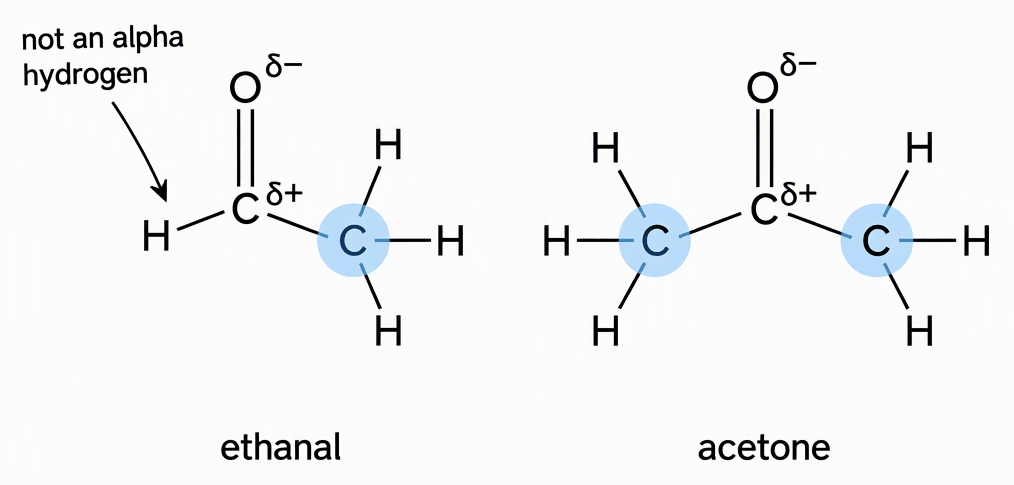
The carbonyl carbon is electron-poor, so nucleophiles attack it. An alpha hydrogen is attached to a carbon adjacent to the carbonyl group, not to the carbonyl carbon itself.
- Follow the dependencies. Study nucleophilic addition first, oxidation and reduction next, alpha-carbon chemistry after that, and preparation routes and chemical tests last. This is a recommended learning order, not an official syllabus order.
Aldehydes usually undergo nucleophilic addition more readily than comparable ketones. They offer less crowding around the carbonyl carbon and less electron donation from alkyl groups. Substituents and conjugation can change this comparison.
- Make a one-page sheet with four fields: substrate feature; reagent and conditions; bond change; restriction or exception. Start with these entries:
- Hydride reduction: aldehyde or ketone; sodium borohydride followed by work-up; carbonyl becomes alcohol; aldehydes give primary alcohols, ketones give secondary alcohols.
- Grignard addition: aldehyde or ketone; Grignard reagent in dry ether, then aqueous work-up; a carbon substituent forms a new carbon–carbon bond; water and acidic groups consume the reagent.
- Aldol: an enolisable carbonyl partner; suitable acid or base conditions; its alpha carbon bonds to another carbonyl carbon; heating can produce dehydration.
Connect alcohol oxidation with carbonyl reduction rather than learning them separately. Use How to Study Alcohols Phenols Ethers JEE: A Six-Step Method to study both directions.
How do I turn the decision sheet into a solving routine?
- Read the substrate and every condition before predicting anything. Mark aldehyde or ketone, alpha hydrogens, any methyl-carbonyl unit, other reactive groups, and everything written over the arrow. These features decide eligibility; the reagent name alone does not.
The methyl-carbonyl unit to recognise is:
Ethanal with dilute base suggests aldol because it has alpha hydrogens. Benzaldehyde with concentrated base suggests Cannizzaro because it is an aldehyde without alpha hydrogens. Base concentration alone does not select the reaction.
- Draw the bond change before naming the product. Separate the immediate addition intermediate from the product after aqueous work-up. Also separate an aldol addition product from the dehydrated product obtained on subsequent heating.
Keep these reduction entries distinct:
- Sodium borohydride or lithium aluminium hydride: carbonyl to alcohol after suitable work-up.
- Clemmensen reduction: zinc amalgam and hydrochloric acid replace carbonyl oxygen with hydrogens under acidic conditions.
- Wolff–Kishner reduction: hydrazine, strong base and heat accomplish the same deoxygenation under strongly basic conditions.
For ketones, the latter two convert the carbonyl group into a methylene group. Aldehydes give a terminal methyl group.
- Audit carbon count, oxygen fate, valency and eligibility. Record the missed trigger for each mistake, such as “ignored acidic work-up”, rather than copying the entire solution.
Use NCERT as your reaction-and-condition checklist, then cover the product side and reconstruct it. Rereading a completed equation tests recognition, not recall.
Once a family is secure, JEEnius daily practice problems provide a fresh ten-question set on a topic every day, with free sets daily. The three examples below are constructed teaching problems, not claimed previous-year questions.
What does acetone form with methylmagnesium bromide?
The final product is 2-methylpropan-2-ol, a tertiary alcohol. The problem specifies acetone with methylmagnesium bromide in dry ether, followed by acidic aqueous work-up. The reagent supplies a methyl group as a new carbon substituent: this is carbon addition, not simple reduction.
Apply steps 4–6:
- Read: acetone is a ketone; its carbonyl carbon is the electrophilic site.
- Draw: the supplied methyl group bonds to that carbon, forming a magnesium alkoxide.
- Work up: protonation converts the alkoxide into the alcohol.
Three carbons from acetone plus one from the reagent give four in the alcohol:
Propan-2-ol is wrong because it retains only acetone’s three carbons. That answer describes carbonyl reduction without carbon addition.
For a numerical extension, suppose the amounts are:
The reaction uses them in equal molar amounts, so acetone limits the theoretical yield. Assuming complete conversion and recovery:
The addition stage must remain dry because water consumes the Grignard reagent. Aqueous work-up belongs after carbon–carbon bond formation.
How do I choose between aldol and Cannizzaro?
Check alpha hydrogens before treating the base as a reaction label. Ethanal has alpha hydrogens and gives self-aldol addition under dilute aqueous sodium hydroxide at low temperature. Benzaldehyde has none and undergoes Cannizzaro disproportionation with concentrated aqueous sodium hydroxide.
Problem A: ethanal with dilute aqueous sodium hydroxide at low temperature. Its methyl hydrogens are alpha hydrogens. Base generates an enolate, whose alpha carbon attacks the carbonyl carbon of another ethanal molecule.
The product is 3-hydroxybutanal. The new carbon–carbon bond joins the alpha carbon of one molecule to the former carbonyl carbon of the other. Two two-carbon molecules give a four-carbon product:
On subsequent heating, dehydration gives but-2-enal:
Stopping at the hydroxy aldehyde is aldol addition. Including dehydration gives aldol condensation. The hydroxyl oxygen leaves in water; the aldehyde oxygen remains.
Problem B: benzaldehyde with concentrated aqueous sodium hydroxide. The adjacent ring carbon carries no alpha hydrogen. One aldehyde molecule is reduced to benzyl alcohol while another is oxidised to benzoate:
The basic mixture contains sodium benzoate, not benzoic acid. Benzoic acid appears only after acidification.
Absence of alpha hydrogens does not automatically make every carbonyl compound a Cannizzaro substrate. This standard decision applies to suitable aldehydes, not ordinary ketones.
How can two tests distinguish ethanal, acetone and benzaldehyde?
Ethanal gives both tests, acetone only iodoform, and benzaldehyde only Tollens’. For three separately supplied compounds known to be these candidates, apply Tollens’ reagent and the iodoform test to separate aliquots. Do not perform the second test on the mixture left from the first.
- Ethanal: Tollens-positive; iodoform-positive.
- Acetone: Tollens-negative; iodoform-positive.
- Benzaldehyde: Tollens-positive; iodoform-negative.
A positive Tollens’ test produces a silver mirror or silver deposit. A positive iodoform test produces a yellow precipitate of:
Ethanal is an aldehyde, so it reduces Tollens’ reagent. It is also the aldehyde that gives the iodoform test.
Acetone is an ordinary ketone and does not respond to Tollens’ reagent, but its methyl-carbonyl structure gives iodoform. Benzaldehyde responds to Tollens’ reagent but lacks the structure needed for iodoform formation.
Tollens’ alone leaves ethanal and benzaldehyde unresolved. Iodoform alone leaves ethanal and acetone unresolved.
Keep the inference within the supplied candidates. Tollens’ positivity is not exclusive to aldehydes because alpha-hydroxy ketones can also respond, and ethanol can also give the iodoform test.
What should I practise after the basic carbonyl reactions?
Practise each family separately, then mix them. Start with single-step nucleophilic addition, oxidation–reduction, aldol–Cannizzaro and chemical-test questions. Mixed sets make recognising the reaction family part of the task, rather than something the exercise heading supplies.
Add preparation and conversion drills. Record reagents, conditions, work-up and substrate limits, not just reaction names:
- Alcohol oxidation: distinguish primary and secondary alcohols; track controlled oxidation versus further oxidation of an aldehyde.
- Ozonolysis: reconstruct the alkene carbons that become carbonyl carbons; distinguish reductive work-up from oxidative work-up.
- Rosenmund reduction: acyl chlorides give aldehydes using hydrogen and poisoned palladium on barium sulfate; this is not direct reduction of a carboxylic acid.
- Stephen reduction: nitriles undergo reduction with tin(II) chloride and hydrochloric acid, followed by hydrolysis to aldehydes; stopping before hydrolysis gives the wrong final product.
Next, attempt crossed aldol problems. Identify which partner can form the enolate and which acts as electrophile; if both can enolise, check for multiple products. Introduce formaldehyde in crossed Cannizzaro only after the self-reaction is secure.
Use relevant JEE Main previous-year questions for direct application. Then attempt JEE Advanced previous-year questions involving linked transformations and competing functional groups.
For every wrong answer, classify the cause as substrate reading, reagent or condition recall, bond-change logic, or final-product bookkeeping. Reattempt without the solution. Check mastery by explaining the decisive substrate feature and condition before looking at the options.
For fresh attempts, JEEnius practice mode offers topic sets that skip questions already seen, with free sets included. On your next set, write the eligibility check and carbon audit before selecting each answer.
Next step: practice mode on JEEnius and practise a topic in sets that skip questions you have already seen (free sets included).
Frequently asked questions
What should I study first in aldehydes and ketones for JEE?
Revise carbonyl polarisation, nucleophiles and electrophiles, resonance, inductive effects and alpha hydrogens; do not restart all of GOC. Study nucleophilic addition first, oxidation and reduction next, alpha-carbon chemistry after that, and preparation routes and chemical tests last. Build a reaction sheet recording substrate features, reagents and conditions, bond changes, and restrictions.
How do I choose between aldol and Cannizzaro reactions?
Check the substrate's alpha hydrogens before using the base conditions to predict the reaction. Ethanal has alpha hydrogens and gives aldol addition with dilute aqueous sodium hydroxide at low temperature, whereas benzaldehyde has none and undergoes Cannizzaro with concentrated aqueous sodium hydroxide. Base concentration alone does not decide the reaction, and absence of alpha hydrogens does not make ordinary ketones Cannizzaro substrates.
What does acetone give with methylmagnesium bromide?
Acetone reacts with methylmagnesium bromide in dry ether, followed by acidic aqueous work-up, to give 2-methylpropan-2-ol. The reagent adds one carbon to acetone's three-carbon framework, producing a four-carbon tertiary alcohol. Keep the addition stage dry because water consumes the Grignard reagent.
How can I distinguish ethanal, acetone and benzaldehyde?
Apply Tollens' reagent and the iodoform test to separate aliquots of each sample. Ethanal gives both tests, acetone gives only the iodoform test, and benzaldehyde gives only Tollens' test. These results distinguish the three supplied candidates, but neither test is exclusive to these compounds.