
How should I study 3D Geometry for JEE in five steps?
Study 3D Geometry for JEE by building each solution from a geometric condition, not a remembered formula. Repair vectors, learn to read equations, then practise choosing and checking a method. Use this template throughout: Objects → Condition → Calculation → Check.
- Repair the vector prerequisites. Subtracting position vectors gives a displacement. The dot product tests perpendicularity between nonzero vectors and gives projections. The cross product gives a common perpendicular direction when the vectors are not parallel. A zero scalar triple product means the three vectors are coplanar.
Practise these operations before learning distance formulas. Know what each operation tells you geometrically, not just how to expand it.
- Learn to extract the objects. A point has a position vector. Read the base point and nonzero direction from a line, and the nonzero normal from a plane:
Direction ratios need not form a unit vector. Direction cosines satisfy:
In a symmetric line equation, a zero direction component means that coordinate is fixed. It does not permit division by zero. Convert doubtful forms to parametric equations.
- Study in dependency order. Start with line equations and angles. Follow with projection and point-to-line distance, then relative positions of two lines and shortest distance. Add plane-based applications only where your target syllabus includes them.
JEE Main and Advanced do not have identical syllabi. Check your target year’s official syllabus at jeemain.nta.nic.in for Main and jeeadv.ac.in for Advanced before allocating time to plane extensions.
- Write the geometric condition before choosing a formula. A perpendicular foot lies on the line, and its joining vector is perpendicular to the line. A common perpendicular is perpendicular to both line directions. Reflection displacement follows the plane normal.
These conditions generate the equations. I would choose this approach over memorising separate formulas because it exposes special cases.
- Calculate and check. Substitute a claimed point into its line or plane. Check the required dot products. Before dividing, test whether the denominator can vanish.
How do I find a point’s distance from a line using projection?
Find the perpendicular foot by putting a general point on the line and forcing the joining vector to be perpendicular to its direction. This gives both the foot and the distance without guessing a formula. The following is an original teaching example, not a previous-year JEE question.
Problem: Find the perpendicular foot and distance for:
Objects: Extract the base point, direction and displacement.
Condition: Put the foot on the line, then impose perpendicularity.
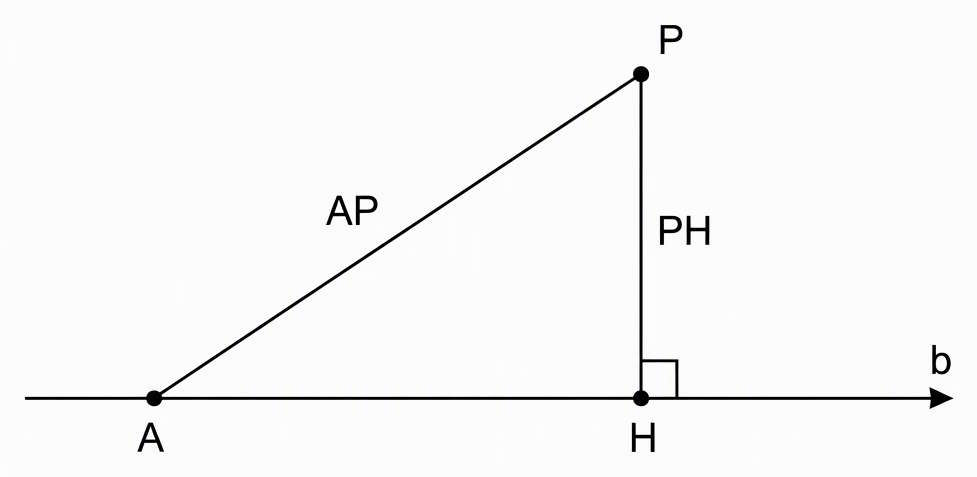
Calculation: Substitution gives the projection parameter. The denominator is nonzero because a line’s direction vector cannot be zero.
Check: The same parameter reproduces every coordinate of the foot, so it lies on the line. The required dot product is zero:
The cross-product formula measures the same perpendicular component: parallelogram area divided by base length gives its height. It is not a separate fact to memorise:
How do I distinguish skew, intersecting and parallel lines before finding distance?
Test the cross product first. If it is nonzero, test the scalar triple product to distinguish intersecting from skew lines. If the cross product is zero, take the parallel branch instead: the skew-line distance formula has a zero denominator.
Original teaching problem: Determine the relative position and shortest distance of:
Objects: Choose the displayed base points and take the displacement from the first to the second.
Condition and classification: A common perpendicular must be perpendicular to both directions.
The lines are nonparallel and noncoplanar, hence skew.
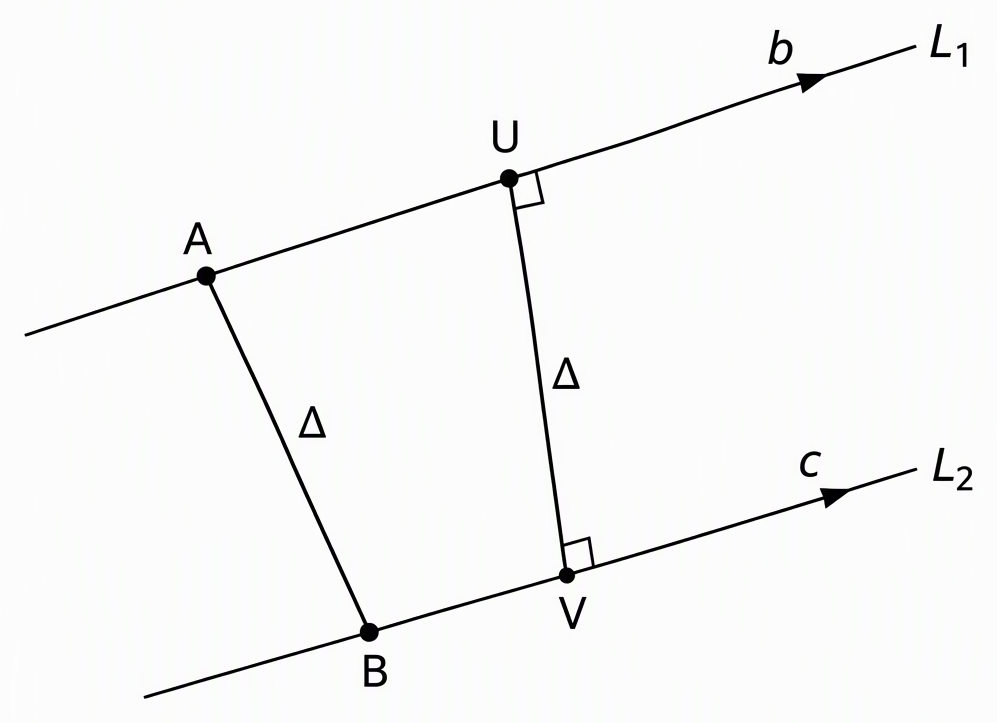
Calculation: Project the base-point displacement onto the common perpendicular.
Check: These parameters give endpoints whose joining vector is perpendicular to both lines:
Use these decision branches:
- Nonzero cross product, zero triple product: intersecting lines; shortest distance is zero.
- Nonzero cross product, nonzero triple product: skew lines; use the triple-product distance.
- Zero cross product: parallel directions; use point-to-line distance instead.
For the parallel branch:
A zero result means coincident lines. Substituting parallel directions into the skew-line formula produces an invalid zero denominator.
Continue with Distance Between Skew Lines: Solved Example. For single-topic practice, JEEnius daily practice problems provide a fresh ten-question set on a topic every day, with free sets daily.
How do I reflect a point in a plane using its normal?
Find the perpendicular foot first, then move the same distance beyond the plane along its normal. The foot is the midpoint of the original point and its reflection. This original extension problem is for readers whose target syllabus includes plane-based applications.
Problem: Find the reflection of:
Objects: Read the normal from the coordinate coefficients and calculate the signed plane residual.
Condition: The perpendicular foot lies along the normal from the point and satisfies the plane equation. Substitute that normal displacement into the plane equation:
Calculation: Double the displacement from the point to its foot.
Check: The midpoint lies in the plane, and the reflection displacement is parallel to its normal.
The point-to-plane distance also checks the displacement length. The original point and its reflection are twice that distance apart:
The common error is stopping at the foot. Subtracting one normal displacement finds the foot; subtracting twice that displacement finds the reflection:
What should I practise next, and how do I know I am ready?
Begin untimed, then move from single-type problems to mixed sets. You are ready for timed mixed practice when you can identify the objects, state the condition and explain why a formula applies before doing arithmetic, then verify the result independently.
- Practise extraction first. Read points, directions and normals from vector, parametric and coordinate forms. Rewrite symmetric line equations when necessary, especially when a direction component is zero.
- Practise one type at a time. Solve projection, line-classification and distance questions. Add plane applications only where relevant to your target syllabus. Write Objects → Condition → Calculation → Check on each solution.
- Mix the types and exceptions. Include parallel lines, coincident lines, zero direction components and points already lying on the object. Choosing the method must become part of the task.
Use official previous-year questions filtered against your current target syllabus. An older question’s presence in a book does not prove that its topic remains included.
Keep an error log with four labels:
- Representation: extracted the wrong point, direction or normal.
- Configuration or formula choice: missed the geometric case.
- Algebra: setup was correct, calculation failed.
- Missing verification: accepted an unchecked result.
Redo failed questions from a blank page before trying unseen variants. Use JEE Main Silly Mistakes: Five Steps to Reduce Errors to structure that review.
Keep deliberate reattempts in a separate queue: JEEnius practice mode offers topic sets that skip questions already seen, with free sets included, so use it for unseen practice, not mistake revision.
Frequently asked questions
In what order should I study 3D Geometry for JEE?
Start with vector subtraction, dot products, cross products and scalar triple products. Then study line equations and angles, projection and point-to-line distance, followed by relative positions of lines and shortest distance. Add plane-based applications only where your target year's official syllabus includes them.
How do I tell whether two lines are skew, intersecting or parallel?
First take the cross product of the two nonzero direction vectors: a zero result means parallel directions, including the coincident case. If the cross product is nonzero, take its dot product with the displacement between the base points. A zero scalar triple product means the lines intersect; a nonzero result means they are skew.
Should I study planes for JEE Main and Advanced?
JEE Main and Advanced do not have identical syllabi, so check your target year's official syllabus before allocating time to plane-based applications. Use jeemain.nta.nic.in for Main and jeeadv.ac.in for Advanced. An older plane question in a practice book does not establish that the topic remains included.
When should I start timed practice for 3D Geometry?
Start timed mixed practice when you can identify the objects, state the geometric condition and explain why your method applies before calculating. You should also be able to verify the result independently. Begin with untimed single-type problems, then mix configurations and exceptions such as parallel lines and zero direction components.