
How should I prepare Maths for JEE every day?
JEE Maths preparation must train you to produce solutions, not just follow them. Protect a daily slot for brief concept work, independent solving, exam-style practice and correction. Two Maths hours within four self-study hours is a sample allocation, not a universal requirement or score guarantee. Repair prerequisite gaps before hopping chapters, while keeping Physics and Chemistry active.
Close the solution and solve a fresh question. If you cannot choose the first step, understanding the explanation has not yet become independent solving.
What does a four-hour self-study timetable look like?
Use two separate Maths blocks: one for learning and independent attempts, the other for exam-style work and correction. This is an illustrative day after school or coaching and travel, not four hours to add regardless of your existing workload. Move the clock times to fit your day.
Clock time, task and required output:
- 16:30–17:30 | Physics: Current-topic practice and correction. Output: Written attempts and corrected reasoning for errors.
- 17:30–17:45 | Break: Leave the desk. Output: No study requirement.
- 17:45–18:45 | Chemistry: Current-topic recall and questions. Output: Recall checked against your source, followed by corrected answers.
- 18:45–19:30 | Dinner and rest: Eat and recover. Output: No study requirement.
- 19:30–20:30 | Maths block one: 20 minutes of concept or prerequisite repair, then 40 minutes of independent attempts. Output: A checked prerequisite skill and written attempts with help clearly marked.
- 20:30–20:40 | Break: Stop working briefly. Output: No study requirement.
- 20:40–21:40 | Maths block two: 40 minutes of syllabus-aligned previous-year or exam-style questions, then 20 minutes of correction. Output: Checked answers and a specific repair task.
The self-study total excludes meals and breaks:
If the Maths topic is entirely new, use graded basic questions in the second block. Do not force previous-year questions before you understand the basic methods.
Shift these blocks around school and coaching without cutting sleep. Coaching homework can occupy the relevant subject block; do not count that same homework again as a separate obligation.
On a crowded school day, use a proposed two-hour fallback: 60 minutes Maths, 30 minutes Physics and 30 minutes Chemistry. Keep independent solving and correction inside the shorter Maths slot.
Droppers should add work against a diagnosed need, such as weak trigonometric manipulation or incomplete Physics practice. Do not copy a longer timetable without identifying what the extra block should fix.
How should I divide study time between Maths, Physics and Chemistry?
Start with Maths at 50% of self-study time and Physics and Chemistry at 25% each if Maths needs extra independent practice. This is a starting recommendation for that need, not a universal split. Use the previous week’s attempts and corrections to decide whether to keep it.
JEE Main’s current pattern gives each subject 25 questions and 100 marks. Maths does not carry more marks than Physics or Chemistry, so marks allocation cannot justify giving it half your study time.
Keep these kinds of work active:
- Maths: Daily independent method selection and algebraic practice to maintain fluency.
- Physics: Numerical practice, model selection and checking assumptions.
- Chemistry: Recall alongside conceptual and numerical problem solving.
If Maths questions remain unfinished because you cannot use functions correctly, preserve the slot but replace some difficult practice with prerequisite repair. More time on questions whose prerequisites you lack is not the correction.
If Maths is becoming reliable while Physics corrections or Chemistry recall are slipping, reallocate a block. Keep all three subjects in the weekly plan rather than abandoning another subject to improve Maths.
To fit this routine into a larger preparation cycle, use How to Prepare for JEE Main 2027: A Four-Month Plan.
Study time is not examination time. Giving Maths half your self-study hours does not mean automatically giving it half of JEE Main’s 180-minute paper. Test subject order and time allocation through full mocks.
Why does a Maths timetable fail even when I follow the hours?
A timetable fails when lectures, copied solutions and repeated explanations replace independent attempts. Check what you produced during the slot: written reasoning, identified errors and successful reattempts. Before adding hours, identify which habit below is consuming the time already available and apply its matching correction.
- Watching lectures throughout the slot: Make written attempts before deciding that another explanation is necessary. Use the attempt to identify the exact concept you need explained.
- Opening the solution when the first method fails: Record what you tried and where it stopped. Seek the smallest useful hint, then close it and continue.
- Counting copied solutions as solved questions: Mark copied, hinted and immediately repeated questions separately from independent solutions. Reattempt them later without help.
- Starting calculus with shaky functions or algebra: Repair the precise missing skill, such as domain restrictions or factorisation. Do not restart the entire calculus chapter whenever one prerequisite fails.
- Turning an unfinished day into late-night debt: Resume the next scheduled block. Move only the essential unfinished task and drop lower-priority extras rather than cutting sleep.
- Collecting books and question banks: Use one main learning source, one practice sequence and previous-year questions before adding material. Add a source only when you can name the gap it fills.
- Judging progress by desk hours: Parents can check independent solutions, unresolved errors and completed review instead. A corrected misconception is better evidence than another hour of passive video watching.
Which Maths topics should I study first for JEE?
Choose the next topic using syllabus coverage and prerequisite readiness, not a guessed weightage list. Start from the current official syllabus for your target exam. For JEE Main, check jeemain.nta.nic.in; for Advanced, use its official syllabus. Classify each topic by what you can solve, not whether its lectures are complete.
Use three working categories:
- Unstudied: You have not learned the basic definitions and methods.
- Understood but unreliable: Explanations make sense, but independent attempts break down.
- Independently solvable: You can handle unseen basic questions without hints and explain your method.
Dependencies help locate the next repair. Algebraic manipulation, functions and graphs support limits and differentiation. Differentiation supports applications of derivatives, while integration methods support definite integrals and area problems.
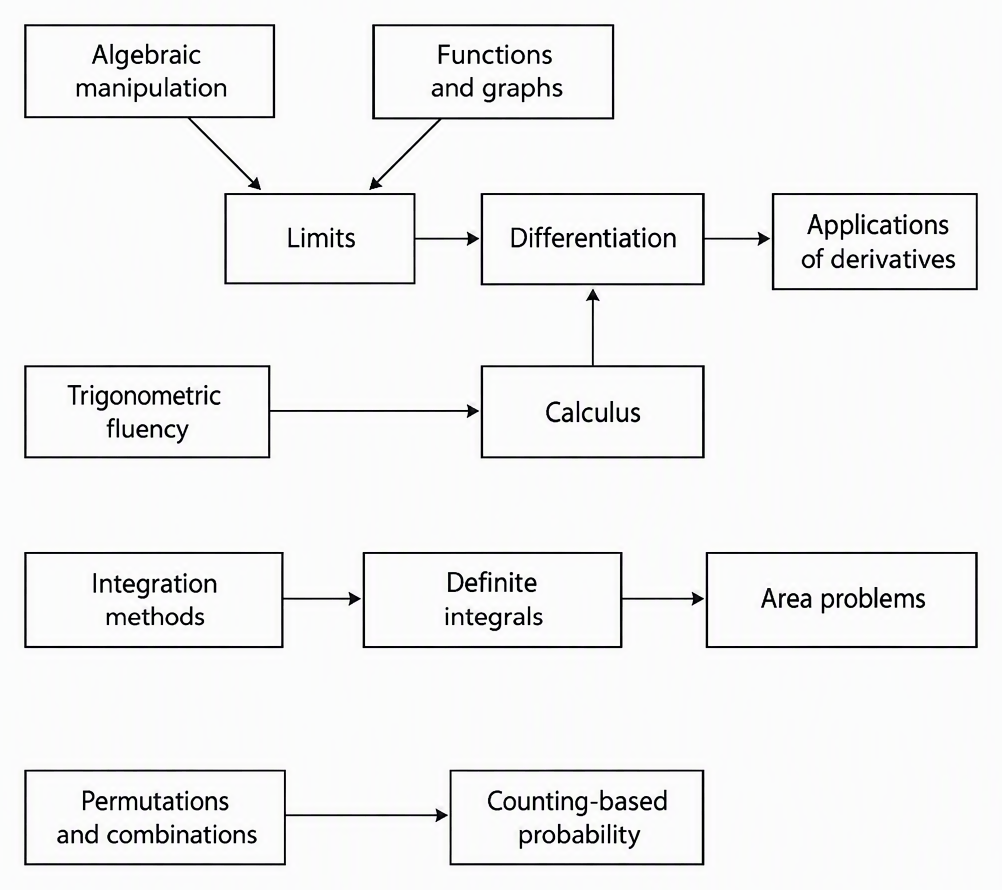
Trigonometric fluency also supports calculus, and permutations and combinations supports counting-based probability. These are learning dependencies, not chapter-wise marks forecasts.
Not every branch must wait for calculus. Coordinate geometry and vectors/3D geometry can have separate blocks once their own prerequisites are ready and the topics fit your target syllabus.
Adjust the plan to your stage:
- Class 11: Keep pace with the current course and repair foundation gaps promptly.
- Class 12: Maintain current work while scheduling one specific Class 11 gap.
- Droppers: Diagnose through written attempts before replaying the entire lecture sequence.
Keep one current topic and one bounded repair task active. “Practise domain restrictions in composite functions” is workable; “finish all weak Maths” is not.
Mark a topic reliable only when you can solve unseen basics, explain the method and handle mixed questions after a gap. A completed playlist is not that evidence, and no short chapter list guarantees a particular score.
How should I practise a chapter so I can solve its questions in a test?
Use this sequence: worked example, independently attempted similar question, unseen variant, then mixed practice where the chapter or method is not announced. Remove support at each stage. A successful attempt means choosing and completing the method yourself, not recognising steps you have just read in a solution.
Before calculating, write the given conditions, required result and why your chosen method fits. Check domains, signs and possible extraneous roots where relevant. Reject answers that violate the original restrictions.
For counting problems, ask: Does order matter? Can objects repeat? Do the cases overlap? Suppose four distinct students are available, and you must appoint a captain and a different deputy. Swapping the students changes the outcome because the roles differ; repetition is forbidden.
If the task were simply to select two representatives with identical roles, each pair would have been counted twice:
The wording determines whether order matters. Use Permutations and Combinations JEE 2026: Why 48, Not 72? as a related worked discussion, then close the explanation before trying another question.
Classify failed attempts and match the repair:
- Concept gap: Revisit the specific definition or result, then attempt a basic question using it.
- Method-selection gap: Compare possible methods and write the clue that selects one.
- Algebra/calculation error: Do focused written drills and check intermediate steps.
- Missed condition: Rewrite the restrictions before solving and verify the final answer against them.
- Time-management problem: Identify where progress stopped, then practise leaving and returning during timed mixed work.
An immediate redo checks comprehension. A delayed, closed-solution attempt checks retention. Record them separately.
For optional unseen topic practice, JEEnius practice mode offers sets that skip questions you have already seen, with free sets included. That supports fresh attempts, not deliberate revision of old errors.
The same workflow works on paper: record the question source, independent or assisted status, failure type and next review day. Keep solutions covered during review, and judge the attempt before checking the answer.
How can I tell each week whether my Maths is improving?
Replace the usual Maths blocks on one day with a 60-minute mixed test and a separate 60-minute review. Do not add two more hours. Test studied topics first if coverage is limited; move to full-syllabus papers when the results can diagnose solving problems rather than mainly expose unstudied chapters.
Keep a compact weekly record:
- Attempted, correct, wrong and unattempted: Record all four counts.
- Stalled time: Record minutes spent on attempts that stopped progressing.
- Delayed reattempts: Record how many old errors you solved independently.
- Failure types: Separate missing knowledge from method, algebra, condition and timing errors.
Define attempted-question accuracy consistently:
Do not impose a universal accuracy target. Compare tests alongside their coverage and difficulty, not just their percentages.
Use the evidence to change next week’s work:
- Repeated concept failures: Schedule prerequisite repair.
- Untimed success but timed failure: Increase mixed timed work and practise moving on.
- Repeated algebra errors: Use focused written drills with intermediate checks.
Under JEE Main’s current marking scheme:
Its 75-question pattern has no optional question selection within sections. That does not make blind guessing sensible; an unattempted question still scores zero.
Use full 180-minute computer-based Main mocks periodically to test subject order and time allocation. A Maths notebook alone cannot test switching between three subjects under one clock.
Advanced requires separate preparation: two compulsory three-hour papers, with question types and marking schemes that vary by year. Practise multi-concept problems and read each paper’s instructions rather than importing Main’s pattern. For a future attempt, treat these formats as expectations based on current rules, and check the official instructions for changes.
Finish the review by scheduling the exact prerequisite, method-selection exercise or written check that the test exposed. A recorded score without a changed task is an incomplete review.
Is two hours of Maths every day compulsory?
No. It is the sample allocation for a student who needs extra Maths practice within a four-hour self-study day. On crowded days, use the shorter plan and protect independent attempts rather than preserving the clock at the cost of sleep.
How many Maths questions should I solve daily?
Choose enough to fill the solving blocks while leaving correction time. A fixed count cannot account for question difficulty, current understanding or the amount of help used, so record attempt quality rather than chasing a quota.
What should I do if I understand solutions but cannot start questions?
Write the conditions and required result, then attempt a graded similar question without looking back. If you still cannot begin, identify whether you lack a concept or cannot recognise when to use it; those need different repairs.
For delayed review, the JEEnius mistake notebook automatically saves every question answered incorrectly and returns it at 1, 3, 7 and 14 days until you answer it correctly three times. It is free and unlimited; a dated paper notebook can support the same review habit.
Choose tomorrow’s current topic, identify one prerequisite gap and put the first independent-solving block on your timetable.
Next step: practice mode on JEEnius and practise a topic in sets that skip questions you have already seen (free sets included).
Frequently asked questions
How many hours should I study Maths daily for JEE?
Two Maths hours within a four-hour self-study day is a sample allocation for students who need extra Maths practice, not a compulsory target. On crowded days, a two-hour fallback can allocate 60 minutes to Maths and 30 minutes each to Physics and Chemistry. Preserve independent solving and correction without cutting sleep.
How many Maths questions should I solve daily for JEE?
Choose enough questions to fill your solving blocks while leaving time for correction. A fixed quota ignores difficulty, your current understanding and how much help you used. Record independent, hinted and copied attempts separately rather than treating them as equal progress.
Why can I understand Maths solutions but not solve questions myself?
Following an explanation does not establish that you can choose and complete a method independently. Write the given conditions and required result, then attempt a graded similar question with the solution closed. If you still cannot start, identify whether the problem is a missing concept or difficulty recognising which method applies.
How do I track my progress in JEE Maths each week?
Replace one day's usual Maths blocks with a 60-minute mixed test and a separate 60-minute review. Record attempted, correct, wrong and unattempted questions, stalled time and independently solved delayed reattempts. Compare results alongside coverage and difficulty, then schedule specific repairs for the errors the test exposes.