
How should I prepare for JEE Main 2027 with roughly four months left?
Start your JEE Main 2027 preparation with a diagnostic paper, then combine daily Physics, Chemistry and Mathematics practice with targeted backlog repair and scheduled revision. Try 3 focused self-study hours on school-and-coaching weekdays, plus longer weekend blocks, as a sample workload, not a requirement for success. Aim for the expected January session; treat April as a second opportunity, not permission to postpone.
The expected January and April 2027 windows follow the established session pattern. Exact dates and registration status are not verified here: check the official NTA site, jeemain.nta.nic.in. This plan promises neither a percentile nor complete syllabus coverage.
What does a 27-hour weekly timetable look like around school and coaching?
Use 15 self-study hours across Monday to Friday and 12 across the weekend. The sample assumes school from 08:00–14:00, coaching from 16:00–18:00, and sleep from 22:00–06:00. These are illustrative timings, not universal school hours. If Saturday has school or coaching, redistribute or reduce the weekend blocks rather than force an impossible total.
Each entry lists day, clock time, task and net self-study duration. Net time excludes breaks and attendance.
- Monday–Friday | 06:00–06:45 | Chemistry | 45 minutes: Recall, calculations or reaction practice, chosen the previous evening.
- Monday–Friday | 18:30–19:30 | Mathematics | 60 minutes: Independent problem solving, including relevant coaching homework.
- Monday–Friday | 20:00–21:00 | Physics | 60 minutes: Concept application and numerical problems.
- Monday–Friday | 21:00–21:15 | Due error reattempts | 15 minutes: Rotate subjects according to which questions need another attempt.
- Saturday | 09:00–10:30 | Mathematics | 90 minutes: Longer problem sets and failed setups.
- Saturday | 11:00–12:30 | Physics | 90 minutes: Mixed numerical practice and concept repair.
- Saturday | 14:00–15:30 | Chemistry | 90 minutes: Branch-specific practice and NCERT revision.
- Saturday | 16:00–17:30 | Backlog repair and error review | 90 minutes: Address the week’s most important unfinished task.
- Sunday | 09:00–12:00 | Computer-based mock | 180 minutes: Take one uninterrupted paper.
- Sunday | 14:00–16:00 | Mock analysis | 120 minutes: Review wrong, skipped and slow correct answers.
- Sunday | 16:30–17:30 | Reattempts and next-week planning | 60 minutes: Reattempt selected errors and schedule delayed checks.
That gives 3 hours each weekday, 15 across five weekdays, 6 on Saturday and 6 on Sunday: 27 hours weekly. Coaching attendance is separate. Coaching homework can occupy the relevant subject block; it must not become an automatic extra workload after these hours.
Reserve the remaining gaps for breakfast, travel, lunch, rest, dinner and winding down. A longer commute means reducing or moving a study block, not cutting the eight-hour sleep window. Keep the last part of the evening free rather than filling every spare minute.
For crowded weekdays, use 45 minutes per subject plus 15 minutes of error review, totalling 2.5 hours. Keep all three subjects present and reduce the scope of each task.
Droppers can use three 90-minute subject blocks plus 90 minutes of revision and analysis, totalling 6 net hours daily. Separate them with meals and breaks. Add time only after the planned work and its review are complete.
These are recommended study allocations, not official figures or evidence-backed minimums. Pick the version you can repeat through an ordinary week, including its tiring days.
How should I divide time between Physics, Chemistry and Mathematics?
Practise all three subjects, then shift time towards the weakness your work reveals. The current Paper 1 pattern gives each subject 25 questions and 100 marks. Ignoring one sacrifices an equally weighted part of the paper. Begin weekdays with Mathematics for 60 minutes, Physics for 60 minutes and Chemistry for 45 minutes, plus 15 minutes of rotating error review.
Treat this split as a starting hypothesis. It does not mean Chemistry is always easier or needs less work.
- Mathematics: Protect uninterrupted solving time. When you cannot solve a question, identify the missing setup: choosing variables, translating a condition or selecting a method. Reading the solution prepares you for another attempt; it does not prove you can solve it.
- Physics: Connect each equation to the physical situation, assumptions and units. Use diagrams where the arrangement matters, then solve mixed numerical problems that require you to choose the governing principle yourself.
- Chemistry: Separate Physical Chemistry calculations, Organic Chemistry reaction logic and Inorganic Chemistry recall. Use NCERT closely where relevant, but do not mistake repeated reading for reliable recall. Follow the branch-specific approach in JEE Chemistry Preparation: Study Plan for All Three Branches.
On Sunday, inspect concept gaps, repeated errors and time spent on correct solutions. Move one 30-minute block next week towards the largest repairable weakness, preferably within Saturday’s flexible allocation. Preserve daily practice in every subject.
A repairable weakness is specific enough to act on: choosing the correct forces, handling a calculation step or recalling a reaction condition. “I am bad at Physics” is not a scheduling instruction.
Choose chapter priorities by prerequisites and demonstrated weakness. I would use that evidence over unsupported chapter-weightage rankings or marks-per-hour claims: it identifies what is blocking your work rather than promising easy marks.
What mistakes can make this timetable fail?
The main failures are counting attendance as independent practice, postponing current work until the backlog disappears, and skipping test analysis. Protect solving, reattempts and review before adding lectures. When work spills over, replace a lower-priority task rather than turning every missed block into tomorrow’s extra burden.
- Counting the same work twice: School and coaching attendance are not independent retrieval or problem solving. Count completed homework once, inside its subject block. A lecture followed by copied examples is not equivalent to a fresh problem set.
- Clearing all Class 11 backlog first: This stops current Class 12 work and creates another backlog. Repair the prerequisite blocking today’s chapter, then continue current work alongside it.
- Calling watched solutions “solved”: Close the solution and reattempt the question independently after a delay. Mark the error repaired only when you can reproduce the reasoning without help.
- Taking mocks without analysis: Protect Sunday’s analysis block. Carry unfinished analysis into the next repair block instead of taking another test.
- Doubling tomorrow after a missed day: Move the highest-priority unfinished task to Saturday. Remove or defer a lower-priority task so the weekly load remains realistic.
- Treating ten questions as the whole day: A short set is one component, not a substitute for concept work, previous-year questions and revision. JEEnius daily practice problems offer a fresh ten-question set on a topic every day, with free sets daily; use one inside a subject block.
- Borrowing time from sleep and meals: Preserve the sample’s eight-hour sleep window and travel and meal buffers. Shorten the task list before shortening sleep.
- Reading “compulsory” as “compulsory guesses”: The current paper has no optional question selection, including within Section B. That does not require blind guessing: an unattempted answer scores 0, while a wrong answer scores minus 1.
What should I do from September 2026 to the expected January and April 2027 sessions?
Use late September for diagnosis, October for prerequisite repair alongside current work, November for mixed practice, and December onwards for full-paper practice and review. This recovery plan targets the expected January 2027 session, based on the established session pattern, not a fresh two-year preparation cycle. Keep the expected April opportunity in view without postponing preparation for the first session.
- First week, late September: Take one previous-year paper under timed, computer-based conditions. Use the official syllabus available through NTA to build a chapter checklist. Mark topics as unseen, conceptually weak or ready for timed practice. Separate unanswered questions caused by missing knowledge from those skipped because time ran out.
- October: Continue the syllabus being taught while repairing prerequisites exposed by the diagnostic. If current work fails because an earlier idea is missing, schedule that idea first. Choose backlog topics by dependency and demonstrated weakness, not an invented high-weightage list. Give each repair block a bounded target.
- November: Increase mixed-topic practice and close the highest-priority gaps. Count independently solved questions and successful delayed reattempts as evidence of progress. Lecture completion alone does not show that you can retrieve a method under time pressure.
- December to the expected January session: Emphasise full papers, analysis and repeated revision. Keep selective concept repair where it removes a recurring obstacle. A blanket ban on new learning can leave a small, fixable gap untouched.
- Final two weeks before the confirmed exam date: Stabilise your sleep and practice timing around the confirmed examination instructions. Review the error log, repeat essential recall work and avoid changing your entire resource set.
Start with one full mock each week. Increase to up to two only when both can receive proper analysis. A second mock must replace existing work: combine Saturday’s morning study time into an uninterrupted paper block and reallocate afternoon blocks to analysis, rather than adding another five hours.
After the expected January session, use that experience to identify weaknesses for the expected April opportunity. Under current rules, candidates may sit both sessions, and the better score counts; verify this in the 2027 bulletin. For Class 12 students, protect board preparation by combining overlapping concept work while retaining board-style written practice.
Class 11 readers should use this study-and-review method for foundation building. Check eligibility in the official bulletin rather than assuming that every Class 11 student should target the 2027 attempt.
How do I use practice and mock errors to decide next week’s plan?
Run a repeatable cycle: study one bounded concept, solve independently, attempt relevant previous-year questions, classify errors and reattempt after a delay. Use the results to choose next week’s repair blocks. Analyse skipped questions and correct but slow solutions too: wrong-answer counts alone cannot explain where your paper time went.
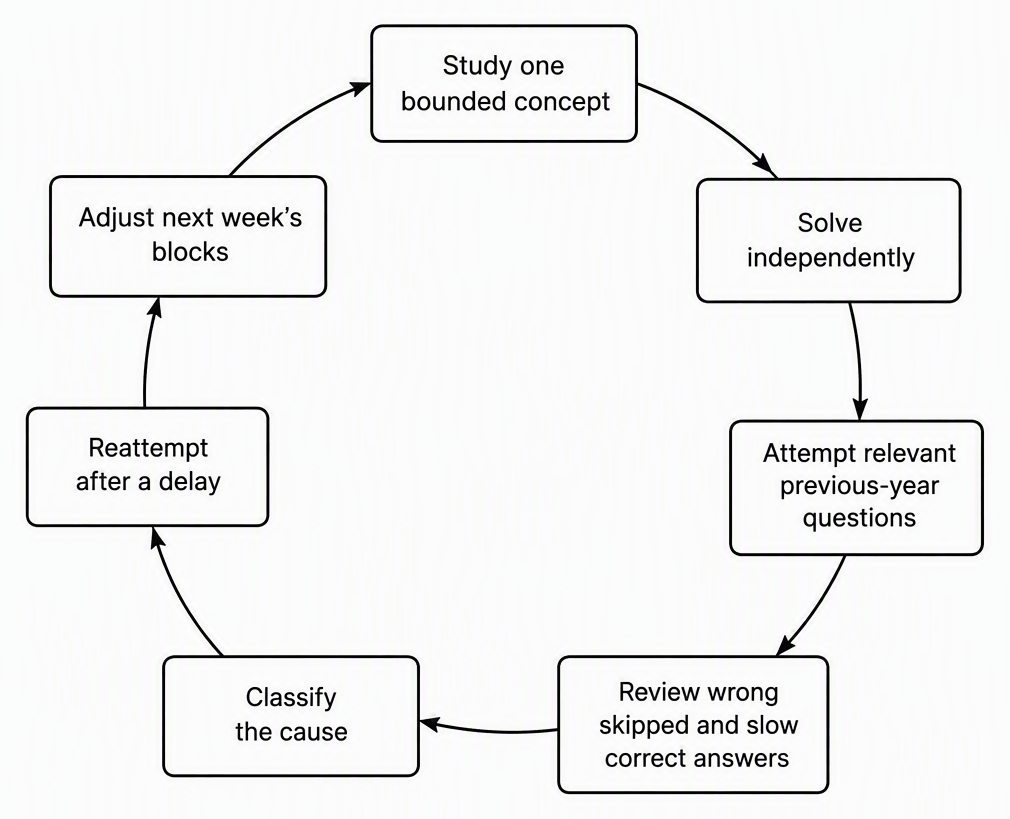
Use the current Paper 1 baseline for full-paper practice: computer-based, 180 minutes, 75 questions and 300 marks. Each subject contains 20 single-correct MCQs and 5 numerical-answer questions. Correct answers earn 4 marks, wrong answers lose 1 mark, and unattempted questions score 0; Section B has no optional selection. Check the 2027 bulletin for any changes.
Use this reusable worksheet for each topic set. Fill it from your own work rather than estimating afterwards.
- Topic: Record the exact concept or subtopic.
- Attempted questions: Count independent attempts, excluding copied solutions.
- Correct answers: Count answers checked against the key.
- Time taken: Record the set duration and flag unusually slow questions.
- Error type: Assign a cause using the categories below.
- Next action: Specify the repair task and when you will do it.
Match the repair to the cause. “Practise more” is too vague to schedule.
- Concept: Relearn the missing principle, explain when it applies and solve a fresh application.
- Recall: Retrieve the fact, formula or reaction condition without notes, then check it.
- Calculation: Locate the faulty step and practise that operation, including signs and units.
- Question-reading: Identify the missed condition and write what the question actually asks before solving again.
- Time-management: Examine question selection and method length, then practise a bounded timed set.
Repeated equation-setup errors in Physics should trigger a concept-and-setup repair block. Slow but correct Mathematics solutions should trigger timed practice and method comparison, not another full lecture.
Start today:
- Choose the applicable timetable: standard, compressed or dropper.
- Schedule the diagnostic paper in an uninterrupted three-hour block.
- Identify the first repair topic from that paper.
- Reserve Sunday’s review block before filling the rest of next week.
For delayed reattempts, use JEEnius’s mistake notebook: every question you get wrong is saved automatically and returned at 1, 3, 7 and 14 days until you get it right three times. It is free and unlimited. Automatic wrong-answer tracking complements, but does not replace, your analysis of skipped questions and slow correct answers.
Next step: the mistake notebook on JEEnius and every question you get wrong is saved automatically and returned to you at 1, 3, 7 and 14 days until you get it right three times (free, unlimited).
Frequently asked questions
How should I prepare for JEE Main 2027 with four months left?
Start with a timed diagnostic paper and classify topics as unseen, conceptually weak or ready for timed practice. Repair prerequisites alongside current work, then increase mixed practice, full papers and revision. Target the expected January session rather than postponing preparation until April, and verify dates through NTA.
How many hours should I study daily for JEE Main 2027?
A sample schedule around school and coaching uses three focused self-study hours each weekday and six hours each weekend day, totalling 27 hours weekly. Crowded weekdays can use 45 minutes per subject plus 15 minutes of error review, while droppers can start with six net hours daily. These are adaptable allocations, not minimum requirements for success; reduce the workload before cutting sleep.
How do I clear my Class 11 backlog while studying Class 12?
Repair the Class 11 prerequisite that is blocking your current chapter, then continue Class 12 work alongside that repair. Give each backlog block a specific, bounded target rather than trying to finish every old chapter first. Choose priorities from diagnostic results and repeated errors, not unsupported chapter-weightage rankings.
How many mock tests should I take each week for JEE Main?
Start with one full mock each week and increase to up to two only when you can analyse both properly. Review wrong answers, skipped questions and slow correct solutions, then schedule targeted repairs and delayed reattempts. A second mock must replace existing study blocks rather than become extra workload.