
How should you prepare Chemistry for JEE?
Effective JEE chemistry preparation uses three methods: solve Physical Chemistry, reason through Organic Chemistry, and retrieve Inorganic Chemistry facts from memory. Repeat this cycle: learn a small topic, answer questions without notes, diagnose errors, and revisit weak points. Use NCERT as a core reference, especially for factual coverage, not as a substitute for numerical and application practice. The sample plan starts with a proposed 90 minutes on regular study days, not a universal requirement or score guarantee.
What Chemistry timetable fits around Physics and Mathematics?
Use this example if school or coaching finishes before evening. Every duration is a proposed allocation, not an exam statistic. It provides 3 hours 30 minutes of focused self-study, including 90 minutes of Chemistry. School and coaching are not included in these hours.
- 17:00–18:00: Physics, 60 minutes. Work on the assigned topic or homework; solve a representative problem without seeing the method.
- 18:00–18:15: Break, 15 minutes. Leave the desk; return ready for Mathematics.
- 18:15–19:15: Mathematics, 60 minutes. Complete a defined question set; reattempt a question that previously required help.
- 19:15–20:00: Dinner and rest, 45 minutes. Eat and pause study; do not convert this into another lecture slot.
- 20:00–20:40: Chemistry concepts, 40 minutes. Learn one small topic; explain the relation, reaction choice or trend without reading.
- 20:40–21:10: Chemistry questions, 30 minutes. Attempt questions without notes; mark every place where you needed help.
- 21:10–21:30: Chemistry recall and due error revision, 20 minutes. Reproduce facts accurately without opening the book or solve scheduled retests before checking answers.
Rotate the main concept-and-question block across the branches. Keep the daily revision block available for any branch whose review is due, not just that evening’s main branch.
- Monday and Thursday: Physical Chemistry.
- Tuesday and Friday: Organic Chemistry.
- Wednesday and Saturday: Inorganic Chemistry.
Reserve Sunday, 09:00–11:00, for Chemistry: a proposed 60-minute mixed practice set, 40-minute analysis and 20-minute block for previously scheduled error retests. This is a learning session, not an official exam-duration simulation.
Six 90-minute days contribute nine hours; Sunday adds two hours, making 11 hours of Chemistry per week. Move these clock times around your actual commitments. If travel or coaching pushes dinner later, shorten or relocate a block rather than copying this schedule at the cost of sleep.
How much time should you give PCM and each Chemistry branch?
The proposed weekday split of Physics 60 minutes, Mathematics 60 minutes and Chemistry 90 minutes is a temporary Chemistry-repair allocation. JEE Main gives each subject 100 marks, but equal marks do not demand identical study time when weaknesses differ. Keep daily contact with Physics and Mathematics while repairing Chemistry, then reassess the split using your practice record.
Coaching homework belongs inside this self-study budget. If Chemistry homework takes the question block, use it as that block’s practice. Do not add assignments invisibly after allocating the available hours.
Each Chemistry branch gets two main blocks to prevent neglect before you have evidence to adjust the plan. Recall and error correction continue throughout the week: yesterday’s Physical Chemistry error may need attention on an Organic Chemistry day.
Adjust time according to the failure, rather than prescribing more reading for every weakness:
- Missing knowledge: Relearn the specific idea and explain it without notes.
- Slow calculation: Practise short calculations with units and organised working.
- Forgotten information: Use closed-book retrieval followed by correction.
Move one concept-and-practice block towards a branch showing repeated prerequisite failures. Do not delete another branch’s revision to make room.
Use Main previous-year questions for Main-style demands and Advanced questions for Advanced preparation. Advanced has variable question types and marking, so read each paper’s instructions rather than applying Main’s pattern.
Which habits can make this Chemistry plan fail?
Counting study activity as learning without an independent check makes this plan fail. A finished lecture, highlighted page or copied solution does not show that you can answer a question unaided. Use these failure signals to change the next study block instead of adding more hours.
- Passive NCERT rereading: The warning sign is recognising a paragraph but failing to explain it with the book closed. Replace another reading with a written recall check, then reopen only to correct omissions.
- Counting watched solutions as solved questions: The warning sign is needing the same hint again. Schedule a later unaided attempt before considering the method learned.
- Collecting books and lecture series: The warning sign is several half-finished sources covering the same chapter. Use NCERT, one primary teaching source, one question source and relevant previous-year questions before expanding.
- Memorising Organic reaction lists: The warning sign is choosing the wrong product when conditions change. Record the substrate, reagent and conditions, then repair the reasoning behind the transformation.
- Postponing Inorganic Chemistry: The warning sign is forgetting material that felt secure last month. Retain short retrieval sessions even when another branch takes the main block.
- Following old chapter lists or weightage predictions: The warning sign is choosing chapters from unsupported claims rather than syllabus coverage and errors. Check the target year’s Main syllabus at jeemain.nta.nic.in and Advanced syllabus separately at jeeadv.ac.in.
- Letting backlog consume revision: The warning sign is repeatedly postponing scheduled retests. Replace a named learning block when necessary; do not silently extend the day or erase all revision.
How should you study Physical, Organic and Inorganic Chemistry differently?
Physical Chemistry needs model selection and calculation, Organic Chemistry needs reasoning about transformations, and Inorganic Chemistry needs understanding plus deliberate recall. NCERT supports all three, but reading it alone does not test these skills. Check numerical work through unaided problems, reaction reasoning through changed conditions, and factual memory through closed-book prompts.
How do you turn Physical Chemistry theory into correct numerical answers?
Learn what a relation means, its units and the conditions under which it applies before practising substitutions. Work through one representative example, close the solution, then attempt questions with changed data or wording. Check whether you can choose the relation yourself, not whether you remember where numbers appeared in an example.
Start with mole calculations and concentration terms before depending on them in later numerical chapters. This is prerequisite-led sequencing, not an official priority list or permission to omit other syllabus topics.
For a wrong concentration answer, identify the earliest broken step:
- Incorrect mole calculation: Revisit the conversion from mass to amount of substance and check the molar mass used.
- Incorrect unit conversion: Practise writing the given unit and required unit before calculating.
- Wrong concentration definition: State what the denominator represents. Molarity uses solution volume in litres; molality uses solvent mass in kilograms.
Repair the failed step rather than rereading the whole chapter for a single conversion mistake. Then attempt another question that tests that step without showing the method.
Use NCERT to establish definitions and textbook reasoning. Numerical fluency still requires unaided questions, including unfamiliar wording and relevant previous-year applications.
How do you learn Organic Chemistry without memorising every reaction blindly?
Establish general organic chemistry, resonance, inductive effects, acidity and basicity, and isomerism before attempting large reaction networks. These ideas help explain why a reactive site behaves as it does. Memorisation should preserve reagents, conditions and exceptions rather than replace reasoning.
Write reaction notes using five fields: starting functional group, reagent, conditions, transformation and reasoning where applicable. Keep syllabus-specific exceptions explicit instead of forcing every named reaction into one explanation.
Consider bromoethane under different conditions:
- With aqueous potassium hydroxide: Hydroxide acts as a nucleophile, favouring substitution to give ethanol under the usual textbook conditions.
- With alcoholic potassium hydroxide and heat: Basic conditions favour elimination, giving ethene under the usual textbook conditions.
Recognising “bromoethane” alone cannot decide the answer. The reagent and conditions affect whether substitution or elimination is favoured, so read both before predicting the product.
After studying an example, cover the product and explain your choice. Then change a condition or compare a different substrate and identify what reasoning needs to change.
NCERT anchors the relevant reactions and facts. Application practice checks whether you can connect those facts when the question does not resemble the page you revised.
How do you remember Inorganic Chemistry for longer?
Turn relevant NCERT material into closed-book prompts, then revisit the prompts after a delay. First check the material against the current official syllabus for your target exam. Convert trends, exceptions, equations and observations into questions that require you to produce an answer, not recognise a highlighted line.
Separate understanding from deliberate memorisation:
- Explainable trends: Use periodic trends and chemical bonding to explain the broad behaviour.
- Exceptions: Record the exact exception and its explanation where available.
- Equations and observations: Retrieve the stated products, conditions or colour before opening the book.
Understanding bonding reduces isolated memorisation, but it does not eliminate factual revision. If you remember a general trend but reverse an exception, revise that exception specifically.
NCERT is a core factual source; rereading alone does not prove readiness for unfamiliar applications. Across all three branches, call a chapter complete only after:
- Relevant syllabus coverage has been checked.
- Representative questions have been attempted unaided.
- Incorrect reasoning has been repaired.
- Recall has been tested after a delay.
How should questions and a mistake notebook decide tomorrow’s work?
Choose tomorrow’s Chemistry work from errors in today’s answers, including questions left unanswered. Keep a compact error record with four fields: topic, what went wrong, correction and next unaided retest. Label the error as conceptual, recall, calculation or question-reading. Use the label to decide whether to relearn an idea, retrieve a fact, check calculations or identify a missed condition.
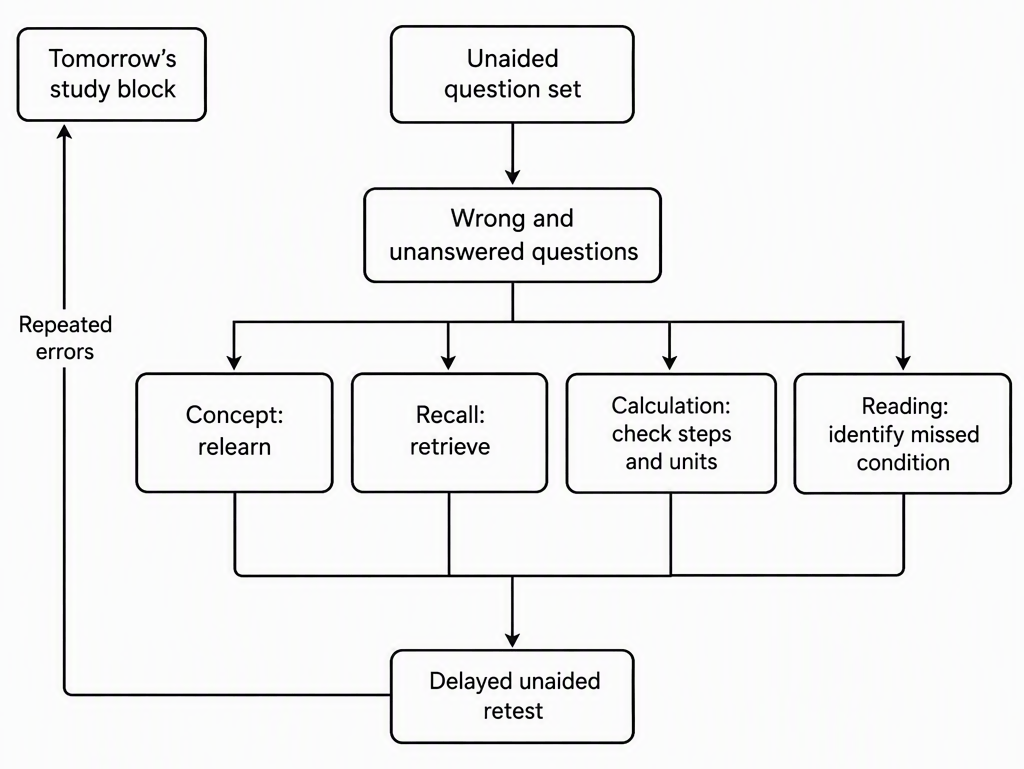
For example, “concentration, used solvent volume instead of solution volume, restate molarity definition, retest Thursday” gives you a repair instruction. “Silly mistake” does not.
Separate omissions caused by missing knowledge from those caused by time pressure. The former needs targeted learning; the latter may need faster calculation, better question selection or shorter working. Check which applies before assigning another lecture.
Use Sunday’s mixed set across previously studied topics, so the current chapter does not supply the method. Look for repeated error types, not merely a total score, and use that pattern to recover lost mock marks.
When scoring Main-style questions, award 4 marks for correct, deduct 1 for wrong and give 0 for unattempted. Main has 25 questions per subject, comprising 20 single-correct MCQs and five numerical-answer questions, without internal question choice. That is not a reason to guess every answer: wrong answers still lose marks.
As a practice option, JEEnius daily practice problems provide a fresh ten-question set on a topic every day, with free sets daily. Ten questions give you material to diagnose; they do not certify that a topic is complete.
How should Class 11 students, Class 12 students and droppers adjust this plan?
Keep the learning-and-retest cycle, but choose new learning according to current teaching and demonstrated gaps. With limited remaining time, prioritise syllabus-relevant prerequisites and errors found in practice, not unsupported “high-weightage” lists. Use these adjustments without building a separate timetable for every unfinished chapter.
- Class 11: Stay aligned with current teaching, secure prerequisites and use the daily revision block to retain earlier topics.
- Class 12: Keep current coursework moving. Assign a named learning block to a specific Class 11 gap, such as concentration definitions, rather than maintaining a vague second syllabus called “backlog”.
- Droppers: Begin with representative questions from previously studied chapters. Rebuild selectively where answers expose gaps; do not automatically replay every lecture.
For a shorter day, use this proposed 60-minute Chemistry fallback: 20 minutes of targeted learning, 25 minutes of questions and 15 minutes of recall or due retests. Reduce the topic size rather than removing the feedback step.
Start today:
- Verify the relevant official syllabus.
- Select one specific weak topic.
- Place its next study block on your timetable.
- Attempt a question set unaided and record the errors.
For ongoing retesting, JEEnius’s free, unlimited mistake notebook automatically saves every question you get wrong and returns it at 1, 3, 7 and 14 days until you answer it correctly three times. Put those due retests into the revision block you have already reserved.
Next step: practice mode on JEEnius and practise a topic in sets that skip questions you have already seen (free sets included).
Frequently asked questions
How many hours should I study Chemistry daily for JEE?
The sample plan proposes 90 minutes on six regular study days and a two-hour Sunday session, totalling 11 hours weekly. This is a temporary Chemistry-repair allocation, not a universal requirement. Adjust it around your weaknesses, school, coaching and sleep while maintaining daily contact with Physics and Mathematics.
Is NCERT enough for JEE Chemistry preparation?
NCERT is a core reference, especially for factual coverage, but reading it alone does not test numerical fluency or application skills. Add unaided numerical questions, reaction reasoning and closed-book factual recall. Use relevant Main or Advanced previous-year questions according to your target exam.
How do I study Organic Chemistry without blindly memorising reactions?
Build general organic chemistry, resonance, inductive effects, acidity and basicity, and isomerism before tackling large reaction networks. Record each reaction's starting functional group, reagent, conditions, transformation and reasoning where applicable. Test yourself by covering the product, explaining your choice and checking how changed conditions affect the answer.
How can I remember Inorganic Chemistry for longer?
Turn syllabus-relevant NCERT material into closed-book prompts and revisit them after a delay. Use periodic trends and chemical bonding to explain broad behaviour, while retrieving exceptions, equations and observations explicitly. Correct the specific fact you missed rather than rereading the entire chapter.
What should I write in a JEE Chemistry mistake notebook?
Record the topic, what went wrong, the correction and the next unaided retest. Label each error as conceptual, recall, calculation or question-reading so the next task addresses the actual failure. Include unanswered questions and distinguish missing knowledge from time pressure.