
How can I improve my JEE Main score by finding lost marks?
Take a timed mock, classify lost marks, repair recurring errors and test those repairs under timed conditions. For JEE Main score improvement, extra attempts help only when their scoring outcome raises your total.
Paper 1 has 75 questions, 300 marks and 180 minutes, with 25 questions and 100 marks each in Physics, Chemistry and Mathematics. Under this marking scheme, you can recover marks by getting more answers correct, reducing wrong answers or reaching questions you already know how to solve.
A concept gap needs learning; a missed condition needs a checking habit; a solvable question left unseen needs better time allocation. Diagnose the loss before adding study hours.
How do I build a marks-recovery table from my latest mock?
Record your own Physics, Chemistry and Mathematics marks, correct answers, wrong answers and blanks. Classify each doubtful or unsuccessful attempt, including guessed correct answers: they raise this test’s score without proving mastery. Use four columns in your notebook: test outcome, how to diagnose it, corrective action and what to check next time.
- Concept gap. Diagnose: You cannot explain the method without help. Action: Relearn the exact concept. Next check: Solve a fresh related question independently.
- Calculation or reading error. Diagnose: Your method works, but you mishandled a sign, unit or condition. Action: Write a specific check. Next check: See whether that trigger recurs.
- Uncertain attempt. Diagnose: Your answer depended on an unsupported assumption or guess. Action: Resolve the missing reasoning. Next check: Record whether doubtful attempts still lose marks.
- Solvable question left unattempted. Diagnose: Retry without notes or solutions and record the time. Action: Adjust selection or pacing if knowledge is sound. Next check: Count independently verified solvable blanks.
- Correct answer obtained by guessing. Diagnose: You cannot justify the answer. Action: Mark the concept unverified. Next check: Solve an unfamiliar related question.
Calculate raw marks from correct and wrong answers. Blanks contribute nothing:
These changes recover different numbers of marks:
Do not count every blank as recoverable. A solution looking obvious after reading it does not prove you could have produced it independently.
How are JEE Main marks different from percentile?
Raw marks come from your correct and wrong answers. The NTA percentile describes relative performance within the relevant exam shift. It is not percentage marks, and there is no fixed conversion from a score out of 300.
Normalisation does not mean every difficult paper receives a fixed marks bonus. Keep your preparation target on accuracy, question selection, syllabus command and performance within 180 minutes. Use jeemain.nta.nic.in for official scoring information rather than treating an online percentile estimate as a result.
Can the same marks give different percentiles across sessions and years?
The same raw marks can correspond to different percentiles across shifts, sessions and years because papers and candidate performance differ. January and April are sessions; each contains individual exam shifts, not one common paper.
Candidates may sit both sessions. The better total NTA score counts, not a combination of the best subject scores from different sessions. Compare mocks with similar coverage and difficulty: one easier paper is weak evidence, and a fixed marks increase cannot guarantee a particular percentile gain.
How do I repair an error instead of revising the whole chapter?
Prioritise recurring, repairable errors in your own record rather than restarting every chapter containing a wrong answer. An error that repeatedly costs marks and has a specific fix deserves attention before an isolated mistake with no clear pattern.
- For a concept gap: Revisit the relevant definition or method. Work through an example actively, covering the solution and producing each next step yourself. Then attempt fresh related questions without notes.
- For a calculation or reading error: Identify the precise trigger. If you missed a unit, add “convert units before substitution”; if you answered the wrong quantity, add “reread the requested quantity before submission.”
- For a solvable blank: Retry without the solution. If you still cannot find a route, it is not merely a time-allocation problem. If you can solve it, record how long it takes.
- For a guessed correct answer: Keep the concept marked unverified until you can explain the method and solve a fresh question independently.
For an optional example of checking assumptions and rate calculations, use Chemical Kinetics: Pseudo-First-Order Rate Error. Successful repair means solving a fresh related question independently, not recognising a solution you have already read.
How should I change my attempt strategy before attempting more questions?
Test a staged approach: attempt questions with a clear solution route before longer but tractable questions, then review flagged work if time remains. Choose your subject order from timed-test evidence, not from claims that Chemistry, Physics or Mathematics is always easiest.
- First pass: Attempt questions you can start confidently. Move on when you cannot identify a workable route.
- Second pass: Return to questions whose method you know but whose calculation needs more time.
- Final review: Check flagged signs, units, conditions and answer entries.
Having 75 questions in 180 minutes does not mean every question deserves equal time. Test whether your allocation reduces solvable blanks and rushed errors, rather than imposing a universal attempt target or rigid subject clock.
The absence of optional question selection does not make blind attempts compulsory. An unattempted question receives 0 marks. Both MCQs and numerical-answer questions award 4 marks for a correct answer and deduct 1 for a wrong answer.
How can I check whether my mock-test changes are working?
Start with a full-length test under the actual 180-minute limit, then complete the error audit before taking another full paper. Choose a small set of recurring error types, revise them and check each repair with fresh timed questions. Only then test the changes in a comparable mock.
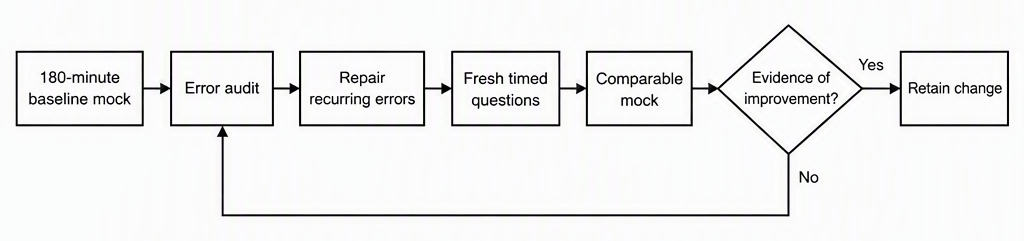
Compare these measures across comparable mocks:
- Total and subject-wise marks: Check where the change helped or hurt.
- Wrong answers: Check whether avoidable losses fell.
- Independently verified solvable blanks: Check whether selection and pacing improved.
Retain a strategy change only when the evidence supports it. More attempts and more study hours are not, by themselves, JEE Main score improvement.
For Class 11, track chapter-test progress separately from full-syllabus performance. Class 12 students and droppers should use full papers when their coverage makes them meaningful.
JEEnius offers full-length 75-question, 300-mark, 180-minute mocks with a scored per-subject breakdown, including free tests. You must maintain the error log yourself.
Next action: audit your latest test and identify the recurring mistake you will repair before the next mock.
Next step: full-length mock tests on JEEnius and sit a full 75-question, 300-mark, 180-minute paper and get a scored per-subject breakdown (free tests included).
Frequently asked questions
How can I improve my JEE Main score after a mock test?
Classify lost marks into concept gaps, calculation or reading errors, uncertain attempts and independently verified solvable blanks. Also flag guessed correct answers as unverified. Repair a small set of recurring errors, solve fresh related questions under timed conditions and test the changes in a comparable mock.
How many marks do I gain by turning a wrong answer into a correct one?
Turning a wrong answer into a correct one recovers 5 marks because the outcome changes from −1 to +4. Turning a blank into a correct answer gains 4 marks, while leaving an otherwise wrong attempt blank saves 1 mark.
Should I attempt more questions to increase my JEE Main score?
More attempts help only when their scoring outcome raises your total. Both MCQs and numerical-answer questions award 4 marks for a correct answer, deduct 1 for a wrong answer and give 0 for a blank. Prioritise questions with a clear solution route, then return to longer but tractable questions.
Does the same JEE Main score always give the same percentile?
No, the same raw marks can correspond to different percentiles across shifts, sessions and years because papers and candidate performance differ. NTA percentile measures relative performance within the relevant shift; it is not percentage marks. A fixed marks increase cannot guarantee a particular percentile gain.
How do I know if my JEE Main mock-test strategy is working?
Compare total marks, subject-wise marks, wrong answers and independently verified solvable blanks across mocks with similar coverage and difficulty. Check repairs using fresh timed questions before taking the next full paper. Retain a strategy change only when the evidence supports it, not merely because you attempted more questions.