
What order should I study Gravitation in for JEE?
- Check prerequisites, then repair only the missing skill. To study Gravitation for JEE, learn to choose the source model before the formula. Check whether you can draw a force diagram, add vectors, apply conservation of mechanical energy and use circular acceleration:
If one skill fails, revise it and solve a few focused questions. Do not restart all of mechanics to repair vector addition.
- Study the chapter in this order. Each stage supplies ideas needed for the next:
- Newton’s law and superposition.
- Gravitational field and potential.
- Spherical shells and uniform solid spheres.
- Variation of gravitational acceleration.
- Escape and radial motion.
- Circular satellites and Kepler’s laws.
Field is force per unit test mass and is a vector. Potential is potential energy per unit test mass and is a scalar:
The last relation gives the radial field component, taking outward as positive. A positive potential slope therefore means an inward field.
- Identify the source and region before writing equations. Decide whether the source is a point mass, thin shell or uniform solid sphere. Locate the particle inside or outside it; above a spherical planet, centre-distance is radius plus altitude:
Outside an isolated spherical source, use these expressions with potential zero at infinity. They are not the interior formulas for a uniform solid sphere:
Inside a thin spherical shell, the field vanishes and potential is constant. Inside a uniform solid sphere, field magnitude grows linearly with centre-distance:
- Choose the equation family from what is asked.
- Acceleration or equilibrium: field, force and vector addition.
- Speed, turning point or escape: potential and mechanical energy.
- Circular orbit: radial force balance, followed by energy if needed.
Check the motion as well as the requested quantity. A given speed does not make a radial launch an orbit problem.
- Write assumptions before substituting. State spherical symmetry, uniform density where required, negligible atmospheric drag and circular versus radial motion. Conserve mechanical energy only when no non-conservative work changes it.
- Check units, signs and limits. Field has acceleration units; potential has energy-per-mass units. Check the centre, surface and infinity where relevant. Zero field means zero local potential slope, not zero potential.
All examples below are original illustrative mathematics, not exam statistics or claimed previous-year questions.
How do I find field and potential inside a uniform planet?
Use uniform-sphere interior formulas inside the planet and point-mass formulas outside. Outer spherical layers contribute zero net field at an interior point, but their potential contributions remain.
Problem: A non-rotating uniform solid planet has the mass and radius shown below. Find field magnitude and potential at the two positions, taking potential zero at infinity:
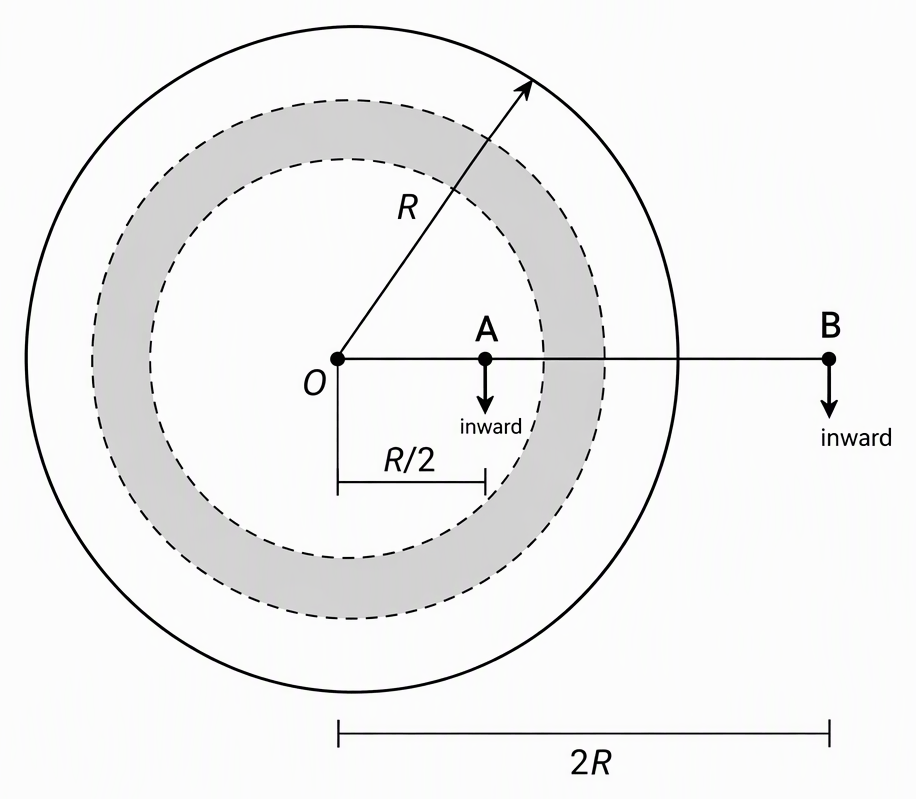
Uniform density makes enclosed mass proportional to enclosed volume. Newton’s shell theorem then gives the interior field:
Use the interior potential directly here. It includes both enclosed mass and outer layers:
At the interior point, substitution gives the following values. The field points inward:
At the exterior point, use the whole planet as a point mass at its centre. The field again points inward:
At the surface, the interior and exterior expressions agree. This checks both formulas:
At the centre, field is zero but potential is negative. Zero slope does not require zero potential:
Diagnostic error: using only enclosed mass in the expression below gives the wrong interior potential. It discards the nonzero potential of all outer layers:
How do I solve a radial launch question without confusing it with an orbit?
Use mechanical energy to connect launch speed with the turning point, where speed is zero. Circular force balance does not apply: the launch direction is radial, not tangential.
Problem: Launch a particle radially outward from a non-rotating spherical planet’s surface, neglecting drag. Its launch speed is:
Find its maximum height above the surface. Conservation of mechanical energy gives:
Substitute the launch speed to obtain the initial energy. Equating it to the turning-point energy gives the maximum centre-distance:
The question asks for height, not centre-distance. Subtract the planet’s radius:
Compare the launch speed with the surface escape speed below. The launch is slower, so its negative total energy is consistent with a finite turning point:
Minimum escape reaches infinity with zero remaining speed and zero total energy. Do not use constant-gravity kinematics when the height is comparable with the planet’s radius.
This launch speed equals the ideal circular speed at the surface. But speed alone does not determine the path: radial launch cannot produce a circular orbit.
After re-solving this example, JEEnius practice mode offers topic sets that skip questions already seen, with free sets included, to test whether the method transfers.
Why does a higher circular orbit have less speed but more energy?
Circular speed decreases with orbital radius, as force balance shows below. Total energy increases because potential energy becomes less negative by more than kinetic energy decreases.
Problem: A satellite moves between circular orbits around the same planet. The satellite mass, planet mass and orbital radii are:
Find the final-to-initial speed ratio, period ratio and change in mechanical energy. Circular force balance gives:
Substitute this speed into kinetic energy. Add gravitational potential energy to obtain total energy:
Speed varies inversely with the square root of radius. The requested ratio is:
For circular orbits around the same central mass, period squared is proportional to radius cubed. This gives:
Subtract initial energy from final energy. The positive difference means the final orbit is less tightly bound:
Check kinetic and potential energy separately. The potential-energy increase is twice the kinetic-energy decrease:
For an illustrative numerical substitution, choose the values below. The energy increases despite remaining negative:
This is an endpoint mechanical-energy difference, not a complete fuel calculation. It does not mean one tangential impulse creates the final circular orbit.
The result below requires a circular orbit. Do not use it as the speed formula at every point of an elliptical orbit:
What should I practise next if I keep making Gravitation mistakes?
Practise the question family behind your error, not another arbitrary set of pages. Read the relevant NCERT theory and derive the core results before mixed problems. Group your revision sheet by source assumptions and problem family, not formula names.
Practise in successive blocks:
- Vector superposition and zero-field points.
- Field and potential graphs for shells and spheres.
- Altitude and depth dependence of gravitational acceleration.
- Radial launches and escape.
- Circular satellites and Kepler’s laws.
For depth questions, state the uniform-density assumption before using linear dependence. Before a small-altitude expansion, check:
Attempt JEE Main previous-year questions to test setup and algebra, then JEE Advanced previous-year questions that combine ideas. Do not organise practice around an assumed fixed chapter weightage or settled Advanced pattern.
Label every mistake:
- Wrong source model.
- Wrong equation family.
- Sign error.
- Centre-versus-surface distance error.
- Algebra.
Re-solve the missed question without looking at the answer before attempting an unseen related question. For your exit check, explain why zero field need not mean zero potential, why a higher circular orbit is slower, and why minimum escape has zero total energy.
Keep revision separate from unseen-question practice: missed questions still need deliberate re-solving. After that repair, use JEEnius daily practice problems for a fresh ten-question set on a topic every day, with free sets daily.
Next step: practice mode on JEEnius and practise a topic in sets that skip questions you have already seen (free sets included).
If that step was the hard part, work through Hyperbola Practice Questions JEE: 6 Drills with Solutions.
Frequently asked questions
What order should I study Gravitation in for JEE?
Start with Newton's law and superposition, then study gravitational field and potential, shells and uniform solid spheres, and variation of gravitational acceleration. Follow these with escape and radial motion, then circular satellites and Kepler's laws. First check your force diagrams, vector addition, conservation of mechanical energy and circular acceleration; repair only the skills you lack.
Can gravitational field be zero but potential be nonzero?
Yes: inside a thin spherical shell, the gravitational field is zero but the potential is constant at -GM/R, taking potential zero at infinity. Zero field means zero local potential slope, not zero potential.
How do I solve radial launch questions in Gravitation?
For a radial launch from a non-rotating spherical planet with negligible drag, use conservation of mechanical energy. If the launch speed is below escape speed, the particle reaches a turning point where its speed is zero. Solve for the maximum centre-distance, then subtract the planet's radius to obtain height above the surface.
Why does a satellite in a higher circular orbit have more energy?
For circular orbits around the same planet, total mechanical energy is E = -GMm/(2r), so increasing orbital radius makes it less negative. Circular speed and kinetic energy decrease, but the increase in potential energy is twice the decrease in kinetic energy. The endpoint energy difference is not a complete fuel calculation.