
Should I start with hyperbola questions or a full mock?
Start with hyperbola practice questions for JEE, not a full mock, if your chapter foundations are uncertain. Choose guided drills when standard forms, signs or tangent conditions are shaky; choose authentic PYQs when those foundations are secure. Use full-length mocks to test question selection and execution across the paper.
Six original questions with worked solutions appear below, ready to attempt directly on this page. These formats serve different purposes: none is universally best.
How do guided drills, hyperbola PYQs and full mocks compare?
Drills repair concepts, PYQs reveal past exam demands, and mocks test whole-paper execution. Choose by the problem you need to fix, not by which format sounds hardest.
The options are original guided drills on this page, authentic JEE hyperbola PYQs from legitimately free sources, and full-length mocks, with free tests available on JEEnius.
- Purpose: Drills isolate a concept; PYQs show how past papers used it; mocks test pacing and selection across Physics, Chemistry and Mathematics.
- Prerequisites: Drills require basic familiarity with the chapter; PYQs require command of standard forms; mocks require enough syllabus coverage to make whole-paper decisions meaningful.
- Hyperbola focus: Every drill here concerns hyperbola. Chapterwise PYQs also stay focused. A full mock is not guaranteed to contain a hyperbola question.
- Feedback required: Drills provide worked solutions below. PYQs need a checked answer and sound derivation. Mocks need review of attempted, skipped and unfinished questions.
- Exam realism: These constructed drills do not reproduce an exam’s difficulty distribution. PYQs preserve authentic past questions, but chapter sorting removes paper context. Full mocks restore cross-subject decisions.
- Main limitation: Drills cannot establish paper performance. Past chapter questions do not predict future weightage. Full mocks are inefficient for repairing one hyperbola concept.
Which practice route should Class 11, Class 12 and dropper students choose?
Let demonstrated errors decide the route, not your class or dropper status. A Class 11 student with secure foundations can move beyond drills; a dropper who confuses an asymptote with a tangent should return to them. Use these situations as starting points, not permanent categories.
- Class 11, just learnt conics: Begin with standard-form, eccentricity and asymptote drills. Explain which axis contains the foci before substituting values. Move to mixed questions once you can justify the basic geometry.
- Class 12, revising a familiar chapter: Attempt this diagnostic without notes. Repair any step you cannot explain, then move to authenticated JEE Main PYQs. Reading a familiar solution is not the same as producing it.
- Dropper, recognising PYQ answers: Treat recognition as a warning. Re-derive the result without looking, then change a parameter and solve again. A remembered answer should not count as evidence of mastery.
- Advanced aspirant, comfortable with substitution: Prioritise parameter restrictions, line intersections and geometric interpretation. Direct formula drills do not test whether you can spot an exception to a familiar method.
- Accurate in chapter practice, inconsistent in papers: Use a full mock. Review question selection, algebra and time allocation rather than repeating a hyperbola worksheet.
For parents, the useful evidence is the student’s written reasoning. A completed worksheet tells less than a correctly explained restriction.
Can I attempt six free hyperbola questions right now?
Attempt all six below before reading the solutions, using only your own working. Record the first step you cannot justify, not merely whether your final answer matches.
All six are original diagnostic drills, not previous-year questions. Their mathematical values are constructed examples, not exam statistics. This is a diagnostic, not a complete Advanced-level problem collection.
Question 1, foundations. Find the eccentricity and coordinates of the foci of the following hyperbola. Identify the transverse axis before calculating.
Question 2, foundations. Find both asymptotes. Keep the slope calculation in your working so you can check whether you reversed the axes.
Question 3, tangent application. Find the tangent to this hyperbola at the given point. Check that the point belongs to the curve first.
Question 4, line-intersection application. Find every real value of the slope for which the line is tangent to the hyperbola at a finite point.
Question 5, geometry bridge. The tangent to the following curve at the given point meets the coordinate axes at A and B. Find the area of triangle OAB, where O is the origin.
Question 6, parameter trap. Is the following line a tangent at a finite point? Justify by substitution, not by quoting a tangent condition.
What are the solutions, and what does each mistake reveal?
Errors in Questions 1–2 point to standard-form gaps; Questions 3–4 test tangent reasoning; Questions 5–6 test geometry and restrictions. Compare the working below with your first unsupported step. A matching answer does not excuse a missing check.
Question 1. The positive squared term identifies a horizontal transverse axis.
The sign trap is importing the ellipse relation. For a hyperbola, the squared focal distance is the sum of the squared semi-axis parameters, despite the minus sign in its equation.
Question 2. Set the difference of the quadratic terms equal to zero.
For this horizontal standard form, divide the vertical semi-axis parameter by the horizontal one. Reversing this ratio gives the wrong slopes.
Question 3. First check membership, then apply the tangent-at-a-point equation.
Skipping membership can produce a line that is not a tangent when a supplied point lies outside the curve.
Question 4. Substitute the line into the hyperbola and clear denominators.
A repeated intersection requires zero discriminant, provided the quadratic coefficient is nonzero.
Both values therefore give a genuine quadratic with a repeated finite root.
Question 5. The tangent cuts both axes, so the area comes from its signed intercepts. Negative parameter values move the construction to the opposite branch without making the area negative.
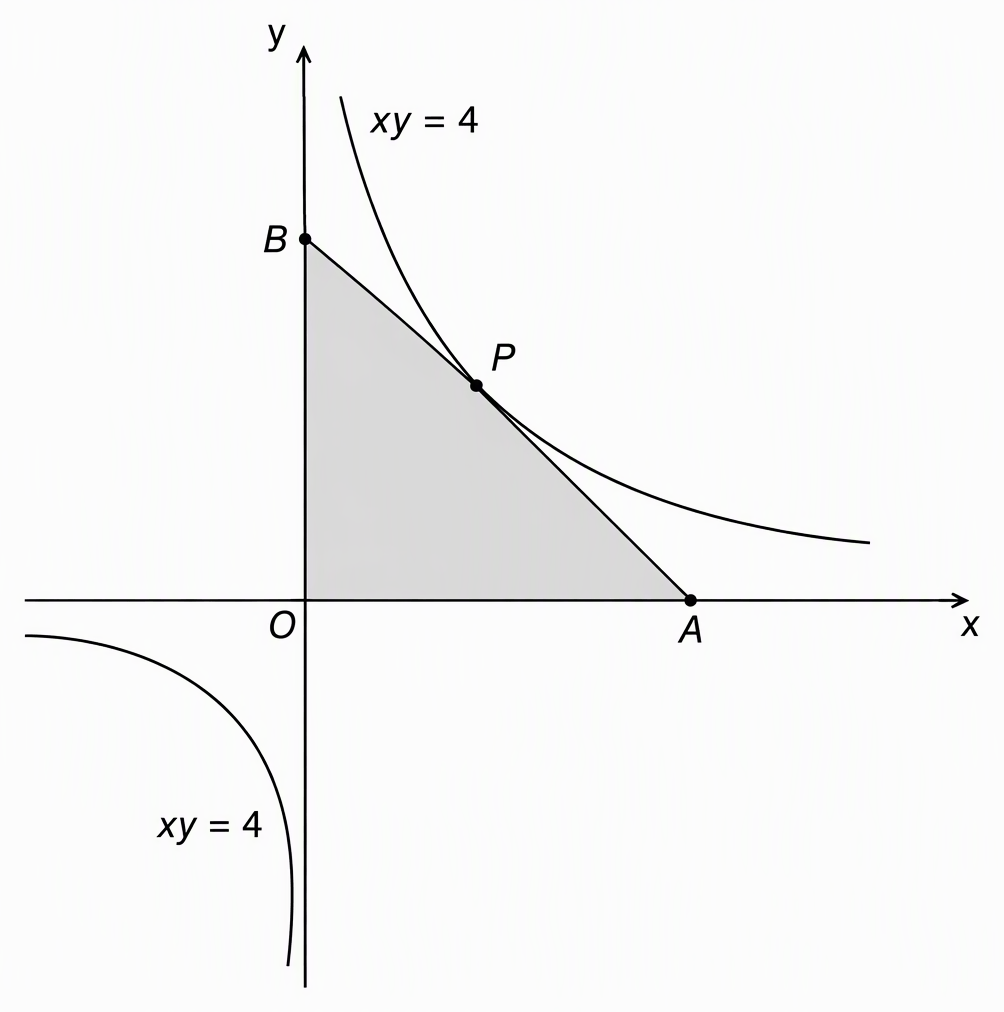
Differentiating and writing the tangent gives:
Keep the absolute value when using signed intercepts. The area formula must also handle negative parameter values.
Question 6. Direct substitution gives a contradiction.
There is no finite intersection. The line is an asymptote, not a finite-point tangent.
The familiar tangent condition below requires a genuine quadratic after elimination:
Here the constant denotes the line’s intercept, not Question 1’s focal distance. Applying this condition blindly when the quadratic terms cancel incorrectly accepts the asymptote.
- Questions 1–2 errors: Repair standard forms and axis identification.
- Questions 3–4 errors: Repair tangent reasoning and elimination.
- Questions 5–6 errors: Repair geometric interpretation and domain checks.
Use these errors to choose the next concept to practise. Do not turn six answers into a predicted score, rank or readiness percentage.
When should I switch to PYQs, and how can I check they are genuine?
Switch when you can reproduce the relevant derivations without looking at these solutions. Before collecting more hyperbola practice questions for JEE, explain why Question 4 permits a discriminant argument and why Question 6 does not.
Use legitimately free access to official papers or reproductions that retain enough identifying information to trace the question. A “PYQ” label alone is not evidence.
- For JEE Main: Check the year, session or date, shift and paper reference where available. Use the official NTA site, jeemain.nta.nic.in, to check official material.
- For JEE Advanced: Check the year, paper and question reference. Follow that specific paper’s instructions and marking scheme; question types and marking are not fixed.
- For solutions: Distinguish an official answer key from a publisher’s worked explanation. A matching final answer does not establish that every step in a third-party solution is valid.
Start chapterwise to expose concept gaps, then return to mixed-paper practice. The label “hyperbola” supplies a hint that disappears in an actual paper, where you must identify the method.
For Advanced preparation, favour questions that make you check restrictions or interpret intersections. Do not mistake a longer algebraic calculation for deeper reasoning.
When should I use a free full mock instead of more hyperbola drills?
Use a full mock when the main uncertainty is execution across the paper, rather than a missing hyperbola concept. Correct chapter solutions do not show whether you can select questions well, control algebra and allocate time across three subjects.
For JEE Main-style full-length practice, JEEnius includes free tests with 75 questions, 300 marks, 180 minutes and a scored per-subject breakdown. These numbers describe that Main-style practice, not JEE Advanced.
After the test, manually inspect your hyperbola or related coordinate-geometry attempts. The feedback is per subject, not a chapter-level diagnosis. Separate a wrong setup from an algebra slip, and an unfinished solution from a poor selection decision.
If the mock contains no hyperbola question, it still tests whole-paper execution but supplies no direct evidence about hyperbola mastery. Diagnose with the free drills, repair the identified concept, practise authentic PYQs, then test execution in a full paper.
Next step: full-length mock tests on JEEnius and sit a full 75-question, 300-mark, 180-minute paper and get a scored per-subject breakdown (free tests included).
Read next: Straight Line Equations JEE 2024: Angle Bisector Solution.
Frequently asked questions
Should I practise hyperbola questions or take a full JEE mock?
Start with chapter drills if standard forms, signs or tangent conditions are uncertain. Move to authentic PYQs when you can reproduce the relevant derivations independently. Use a full mock when your main problem is question selection, algebra or time allocation across the paper.
Are these hyperbola questions JEE previous-year questions?
No. All six questions are original diagnostic drills with worked solutions, not previous-year questions. They help identify concept gaps but do not reproduce an exam’s difficulty distribution or predict your score.
How do I check if a JEE hyperbola PYQ is genuine?
Use official papers or reproductions that retain enough information to trace the question. For JEE Main, check the year, session or date, shift and paper reference where available; for JEE Advanced, check the year, paper and question reference. Distinguish an official answer key from a publisher’s worked solution.
Can an asymptote be a tangent to a hyperbola at a finite point?
For x²/9 − y²/16 = 1, the asymptote y = 4x/3 is not a finite-point tangent: substitution gives 0 = 1, so there is no finite intersection. A zero-discriminant tangent argument requires a genuine quadratic after elimination. Check that the quadratic coefficient is nonzero before applying it.