
What is the answer to the triangle-and-angle-bisector question?
The numerical answer is 42, corresponding to option [2], not the answer-key label 2. This straight line equations JEE 2024 question requires rejecting one algebraic root because it collapses the triangle. Here, 2024 is the supplied question-bank year: its date field, 2023-01-24, conflicts with that year, so the paper date is not verified.
Triangle ABC has a known vertex A and an unknown vertex B. The internal angle bisector at B meets side AC at D, between A and C. Side BC is twice AB.
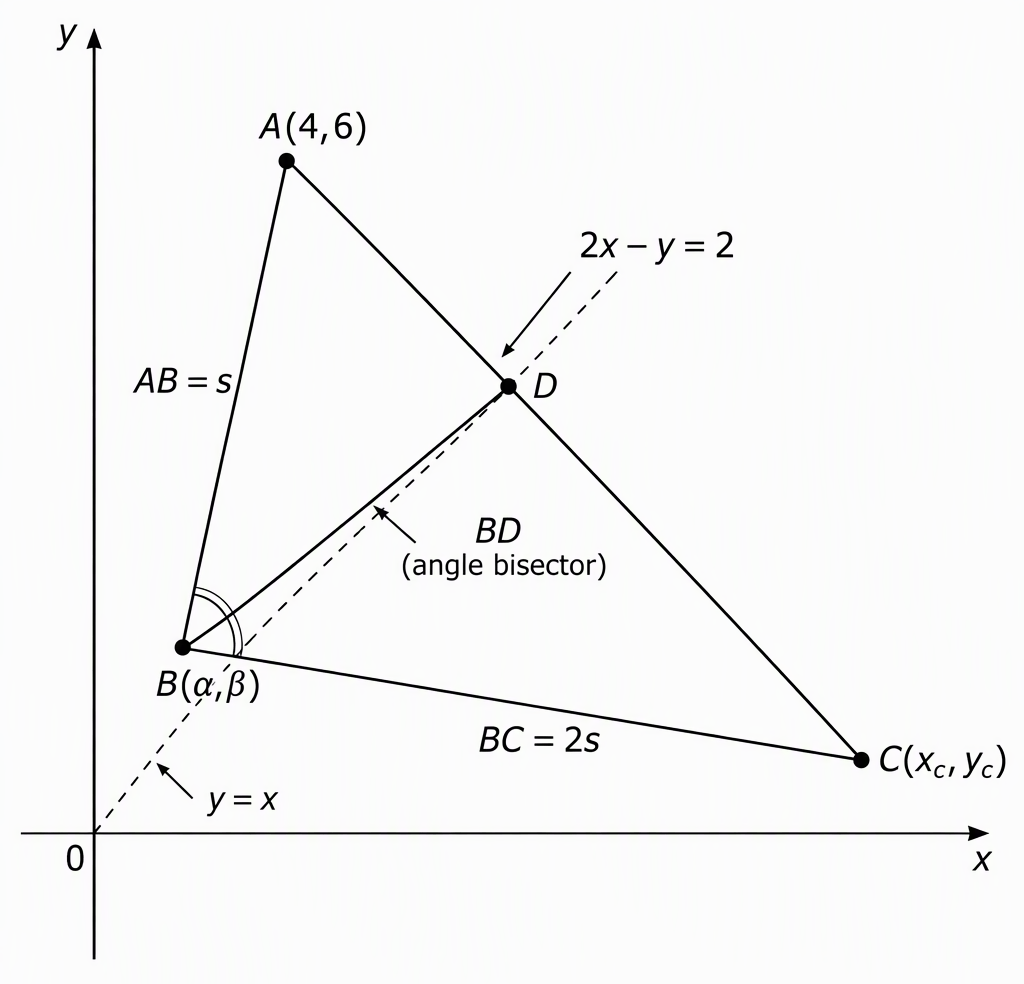
The given conditions are:
Find:
How do we locate B and find D?
The bisector passes through its vertex, so B lies on the bisector line. This relates its coordinates without fixing its position:
The unknown vertex now has just one parameter. D lies on both the bisector and side AC, so solve their equations together:
Substitution gives:
Therefore:
Do not identify B with D. D is the known intersection with the opposite side; B remains unknown along the bisector line.
How does the angle bisector theorem give C?
The internal angle bisector divides the opposite side in the same order as the adjacent sides. Since BC is twice AB, the segment next to A must be half the segment next to C:
Let the remaining vertex be:
The internal section formula gives:
A receives weight 2, corresponding to the opposite segment DC. D is closer to A, so A contributes more to its coordinates.
For the first coordinate:
For the second:
Thus:
Check the side’s equation:
C lies on AC, as required. This verifies the line condition, not the ratio orientation.
How does the side-length condition produce the quadratic?
The distance formula gives a quadratic in the remaining coordinate of B. Squaring the length relation multiplies the squared length by 4, not 2:
Using the recovered C, the squared distances are:
Therefore:
Expand the left side completely:
Expand the right side, keeping the outer factor:
Equating these expressions and moving everything to the right gives:
Divide by 6 and factor:
These roots are candidates for the vertex, not automatically two valid triangles. The distance equation alone does not enforce the triangle’s existence.
Why must we reject one root and choose 42?
The root 2 makes B coincide with D, destroying the triangle. Check both algebraic candidates against the original geometry:
For the first candidate:
Since D lies on AC, all three vertices are collinear. No non-degenerate triangle exists.
This root genuinely satisfies the distance relation:
It is not an arithmetic error or a negative length introduced by squaring. The lost constraint is the existence of a triangle.
Accept the other candidate:
The numerical answer is 42; the correct option is [2], as identified by the supplied worked solution. The answer-key field 2 is an option label, not the expression’s value.
What goes wrong if we reverse the angle-bisector ratio?
Reversing only the side-length ratio produces the wrong C, even though that point still lies on the correct line. The theorem pairs AD with AB, and DC with BC.
The correct relation is:
The incorrect relation is:
Changing the order on only one side reverses the theorem. It changes the section formula to:
That is not the required vertex:
Yet the incorrect point passes the line check:
Checking only the side’s equation cannot detect this mistake. The supplied solution note associates option [1] with this ratio inversion; its numerical option text is unavailable.
How can I practise this method on two related questions?
Use the bisector equation first, then the section formula, the distance condition and the geometric root check. Both questions below are original practice from the same chapter, not additional verified JEE PYQs.
Question 1. The following conditions define a triangle with an internal bisector at B. Find the requested expression:
Worked answer. Intersect the lines and apply the angle-bisector ratio:
The distance condition becomes:
Reject the first root because B equals D:
Accept the other root and evaluate:
Question 2. Find B for the triangle with these conditions, where the stated bisector is internal:
Worked answer. The intersection and section formula give:
Write the unknown vertex directly on the vertical bisector:
Then:
Reject the collapsed case:
The remaining root gives:
Use a vertical bisector’s equation directly. Do not try to assign it a finite slope; fix the horizontal coordinate and solve for the vertical coordinate.
Next step: the past-paper archive on JEEnius and search every JEE Main paper from 2002 and every Advanced paper from 2007, by year, subject or chapter, each with a worked solution (free).
Related on JEEnius: Chemical Kinetics JEE 2018: Question 13 Worked Solution.
Frequently asked questions
Is the answer to the triangle-and-angle-bisector question 2 or 42?
The numerical answer is 42, corresponding to option [2] in the supplied worked solution. The valid vertex is B = (14,14), so α + 2β = 14 + 28 = 42. The answer-key entry 2 is an option label, not the expression's value.
How do I find C using the angle bisector theorem?
Since BC = 2AB and BD is the internal angle bisector, AD:DC = AB:BC = 1:2. Intersecting y = x with 2x − y = 2 gives D = (2,2). The section formula gives D = (2A + C)/3, so C = 3D − 2A = (−2,−6).
Why is the root α = 2 rejected?
Because B lies on y = x, α = 2 gives B = (2,2), which coincides with D on side AC. All three vertices are then collinear, so there is no non-degenerate triangle. This root satisfies BC² = 4AB² but fails the original geometric condition.
How do I use a vertical angle bisector in coordinate geometry?
Use the line's equation directly instead of assigning it a finite slope. For the practice question with bisector x = 0, write B = (0,b), find C using the section formula and apply BC² = 4AB². The roots are b = 0 and b = 16; rejecting B = D leaves B = (0,16).