
What is the optical-bench question in Ray Optics JEE 2019?
The Ray Optics JEE 2019 optical-bench answer is 1.39%: each lens distance uses two scale readings, so its maximum error includes two reading errors. The source is JEE Advanced 2019, Paper 2, Physics. The question bank classifies it as medium difficulty; this is not an official exam rating.
An optical bench has a 1.5 m scale, with each centimetre divided into four equal intervals. An object pin stands at 45 cm and a convex lens at 75 cm. On the other side of the lens, an image pin at 135 cm coincides with the real image of the object pin.
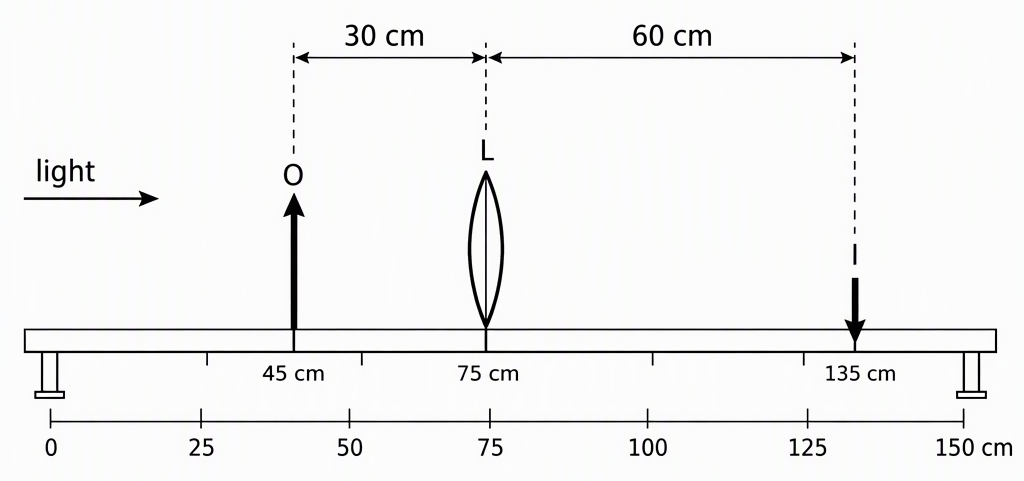
Find the percentage error in the measured focal length. This is a numerical-answer question, with no supplied answer options.
How do you convert the bench readings into signed lens distances?
Subtract the lens coordinate from each pin coordinate: the object distance is negative and the real-image distance is positive. Bench coordinates are not lens distances: both distances must be measured from the lens, not from the scale’s zero. Start the official solution with the least count, which sets the reading error.
Use the Cartesian sign convention with incident light travelling left to right. The two signed distances are:
Apply the lens formula, keeping those signs throughout. Use centimetres consistently in the substitution:
The positive focal length is consistent with the convex lens forming this real image. Subtracting the negative object-distance reciprocal makes the two terms add.
Why does each distance have a maximum error of 0.50 cm?
Each distance is the difference of two measured positions, each with a maximum error of 0.25 cm. The supplied official solution assigns this error of one least count to each bench reading. Adding the two reading errors gives 0.50 cm for each distance.
Write the distances in terms of the raw readings before assigning errors. Both include the lens reading:
Under the official maximum-error procedure:
Subtracting readings does not mean subtracting their maximum error magnitudes. Opposite errors in the two readings can increase the error in their difference.
Keep the supplied convention throughout. Do not substitute half-least-count uncertainty, statistical uncertainty or a different treatment of the shared lens reading when reconstructing the official answer.
How does the official error calculation give 1.39%?
The official method adds the two distance-error contributions weighted by inverse squared distances. It gives a fractional error of approximately 0.0138889, which becomes 1.39% after multiplying by 100 and rounding. Differentiate the lens formula first, then apply the supplied maximum-error rule using positive magnitudes.
Begin again with the lens formula:
Differentiating gives:
Rearrange, then apply the official maximum-error rule:
Maximum error uses positive magnitudes, so the contributions add. The negative object distance is also squared:
Multiply by the focal length to obtain fractional error, then by 100 to obtain percentage error. Substitute every value using centimetres consistently:
Keep sufficient precision in both contributions. Rounding these small terms too early changes the final result:
Their sum is:
The fractional error and percentage error follow:
Round only at the end:
The requested numerical entry is 1.39. Enter the percentage value, not the fractional error or the absolute error in centimetres.
Why does using one least count give the wrong answer of 0.69?
The wrong result comes from assigning one reading’s error to a distance obtained from two readings. The mistaken assumption is:
Using those values produces:
This is exactly half the official unrounded result. Both input distance-error terms have been halved, and the propagation expression is linear in those terms.
0.69 is a derived wrong numerical entry, not an original answer option. A correct lens formula cannot repair an error assigned to the wrong measured quantity.
The method check is specific: write each measured quantity in terms of its raw readings before assigning its error. Here, each distance requires a pin reading and a lens reading, not just one scale reading.
What else can you check using the same optical-bench experiment?
You can calculate the lens power, the absolute focal-length error and which distance contributes more to that error. These are author-written checks, not additional PYQs. Each uses only the supplied setup and quantities already derived; no new measurements are needed.
What is the power of the lens?
The power is positive 5 dioptres. Convert the focal length to metres before taking its reciprocal:
What absolute focal-length error corresponds to the unrounded percentage error?
The absolute error is approximately 0.28 cm. Multiply the focal length by the unrounded fractional error, not by the percentage number:
Which distance contributes more to the focal-length error, and by what factor?
The object-distance contribution is four times the image-distance contribution under the same official propagation method. Compare the two terms directly:
The absolute distance errors are equal, but they are weighted by inverse squared distances. The shorter object distance therefore contributes more.
Before checking a solution, write the two raw-reading differences and their error sums yourself. Check for two reading-error terms in each distance before propagating them.
Next step: the past-paper archive on JEEnius and search every JEE Main paper from 2002 and every Advanced paper from 2007, by year, subject or chapter, each with a worked solution (free).
For a worked example of the same idea, see How to Study Equilibrium JEE: Study Order and Checks.
Frequently asked questions
What is the answer to the JEE Advanced 2019 optical-bench question?
The percentage error in the measured focal length is 1.39% using the supplied official maximum-error method. The numerical entry is 1.39, not the fractional error 0.0138889.
How do you find the focal length from the optical-bench readings?
Subtract the lens reading of 75 cm from the object and image readings to get u = -30 cm and v = +60 cm. Substituting into 1/f = 1/v - 1/u gives f = +20 cm.
Why is the error in each lens distance 0.50 cm?
Each distance is the difference between a pin reading and the lens reading. The supplied official solution assigns one least count, 0.25 cm, as the maximum error of each reading, so the distance error is 0.25 + 0.25 = 0.50 cm.
Why do I get 0.69% instead of 1.39% in the optical-bench question?
Assigning only 0.25 cm error to each distance halves both contributions in the official propagation formula. Each distance uses two readings, so its maximum error must be 0.50 cm under the supplied convention, giving 1.39%.