How do you attempt the d- and f-block elements JEE 2018 matching question?
Vacant metal orbitals, not ligand strength alone, decide the d- and f-block elements JEE 2018 matching question within its valence-bond model. This is JEE Advanced 2018, Paper 2, Chemistry, Q15. The question bank classifies it as medium difficulty and suggests 180 seconds for solving it.
Assign the six numbered complexes below to the four hybridisation categories P, Q, R and S. A category may contain more than one complex. Distinguish the two four-coordinate shapes, then check which orbitals are available for each octahedral complex.
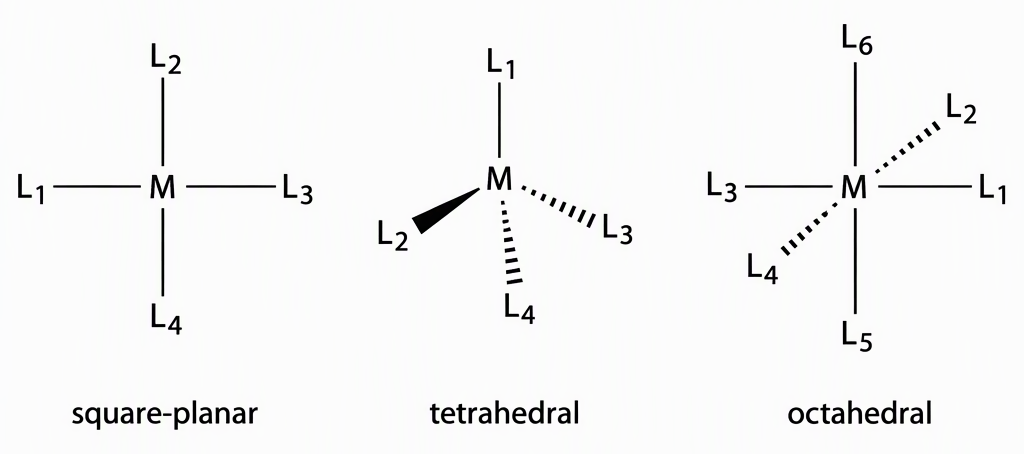
- Categories:
- Complexes:
Choose from these supplied mappings:
- A:
- B:
- C:
- D:
What should you count before choosing hybridisation?
Start with oxidation state, then find the metal’s d-electron count. Follow the official solution’s order: oxidation state → d configuration → ligand-field and orbital-availability check → geometry → hybridisation.
Use these ligand charges:
Coordination number four permits tetrahedral or square-planar geometry here; it does not settle the answer. Within this question’s valence-bond model, both categories below are octahedral, but they use different d shells:
Why do the three four-coordinate complexes give different answers?
Nickel cyanide is square planar; iron chloride and nickel carbonyl are tetrahedral. The difference follows from electron count and available orbitals, not simply from calling a ligand strong or weak.
Complex 6, nickel cyanide:
Strong-field cyanide enables pairing, leaving one inner d orbital available. Combining that orbital with the outer s orbital and two p orbitals gives square-planar bonding:
Complex 4, iron chloride:
Chloride is weak-field, and this four-coordinate complex is tetrahedral. Its bonding uses the outer s orbital and all three p orbitals, without requiring an inner d orbital:
Complex 5, nickel carbonyl:
Start from neutral nickel, not the nickel ion used for complex 6. In the valence-bond account, the two s electrons enter the d shell, giving the effective arrangement:
The d shell is full, so no inner d orbital is available. The s and p orbitals remain available for tetrahedral bonding:
Strong-field CO does not make nickel carbonyl square planar. Its metal electron count differs from nickel cyanide, so ligand strength alone cannot determine both geometries.
Which octahedral complexes can use inner d orbitals?
Iron fluoride requires outer d orbitals, while the titanium and chromium complexes can use inner ones. Check whether two inner orbitals are vacant before deciding whether pairing is needed.
Complex 1, iron fluoride:
Weak-field fluoride produces high-spin octahedral occupancy. Across the five inner d orbitals, the occupancy is:
Every inner orbital contains an electron. Two vacant inner orbitals are therefore unavailable, so the complex uses the outer s orbital, three p orbitals and two outer d orbitals:
Complex 2, titanium aqua-chloro complex:
Only one electron occupies the inner d shell, so two vacant inner orbitals are already available. Six donor atoms give octahedral geometry, and no forced pairing is needed to provide its bonding orbitals:
Complex 3, chromium ammine complex:
The six-coordinate octahedral field places the three electrons singly in the lower-energy set. The two inner orbitals in the upper set remain vacant:
Neither titanium nor chromium needs occupied d orbitals to pair up. Their electron counts already leave the required two inner orbitals free, giving chromium:
What is the correct matching for JEE Advanced 2018 Q15?
The correct option is C. The completed orbital audit gives the following assignments, with all six complexes appearing exactly once:
- P, square planar:
- Q, tetrahedral:
- R, outer-orbital octahedral:
- S, inner-orbital octahedral:
Why does option D wrongly place titanium in the outer-orbital category?
Weak-field ligands do not prove that titanium must use outer orbitals. One faulty route to D is: water and chloride are weak-field, therefore the titanium complex must have:
That skips the electron count. Titanium already has enough vacant inner orbitals:
No ligand-induced pairing is needed. Contrast this with high-spin iron fluoride, where all five inner d orbitals are occupied:
Weak-field fluoride does not cause pairing, so iron fluoride uses outer orbitals. This explains one error in D, not its entire mapping: D also wrongly places complex 4 under P and complex 6 under Q.
Which three practice questions test the same orbital reasoning?
These original practice questions, not additional verified PYQs, test ligand changes while keeping the metal electron count fixed. Attempt each before reading its worked answer.
1. What are the hybridisation and geometry of nickel chloride compared with nickel cyanide?
Weak-field chloride gives tetrahedral bonding. Strong-field cyanide permits pairing and makes one inner orbital available for square-planar bonding:
2. How does iron cyanide differ from iron fluoride?
Both have the same metal electron count. Cyanide causes pairing, leaving two inner orbitals vacant; fluoride leaves the high-spin occupancy:
3. Does chromium aqua require strong-field pairing to use inner orbitals?
No pairing is needed. Its octahedral occupancy leaves the two inner upper-set orbitals vacant:
Before assigning any hybridisation, write the d count and mark the vacant orbitals.
Next step: photograph a doubt on JEEnius and photograph any question you are stuck on and get a step-by-step solution, with a free-body diagram when the question needs one (20 free).
Related on JEEnius: Simultaneous Equations JEE 2024: Determinant Method.
Frequently asked questions
What is the correct answer to JEE Advanced 2018 Paper 2 Chemistry Q15?
The correct option is C: P → 6, Q → 4,5, R → 1 and S → 2,3. These categories correspond to dsp², sp³, sp³d² and d²sp³ hybridisation, respectively.
Why is Ni(CO)4 tetrahedral even though CO is a strong-field ligand?
In the question’s valence-bond model, nickel in Ni(CO)4 has an effective 3d¹⁰ arrangement, leaving no vacant inner d orbital. Bonding therefore uses sp³ orbitals and gives tetrahedral geometry. Strong-field CO alone does not imply square-planar geometry.
Why does [Ti(H2O)3Cl3] have d²sp³ hybridisation?
Titanium is in the +3 oxidation state and has a 3d¹ configuration, so two vacant inner d orbitals are already available. Within the valence-bond model, the six-coordinate complex uses d²sp³ hybridisation without requiring electron pairing.
How do I distinguish sp³d² from d²sp³ hybridisation?
Both describe octahedral complexes in this question’s valence-bond model, but they use different d shells. For these first-row metals, d²sp³ uses two inner 3d orbitals, while sp³d² uses two outer 4d orbitals. Check the d-electron count and orbital occupancy before deciding whether two inner orbitals are available.