
What is the correct option in the Atoms and Nuclei JEE 2019 Bohr-model question?
Option A is correct in the Atoms and Nuclei JEE 2019 question: an electron in a circular Bohr orbit around a nucleus has kinetic energy inversely proportional to the square of its orbit number. The nuclear species stays fixed while the electron’s allowed orbit number changes.
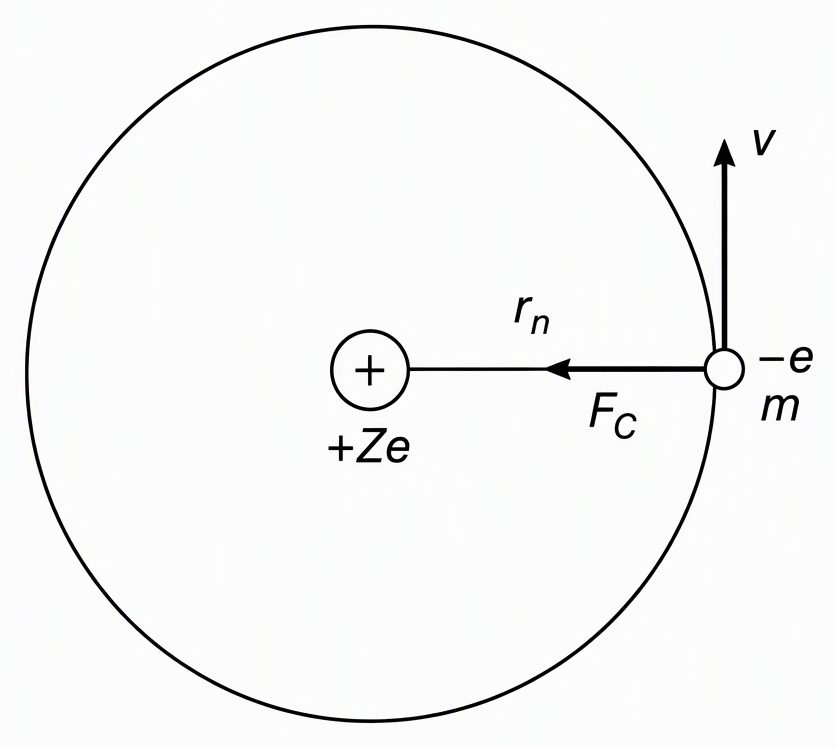
This is JEE Advanced 2019, Paper 2, Physics, Atoms and Nuclei, not JEE Main. The task is to select the valid quantity–exponent pairing for the nth orbit.
List I contains:
- I: orbital radius.
- II: electron angular momentum.
- III: kinetic energy.
- IV: potential energy.
List II gives the possible orbit-number dependence:
The offered options are:
The question-bank difficulty tag is medium, with a 90-second target. These are practice tags, not official exam classifications.
How do Coulomb attraction and Bohr quantisation give the orbit radius?
The radius grows as the square of the orbit number, so I matches T. Derive this by substituting the speed from Bohr quantisation into the centripetal-force equation. Quantisation alone fixes the product of speed and radius, not either quantity separately.
Use these symbols:
All five remain fixed when comparing orbit numbers for the same atom. Coulomb attraction supplies the centripetal force:
Bohr quantisation supplies the second equation:
Rearrange it for speed:
Substitute this expression into force balance before assigning any exponent:
Squaring the bracket and cancelling one mass factor gives:
Multiply both sides by the cube of the radius:
Divide by the fixed charge factors to obtain the radius:
Why does kinetic energy match P and make option A correct?
Kinetic energy is inversely proportional to radius, so the squared orbit-number dependence of radius gives kinetic energy an exponent of negative two. This makes III–P, option A, correct. Potential energy has the same orbit-number exponent, despite having the opposite sign.
First, complete the angular-momentum match using quantisation:
Thus, II matches S. Next, return to force balance and multiply by the radius:
Using the definition of kinetic energy:
Substitute the radius already derived:
For potential energy, take zero at infinite separation. Attraction then gives a negative value:
The negative sign does not alter the exponent, which remains negative two. Equivalently,
So IV also matches P. The italic energy symbol denotes potential energy, while the upright label U in List II denotes an exponent choice.
The complete matching list is:
- I–T: radius.
- II–S: angular momentum.
- III–P: kinetic energy.
- IV–P: potential energy.
This full list is distinct from the offered answer combinations:
- B is wrong: potential energy does not have exponent one-half.
- C is wrong: kinetic energy does not have exponent one.
- D is wrong: potential energy does not have exponent negative one.
Final answer: A.
How can an incorrect radius assumption lead to option D?
A possible incorrect derivation holds the electron’s speed constant while applying quantisation. That produces a radius proportional to orbit number and then the wrong potential-energy exponent, giving IV–Q, option D.
The false step is:
Following that assumption would give:
The assumption fails because speed changes between allowed orbits. Quantisation alone does not permit treating it as constant.
Use the derived radius instead:
Speed decreases as orbit number increases; it is not a fixed factor in the quantisation equation. Combine force balance with quantisation before assigning an exponent to radius or speed.
Can you solve three related Bohr-model questions using the same method?
Use the derived radius dependence and quantisation to check the ratios below, keeping energy signs separate from magnitudes. These are original practice questions based on the same chapter, not additional verified JEE PYQs. Keep the nuclear species fixed in every comparison and attempt each question before reading its worked check.
What are the radius and angular-momentum ratios for the fourth and second orbits?
The radius ratio is four, while the angular-momentum ratio is two. Radius depends on the square of orbit number, but angular momentum depends on its first power:
What are the speed and kinetic-energy ratios for the third and first orbits?
The speed becomes one-third, and kinetic energy becomes one-ninth. Start from quantisation and the derived radius dependence:
For the same electron, mass cancels from the kinetic-energy ratio:
Does potential energy increase when the electron moves from the first to the second orbit?
The signed potential energy increases because it becomes less negative. Its magnitude, however, decreases to one-quarter:
Before selecting an energy option, write two separate checks: how the magnitude scales, then what the sign means for increase or decrease.
Next step: the past-paper archive on JEEnius and search every JEE Main paper from 2002 and every Advanced paper from 2007, by year, subject or chapter, each with a worked solution (free).
For a worked example of the same idea, see How to Study Electrostatics JEE: Topic Order and Practice.
Frequently asked questions
What is the correct answer to the JEE 2019 Bohr-model matching question?
Option A, III–P, is correct because the electron’s kinetic energy scales as n⁻² for a fixed nuclear species. The complete matching is I–T for radius, II–S for angular momentum, III–P for kinetic energy and IV–P for potential energy.
Was the 2019 Bohr-model matching question in JEE Main or Advanced?
This question appeared in JEE Advanced 2019, Paper 2, Physics, not JEE Main. It asks students to select the valid pairing between a Bohr-orbit quantity and its orbit-number exponent.
How does Bohr orbit radius depend on orbit number?
For a fixed nuclear species, the radius scales as n². Substitute v = nℏ/(mr), obtained from Bohr quantisation, into the Coulomb centripetal-force equation to derive this dependence.
Why is option D wrong in the JEE 2019 Bohr-model question?
Option D pairs potential energy with n⁻¹, but its correct dependence is n⁻². The wrong exponent can result from holding speed constant in mvr = nℏ and incorrectly concluding that radius scales as n. Electron speed actually scales as n⁻¹ for a fixed nuclear species.
Does potential energy increase from the first to the second Bohr orbit?
Yes, with zero potential energy at infinite separation, the signed potential energy increases because it becomes less negative. For the same nuclear species, U₂ = U₁/4 with U₁ < 0, so U₂ > U₁. Its magnitude decreases to one-quarter.