
How should I study Electrostatics for JEE in the right order?
To study Electrostatics for JEE, choose the law from the required quantity, symmetry and constraints, not from a familiar-looking formula. Use these five steps to build that habit.
- Repair only the prerequisites you need.
Check vector components, algebra with inverse powers, basic integration and work–energy. You do not need to restart all of Mechanics.
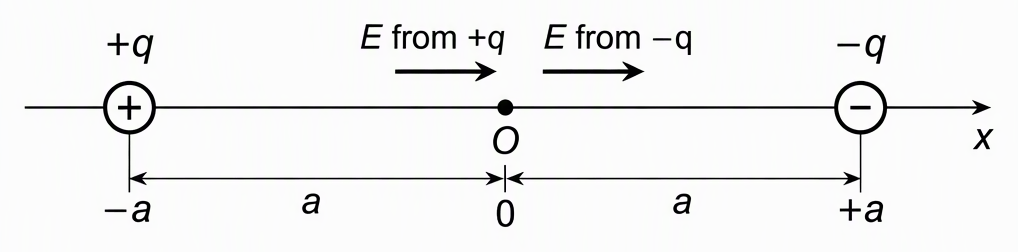
Use this two-charge setup as a diagnostic: decide each field’s direction at the origin before calculating anything. If you cancel the fields merely because the charges have opposite signs, repair vectors first.
- Follow the dependency order.
Study Coulomb’s law and superposition first, then electric field and dipoles, flux and Gauss’s law, potential and potential energy, conductors and electrostatic equilibrium, and finally capacitance, dielectrics and capacitor energy. Each stage supplies ideas needed by the next.
- Build a formula-and-condition sheet beside your textbook.
Read an explanation such as NCERT, then record the physical setup, direction or sign convention, and assumptions beside each equation. Use these condition labels:
- Point-charge field magnitude: the charge symbol below represents its positive magnitude. Handle direction separately.
- Signed point-charge potential: retain the charge’s sign. Take zero potential at infinity.
- Ideal parallel-plate capacitance: uniformly fill the gap with a medium of permittivity epsilon. Neglect fringing.
- Write three decisions before calculating.
State what is required, what symmetry exists and what remains fixed. Choose vector superposition for field or force, scalar addition for potential, and energy for suitable work or speed questions.
Gauss’s law is always valid, but it calculates field directly only when symmetry makes the flux integral usable. Choosing a Gaussian surface does not automatically make the field constant or allow you to take it outside the integral.
For continuous charge, select the charge element for a line, surface or volume distribution, respectively:
Derive the field on a uniformly charged ring’s axis to learn why transverse components cancel. Integrate the surviving axial component rather than merely collecting the final formula.
- Reconstruct, classify and retry.
Close each worked solution and reconstruct its setup. Label errors as law selection, direction/sign, constraint or algebra, then redo the failed question before attempting an unseen variant.
Can electric potential be zero while electric field is nonzero?
Yes. Signed potential contributions can cancel while field vectors add. In this original illustrative problem, place equal and opposite charges on the x-axis and find field and potential at the origin:
Apply the routine: the required quantities are field and potential; the distances are equal; the charges remain fixed. Take potential as zero at infinity.
Potential uses signed scalar addition:
The positive charge’s field points away from it, towards the right. The negative charge’s field points towards it, also towards the right.
For a numerical check, choose:
The wrong step is cancelling fields because the source charges have opposite signs, without first drawing their directions. Replacing the negative charge with an equal positive charge reverses the result:
Charge signs determine scalar potential contributions; field directions determine vector cancellation. Practise paired field-and-potential questions until vector cancellation and scalar cancellation are no longer confused.
When does Gauss’s law actually calculate the electric field?
Gauss’s law calculates the field directly when symmetry fixes its direction and makes its magnitude constant over the relevant parts of the surface. In this original problem, a nonconducting solid sphere carries positive charge uniformly throughout its volume. Find the field inside and outside it.
Apply the routine: field is required, the charge distribution is spherically symmetric and the distribution stays fixed. A concentric spherical Gaussian surface works because the field is radial and equal in magnitude everywhere on that surface.
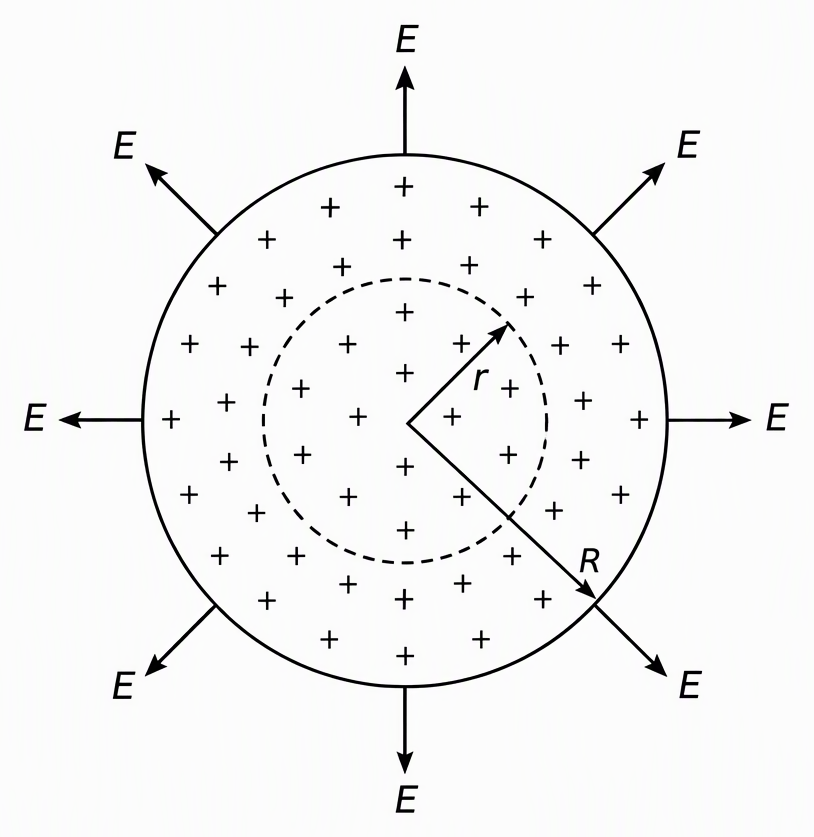
Inside, uniform charge density makes enclosed charge proportional to enclosed volume:
The field is parallel to every outward area vector. Its constant magnitude can therefore come outside the integral:
Outside, the Gaussian surface encloses all the charge:
Both fields point radially outward. Check the centre and surface:
A charged conducting sphere in electrostatic equilibrium has zero internal field. Do not confuse surface charge on a conductor with uniform volume charge in this problem.
Copying this Gaussian surface around an arbitrary finite rod usually fails because the required field symmetry is absent. For focused practice, JEEnius daily practice problems provide a fresh ten-question set on a topic every day, with free sets daily.
How do I choose the energy formula in dielectric capacitor questions?
Choose the energy expression that exposes the quantity held fixed: voltage with a connected ideal battery, charge with an isolated capacitor. In this original idealised setup, an initially air-filled parallel-plate capacitor receives a linear dielectric that completely fills its gap. Plate geometry stays unchanged, and fringing is neglected.
The initial capacitance, voltage and energy are:
Taking air’s permittivity as approximately that of vacuum, the new capacitance is:
Apply the routine: final charge, voltage and energy are required. The ideal plate geometry fixes the capacitance model; the battery connection determines the constraint.
Case A: the battery remains connected. It holds voltage constant and supplies extra charge. Use the voltage form of stored energy:
Case B: the battery is disconnected before insertion, and the capacitor is isolated. Charge cannot enter or leave the plates. Use the charge form:
The two energy formulas are equivalent through the charge–voltage relation:
“Inserting a dielectric increases energy” is not universal. A connected battery exchanges energy with the capacitor, so capacitor energy alone is not a closed-system energy balance.
Check that removing the dielectric effect restores the initial values:
- Fixed voltage: capacitance, charge and stored energy increase by the dielectric factor.
- Fixed charge: capacitance increases; voltage and stored energy decrease by that factor.
What should I practise after learning the basic Electrostatics formulas?
Start with point-charge questions, then continuous distributions and Gaussian symmetry, before combining energy, conductors and capacitors. Advance when you can justify the law, set up the equation unaided and check the result, not after an arbitrary number of days.
- Point charges: practise force, field and potential, including zero-field locations and signed work calculations. Distinguish work done by the electric field from external work in a slow displacement, with no other force doing work.
- Continuous distributions: practise choosing the charge element and resolving components, then move to flux and tests of Gaussian symmetry.
- Linked ideas: solve potential-energy and dipole questions, conductor and shell questions, then capacitor networks before mixed dielectric and energy problems.
After basic exercises, attempt topic-wise JEE Main previous-year questions. Then use JEE Advanced previous-year questions requiring linked ideas; do not assume Main’s question types and marking scheme apply to Advanced.
Move ahead when you can explain why the law applies, set up the equation unaided, and pass a sign, unit or limiting-case check. A correct answer reached through an unjustified cancellation does not pass.
Class 11 students should follow the full dependency sequence. Class 12 students and droppers should use errors in these three examples to locate gaps rather than automatically restarting every lecture.
Separate revision from fresh practice: redo logged mistakes unaided, then test transfer on unseen questions. For that second step, JEEnius practice mode offers topic sets that skip questions already seen, with free sets included.
Next step: practice mode on JEEnius and practise a topic in sets that skip questions you have already seen (free sets included).
If that step was the hard part, work through General Organic Chemistry Practice Questions JEE: 6 Drills.
Frequently asked questions
In what order should I study Electrostatics for JEE?
Start with Coulomb’s law and superposition, then electric field and dipoles, flux and Gauss’s law, potential and potential energy, conductors, and finally capacitance and dielectrics. Before starting, check vector components, inverse-power algebra, basic integration and work–energy rather than restarting all of Mechanics.
Can electric potential be zero when electric field is nonzero?
Yes: at the midpoint between equal and opposite point charges, the signed potentials cancel when zero potential is taken at infinity. The electric fields point in the same direction, from the positive charge towards the negative charge, so they add rather than cancel.
When can I use Gauss’s law to calculate electric field?
Gauss’s law is always valid, but it gives the field directly only when symmetry makes the flux integral usable. For a spherically symmetric charge distribution, a concentric spherical surface has a radial field of constant magnitude, allowing the field magnitude to come outside the integral.
Does inserting a dielectric increase capacitor energy?
It depends on whether voltage or charge remains fixed. For complete dielectric insertion with unchanged plate geometry and negligible fringing, a connected ideal battery holds voltage fixed and stored energy increases by the dielectric factor. If the capacitor is disconnected and isolated before insertion, charge remains fixed and stored energy decreases by that factor.
What should I practise after learning Electrostatics formulas?
Begin with point-charge force, field and potential questions, then continuous distributions, flux and Gaussian symmetry. Next combine energy, dipoles, conductors and capacitor networks before tackling mixed dielectric problems and topic-wise JEE Main followed by JEE Advanced previous-year questions. Move ahead only when you can justify the law, set up equations unaided and check signs, units or limiting cases.