
Should I start GOC practice with concept drills or PYQs?
Start with original topic-wise drills if your reasoning breaks, JEE Main PYQs to check exam application, and JEE Advanced PYQs for less scaffolded reasoning. These General Organic Chemistry practice questions for JEE give you six original questions with worked explanations, free to read without external question-bank access.
The set diagnoses selected fundamentals, not mastery of the entire chapter. Full-length mocks come later: they test whether you can apply Chemistry alongside Physics and Mathematics, rather than replace focused GOC practice.
How do GOC drills, Main PYQs, Advanced PYQs and mocks compare?
Drills isolate concepts; PYQs test authentic exam application; mocks test whole-paper execution. Pick the format that exposes your current weakness.
- Learning objective: Original drills here: repair selected fundamentals. Main PYQs: recognise concepts in exam questions. Advanced PYQs: handle less scaffolded reasoning. Full-length mocks: apply knowledge across subjects.
- Prerequisite readiness: Original drills here: familiarity with GOC terms. Main PYQs: explain individual effects. Advanced PYQs: weigh competing arguments. Full-length mocks: enough syllabus coverage for a meaningful complete attempt.
- Isolating weak concepts: Original drills here: each question has a narrow target. Main PYQs: varies by question. Advanced PYQs: connected ideas can obscure the first mistake. Full-length mocks: require question-by-question review.
- Exam-format exposure: Original drills here: teaching questions, not an exam replica. Main PYQs: authentic Main questions. Advanced PYQs: authentic Advanced questions. Full-length mocks: simulated complete-paper conditions.
- Solution checking: Original drills here: worked reasoning below. Main PYQs: check explanations against the actual question and official key where available. Advanced PYQs: do the same, including the paper’s instructions and marking scheme. Full-length mocks: review reasoning, not just scores.
- Main limitation: Original drills here: narrow coverage. Main PYQs: remembered answers can hide weak understanding. Advanced PYQs: difficulty can hide basic gaps. Full-length mocks: inefficient for repairing one recurring concept error.
These original teaching questions are not PYQs. Verify a claimed PYQ’s wording, structures and options against the source paper; an official answer key confirms the accepted answer but does not teach the reasoning.
JEEnius full-length mocks include free tests with 75 questions, 300 marks, 180 minutes and a scored per-subject breakdown. That format corresponds to JEE Main Paper 1; JEE Advanced has no fixed question-type or marking pattern.
Which GOC practice should I choose in Class 11, Class 12 or a drop year?
Your explanation matters more than your class or attempt number. A dropper repeating a resonance mistake needs targeted drills, not harder questions.
- Class 11: If you can quote an acidity order but cannot explain conjugate-base stability, start with concept drills and their explanations. Learn why the order holds before collecting exceptions.
- Class 12: If you can explain resonance and inductive effects separately but struggle to recognise them in mixed questions, prioritise JEE Main PYQs. Identify the species being compared before choosing an effect.
- Advanced target: Add Advanced PYQs when you can justify your answer and reject competing arguments. Follow each source paper’s instructions and marking scheme.
- Dropper: Repair repeated resonance mistakes by revisiting what a contributor represents and which electrons can move. Another indiscriminate pile of difficult questions does not address that gap.
- Reliable chapter solver: If accuracy drops during a complete paper, use full-length mocks and review the subject breakdown. Inspect individual errors to separate conceptual slips from rushed reading.
This six-question foundational set is not an Advanced readiness test. It can expose missing foundations, but it cannot establish that your reasoning holds across the chapter.
Can I try six free GOC questions before reading the solutions?
Attempt these foundational questions without notes, writing both an answer and a one-sentence chemical justification before scrolling to the solutions. Every question is original practice, not a JEE PYQ or an Advanced-level problem. Keep your first explanation intact so you can review the reasoning you actually used.
Question 1: Which is most acidic in water?
Original practice, not a JEE PYQ. Arrange ethanoic acid, phenol and ethanol in decreasing acidity in aqueous solution. Explain using the species formed after each loses a proton.
Question 2: Is methylamine or aniline more basic in water?
Original practice, not a JEE PYQ. Compare methylamine and aniline as bases in aqueous solution. Identify which nitrogen lone pair is less available for protonation and explain why.
Question 3: Which simple alkyl carbocation is most stable?
Original practice, not a JEE PYQ. Arrange these carbocations in decreasing stability under comparable conditions, excluding resonance-stabilised species. The positive charge is on the central carbon in the first two and the terminal carbon in the third.
Question 4: Are the two carbon–oxygen bonds in ethanoate equivalent?
Original practice, not a JEE PYQ. Decide whether ethanoate has equivalent carbon–oxygen bonds or permanently one single and one double bond. Explain what its resonance contributors represent.
Question 5: Are the cyclopentadienyl anion and cation aromatic?
Original practice, not a JEE PYQ. Assume both five-membered rings are planar, cyclic and fully conjugated. Classify each as aromatic or antiaromatic using its pi-electron count.
Question 6: Who donates the electron pair when ammonia binds boron trifluoride?
Original practice, not a JEE PYQ. In formation of this adduct, identify the electron-pair donor and acceptor. State which reactant acts as the nucleophile and which as the electrophile.
What are the worked answers, and what does each mistake reveal?
A correct answer with incorrect reasoning still marks a concept for review. Check each explanation for the governing idea and the tempting wrong argument, then use the repair topic to choose your next question.
Why is ethanoic acid more acidic than phenol and ethanol?
Ethanoate has stronger conjugate-base stabilisation than phenoxide or ethoxide, giving this decreasing aqueous acidity order. Compare the species left after proton loss, not just the neutral acids.
Ethanoate delocalises its negative charge over two equivalent oxygen atoms. Phenoxide also has resonance stabilisation, but its ring-delocalised contributors place negative charge on carbon rather than sharing it between two equivalent oxygen atoms. Ethoxide has no comparable resonance delocalisation.
Tempting wrong argument: “Phenol has more resonance drawings, so it must be strongest.” Counting contributors without judging their quality fails; repair conjugate-base stability and conjugate species.
Why is methylamine more basic than aniline in water?
Methylamine’s nitrogen lone pair is more available for protonation; aniline’s is delocalised into the aromatic ring. The methyl group also donates electron density through the inductive effect. Methylamine is therefore more basic in aqueous solution.
Tempting wrong argument: “Aniline is aromatic and stable, so it must be the stronger base.” Basicity concerns proton acceptance, not simply molecular stability. Repair lone-pair availability, without extending this comparison to every amine in every solvent.
Why does the tertiary alkyl carbocation come first?
Alkyl groups donate electron density, and adjacent carbon–hydrogen bonds stabilise the electron-deficient centre through hyperconjugation. For these simple alkyl carbocations under comparable conditions, the decreasing stability order is tertiary, secondary, primary.
Tempting wrong argument: “Tertiary always beats primary.” That ignores resonance in benzyl and allyl carbocations. Repair electronic effects: check whether resonance is possible before using the alkyl-substitution order.
Why are both carbon–oxygen bonds in ethanoate equivalent?
The resonance hybrid distributes bonding and negative charge equally across both oxygen atoms. Each carbon–oxygen bond has character intermediate between a single and double bond. Contributors are alternative representations of electron distribution in the same ion, not separate molecules.
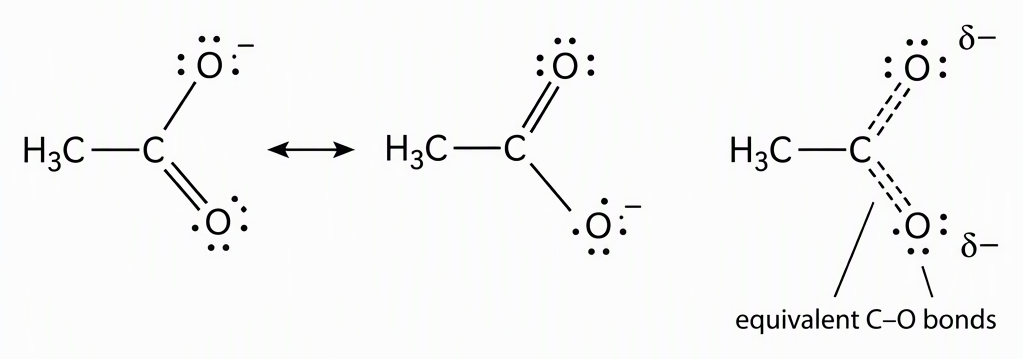
Tempting wrong argument: “The bonds rapidly swap between single and double.” Resonance is not rapid exchange between contributors, and the nuclei do not rearrange between drawings. Repair resonance representation, especially the distinction between a contributor and the actual hybrid.
Why is the cyclopentadienyl anion aromatic but the cation antiaromatic?
Under the stated structural assumptions, the anion has six pi electrons and is aromatic; the cation has four and is antiaromatic. Both have four pi electrons from two double bonds. The anion adds a pair from the negatively charged carbon’s participating p orbital; the cation has an empty p orbital there.
For a planar, cyclic, fully conjugated system, use these counts. Apply them only after checking those structural conditions.
Tempting wrong argument: “A charged ring cannot be aromatic.” Charge alone decides neither aromaticity nor antiaromaticity. Repair continuous conjugation and electron counting.
Why is ammonia the nucleophile in the adduct?
Ammonia supplies its nitrogen lone pair, making it the Lewis base and nucleophile. Boron trifluoride accepts that pair at electron-deficient boron, making it the Lewis acid and electrophile. The coordinate-bond arrow points from donor to acceptor.
Tempting wrong argument: “Only a negatively charged species can be a nucleophile.” Neutral species can donate an available electron pair. Repair electron-pair movement by locating where the pair starts and which atom accepts it.
What should I practise after checking these six answers?
Repair the specific reasoning error, then change formats when your explanation holds without help. Do not use a score on this set as a promotion rule.
- Attempt without notes.
- Write your chemical explanation.
- Check the worked solution.
- Label the error precisely.
- Revise that concept.
- Solve a fresh question testing the same idea.
Keep a small error log with four columns in your notebook: question, wrong reasoning, corrected principle, result on a later fresh attempt. Record “treated contributors as exchanging molecules”, not merely “resonance mistake”.
Move from isolated drills to mixed JEE Main PYQs when you can explain the principle without borrowing the solution’s wording. For Advanced, add authentic Advanced PYQs and examine why alternatives fail; longer calculations do not automatically mean deeper GOC reasoning.
Broader practice must also cover inductive-effect comparisons, carbanions and free radicals, which this set does not adequately sample. Once chapter practice is reliable, JEEnius free full-length mocks are a subsequent whole-paper option, not a substitute for those repairs.
Choose the next question type from the error you made, not from the resource claiming to be hardest.
Next step: full-length mock tests on JEEnius and sit a full 75-question, 300-mark, 180-minute paper and get a scored per-subject breakdown (free tests included).
Read next: Complex Numbers JEE 2024: Why Both Roots Are Valid.
Frequently asked questions
Should I start GOC practice with concept questions or PYQs?
Start with topic-wise concept drills if you cannot explain the principle behind your answer. Use JEE Main PYQs when individual concepts are clear but recognising them in mixed questions is difficult. Add JEE Advanced PYQs when you can justify your answer and reject competing arguments.
Are these GOC questions actual JEE PYQs?
No. All six are original foundational teaching questions with worked explanations, not JEE PYQs or Advanced-level problems. They diagnose selected fundamentals rather than establish mastery of the chapter.
Which GOC topics do these practice questions cover?
The six questions cover acidity, basicity, simple alkyl carbocation stability, resonance, aromaticity and electron-pair donation. Broader practice must also include inductive-effect comparisons, carbanions and free radicals, which this set does not adequately sample.
How should I review mistakes in GOC practice questions?
Write both your answer and a chemical justification before checking the solution. Record the question, wrong reasoning, corrected principle and result on a later fresh attempt in an error log. Revise the specific concept and solve a fresh question testing it; a correct answer with faulty reasoning still needs review.