
Which Dual Nature practice questions should I choose for JEE?
Choose Dual Nature practice questions for JEE by the mistakes they expose, not their difficulty label. Use concept-check MCQs for intensity, frequency and threshold confusion; Main-style calculations for equation or unit errors; Advanced-style linked problems after direct applications are secure. This page includes free, original questions and worked solutions.
Advanced aspirants should not skip foundation checks. Main aspirants should not assume harder questions automatically make better preparation.
How do concept checks, Main-style calculations and Advanced-style problems compare?
Concept checks test your physical model, direct calculations test its use, and linked problems test connections. These are teaching categories, not official syllabus divisions or guarantees of exam difficulty. Move on when you can explain an unfamiliar solution without copying its steps.
- Starting knowledge
- Concept-check MCQs: Know what photon energy, threshold frequency and intensity mean.
- JEE Main-style calculations: Understand the concepts and identify the relevant quantities.
- JEE Advanced-style linked problems: Handle direct applications without prompts.
- Typical task
- Concept-check MCQs: Separate the effects of intensity and frequency.
- JEE Main-style calculations: Find stopping potential or wavelength after acceleration through a voltage.
- JEE Advanced-style linked problems: Interpret a graph or compare photon and electron momentum.
- Error exposed
- Concept-check MCQs: Treating brighter light as higher-energy photons.
- JEE Main-style calculations: Confusing energy with voltage, or using the wrong proportionality.
- JEE Advanced-style linked problems: Reading intercepts incorrectly or applying one momentum formula to every particle.
- Solution standard
- Concept-check MCQs: Explain the correct option and reject the tempting alternative.
- JEE Main-style calculations: Show the starting equation, substitution and dimensional check.
- JEE Advanced-style linked problems: State assumptions and justify each connection.
- When to move on
- Concept-check MCQs: You can explain what changes and what stays fixed.
- JEE Main-style calculations: You can solve an unfamiliar variation and check its units.
- JEE Advanced-style linked problems: You can explain why the chosen relations apply.
Concept checks alone do not test calculation fluency. Direct calculations can reward formula recognition, while linked problems can conceal unresolved basics beneath lengthy algebra.
Where should Class 11, Class 12 and dropper students start?
Start from readiness, not your class or attempt number. Remembering a formula is not the same as knowing when it applies. Use these cases to choose your starting point:
- Class 11, studying the chapter early: Learn the threshold condition and the meaning of each quantity before attempting linked problems.
- Class 12, remembering formulas but confusing photocurrent with stopping potential: Start with concept checks, not a harder worksheet.
- Main-focused, losing signs, ratios or units: Prioritise direct calculations and write intermediate equations.
- Advanced aspirant, explaining direct solutions without prompts: Attempt the graph and momentum extensions below.
- Dropper, recognising answers from repeated PYQs: Use unfamiliar original questions and justify every assumption. Recognition is not mastery.
A wrong foundation answer sends any student back to that concept, regardless of target rank or attempt number. Correct the mistaken idea before attempting another worksheet.
Can I try free Dual Nature practice questions for JEE before seeing the answers?
Attempt these original questions before reading the worked answers in the next section. They are not previous-year questions. Write a reason beside each choice and keep your initial working to trace errors to physics, algebra or an unstated assumption.
Use the standard single-photon model for the photoelectric questions. The constants used below are:
Concept check A, original practice
Light falls on a metal at a frequency below its threshold frequency. The frequency stays fixed while intensity increases. Does photoemission occur? Choose one:
- A: Yes, because more photons arrive each second.
- B: No, because each photon still has insufficient energy.
- C: Yes, once the intensity exceeds a threshold value.
- D: Yes, but the emitted electrons must have zero kinetic energy.
Concept check B, original practice
Light of fixed frequency above threshold illuminates the same metal surface. Its intensity increases under unchanged collection conditions, with no heating or space-charge limitation. What happens to saturation photocurrent and stopping potential? Choose one:
- A: Both increase.
- B: Both remain unchanged.
- C: Saturation photocurrent increases; stopping potential remains unchanged.
- D: Saturation photocurrent remains unchanged; stopping potential increases.
Main-style calculation A, original practice
A metal has threshold frequency given below and is illuminated at twice that frequency. Find the magnitude of its stopping potential.
Choose one:
Main-style calculation B, original practice
An electron starts from rest and gains kinetic energy through an accelerating potential difference. Two separate trials use the positive potential differences below. The electron remains non-relativistic in both trials.
Find the ratio of the second de Broglie wavelength to the first. Choose one:
Advanced-style extension A, original practice
For a fixed metal, stopping-potential measurements above threshold follow the straight line below. Stopping potential is measured in volts and frequency in hertz; both constants are positive.
Infer the threshold frequency and work function. Explain the physical meaning and units of the slope and vertical intercept, distinguishing the intercept from the positive constant being subtracted.
Advanced-style extension B, original practice
A photon in vacuum has the same energy as a free electron’s kinetic energy. The electron is non-relativistic.
Derive the following wavelength ratio and identify which wavelength is longer. State why the same kinetic-energy–momentum formula cannot be used for both particles.
What are the worked answers, and which mistake does each expose?
The single-correct answers are B, C, D and B, in order. Check the reasoning even if your choices match. The extensions test whether you can connect a graph to an energy equation and select the correct momentum relation for each particle.
Concept check A: B, no photoemission
Increasing intensity increases the number of incident photons per second, not each photon’s energy at fixed frequency. Below threshold, one photon cannot supply the work function, the minimum energy needed to remove an electron.
The stated model does not allow an electron to collect several sub-threshold photons to escape. Mistake label: concepts, intensity mistaken for photon energy.
Concept check B: C, current increases but stopping potential does not
More incident photons produce a higher emitted-electron rate under the stated conditions, so saturation photocurrent increases. The maximum kinetic energy remains unchanged because frequency and work function have not changed.
Saturation photocurrent measures collected charge per second. Stopping potential is the retarding voltage needed to stop even the fastest photoelectrons, not a measure of how many electrons are emitted. Mistake label: concepts, electron rate confused with maximum kinetic energy.
Main-style calculation A: D
Write the energy balance before substituting the incident frequency. Subtracting the work function leaves the maximum kinetic energy, not the stopping potential directly.
Option A forgets the energy needed for escape. Option C gives an energy rather than a voltage: dividing energy by charge gives potential difference. Mistake label: calculation practice, missing work function or energy–voltage conversion.
Main-style calculation B: B
The electron gains kinetic energy equal to charge multiplied by accelerating potential. For a non-relativistic electron, momentum therefore grows with the square root of that potential.
The incorrect inverse-voltage shortcut gives one quarter. Wavelength is inversely proportional to the square root of accelerating voltage. Mistake label: calculation practice, wrong proportionality.
Advanced-style extension A: compare coefficients and intercepts
The slope represents Planck’s constant divided by elementary charge. The vertical intercept is negative, and its magnitude represents the work function divided by elementary charge. Extending the line below threshold is an algebraic construction, not a prediction of measurable negative stopping potentials.
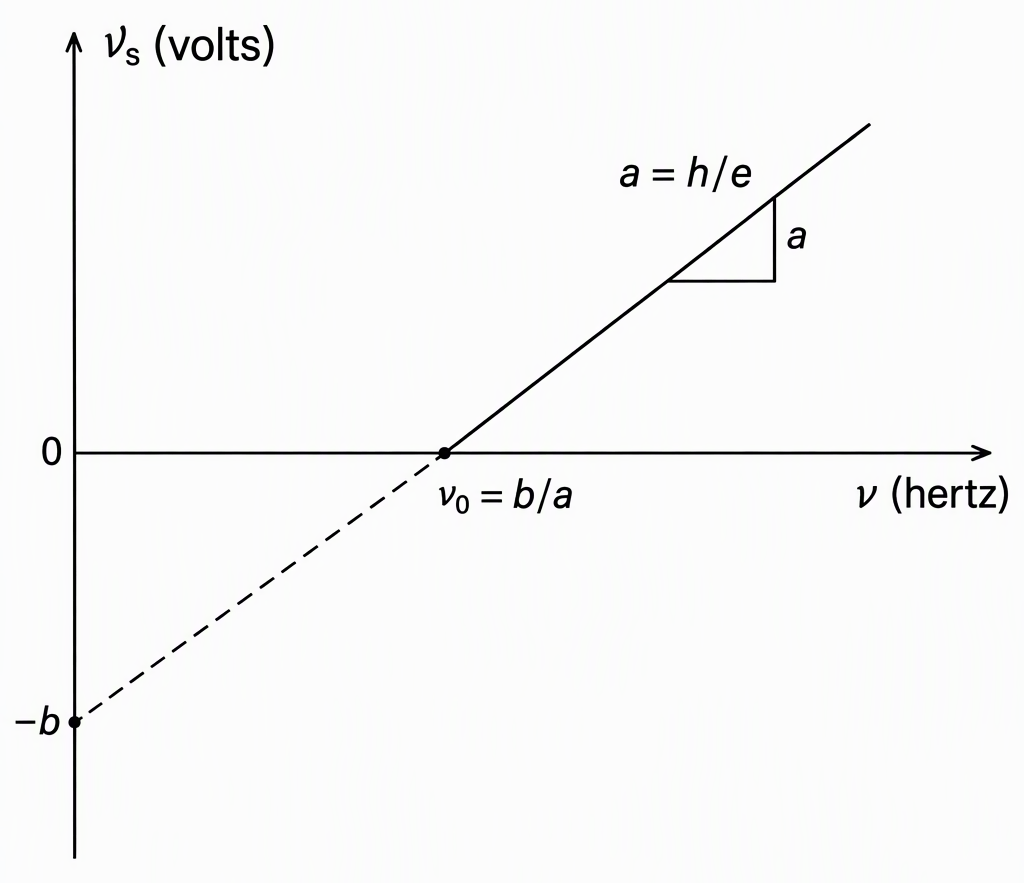
Compare the measured line with Einstein’s photoelectric equation:
At threshold, stopping potential is zero:
The slope has units of volt-seconds because it is voltage divided by frequency. The positive constant has units of volts; the actual vertical intercept is its negative.
Mistake label: linked reasoning, intercept sign or graph quantity misread.
Advanced-style extension B: the photon has the longer wavelength
Equal energy values do not imply equal momenta because the particles obey different energy–momentum relations. For the photon:
For the non-relativistic electron:
Taking the requested ratio:
Do not apply the following massive-particle relation to a photon:
It comes from non-relativistic kinetic energy. The electron calculation requires kinetic energy much smaller than its rest energy; outside that regime, use a relativistic relation.
Mistake label: linked reasoning, wrong energy–momentum model. This small set diagnoses mistakes; it does not establish exam readiness.
What should I practise next, and when should I take a full mock?
Repair the specific error before increasing difficulty; take a full mock after correcting the chapter errors. Use your working to choose the next task. A correct option reached through incorrect reasoning still needs repair.
- Threshold or intensity reasoning failed: Revisit photon energy, threshold frequency, and current versus maximum kinetic energy. Then retry without looking at the explanation.
- Direct calculations failed: Write the energy or momentum equation before substitution. Check dimensions and proportionality before accepting the answer.
- Only the extensions failed: Practise reading graph axes and choosing the correct energy–momentum relation before seeking more elaborate questions.
Next, use authentic Main or Advanced PYQs for exam calibration. Keep them distinct from the original teaching questions here, and include numerical-entry practice: Main Physics contains 20 single-correct MCQs and 5 numerical-answer questions. This symbolic set cannot replace working with numerical values and units.
Once you have corrected the chapter errors, use a full paper to check whether those skills hold alongside other chapters. JEEnius offers full-length mocks, including free tests, with 75 questions, 300 marks, 180 minutes and a scored per-subject breakdown. Use one as a full-paper check, not a substitute for chapter practice, then return to any Dual Nature question whose reasoning you could not reproduce.
Next step: full-length mock tests on JEEnius and sit a full 75-question, 300-mark, 180-minute paper and get a scored per-subject breakdown (free tests included).
If that step was the hard part, work through Equation of a Line JEE 2024: Perpendicular Distance.
Frequently asked questions
Which Dual Nature questions should I practise first for JEE?
Start with concept checks if you confuse intensity, frequency, threshold or photocurrent. Move to direct calculations when those ideas are clear, then attempt graph and momentum extensions once you can explain direct solutions without prompts. Choose by the errors in your working, not your class or attempt number.
Are these Dual Nature questions JEE previous-year questions?
No, these are six original teaching questions with worked solutions, not previous-year questions. Use them to diagnose mistakes, then attempt authentic JEE Main or Advanced PYQs for exam calibration, including numerical-entry practice.
Does increasing light intensity increase stopping potential?
At fixed frequency above threshold, increasing intensity does not change stopping potential for the same metal. It increases saturation photocurrent under unchanged collection conditions, provided heating and space-charge effects do not limit the response. Below threshold, increasing intensity does not cause photoemission in the standard single-photon model.
How does de Broglie wavelength change when accelerating voltage is quadrupled?
For an electron accelerated from rest that remains non-relativistic, de Broglie wavelength is inversely proportional to the square root of accelerating voltage. Quadrupling the voltage therefore halves the wavelength, rather than reducing it to one quarter.