
Which differentiation practice questions should I start with for JEE?
Choose differentiation practice questions for JEE by the error you need to fix: rule-wise drills for unreliable rule application, mixed PYQs when your rules are secure, and full-length mocks for errors inside complete papers. This page provides six original questions with worked solutions, not actual JEE previous-year questions.
These are practice stages, not interchangeable competitors. A mock is an inefficient way to repair a missing inner derivative. Attempt the diagnostic below, then use your mistakes to choose the next stage.
How do free drills, mixed PYQs and full-length mocks compare?
Drills isolate a weakness, PYQs test recognition in authentic exam questions, and mocks test question selection and time allocation across subjects. Compare them by the skill you need to repair, not by the size of the question collection.
- Skill tested: Original rule-wise drills on this page: derivative rules and basic reasoning. Mixed differentiation PYQs: recognising a method without a rule label. Full-length mocks: execution across a complete paper.
- Prerequisites: Original drills: basic formulas. Mixed PYQs: secure rule application. Mocks: enough syllabus preparation to make whole-paper performance meaningful.
- Topic isolation: Original drills: high. Mixed PYQs: differentiation-focused, sometimes with linked concepts. Mocks: low, across Physics, Chemistry and Mathematics.
- Exam realism: Original drills: foundations, not exam questions. Mixed PYQs: authentic questions, but chapter filtering supplies a clue. Mocks: full-paper constraints, not guaranteed exam difficulty.
- Solution review needed: Original drills: each derivative step. Mixed PYQs: method selection and reasoning. Mocks: algebra, selection and time use.
- Best use: Original drills: repair a known error. Mixed PYQs: handle unfamiliar wording. Mocks: check whole-paper execution.
- Main limitation: Original drills: limited breadth. Mixed PYQs: remembered solutions can disguise weakness. Mocks: inefficient for isolating one rule.
For PYQs, retain the exam, year, and paper or shift identification, then check the corresponding official answer key. Use jeemain.nta.nic.in for official Main material. An answer key checks the result; a worked solution provides the steps needed to locate a reasoning error.
When whole-paper practice is appropriate, JEEnius full-length mocks include free tests with 75 questions, 300 marks, 180 minutes and a scored per-subject breakdown. That breakdown is not a verified differentiation-specific diagnostic, and a mock is not guaranteed to contain any particular number of differentiation questions.
Which format should Class 11, Class 12 and dropper students choose?
Choose by your written working, not by class or repeat status. A Class 11 student may select rules correctly, while a dropper may still miss a product-rule term. Familiarity with a question is not evidence that you can solve an unseen variation.
- Class 11, losing inner derivatives: Begin with isolated chain, product and quotient-rule drills. For chain-rule questions, identify the outer operation and inner expression separately. Move to mixed questions once you can explain every factor in the derivative.
- Class 12, solving only when the method is named: Choose a mixed set without rule labels. During review, record which feature should have suggested the method, not merely the correct answer.
- Dropper, recognising remembered PYQ solutions: Use unseen original variations and justify every step. Recalling the next line of a familiar solution is not the same as deriving it.
- Correct in chapter practice, unreliable in full papers: Use a full-length mock. Separate algebra errors from rushed question selection and poor time allocation, because these need different repairs.
- Advanced aspirant with secure routine differentiation: Seek problems combining derivatives with domains, piecewise definitions, modulus and differentiability. A longer expression is not automatically a deeper problem.
Can these six free questions identify my differentiation weakness?
This diagnostic tests rule selection, dependent variables and differentiability checks through separate questions. It is not a complete differentiation question bank. Attempt every question without looking at the solutions, and record the exact line where you became stuck or uncertain.
Original practice, not previous-year questions. No official time limit is attached to this set.
Q1. Single-correct MCQ
For the following function, find the derivative at the stated point:
Q2. Differentiate the following function on its stated domain:
Q3. Numerical-answer style
Find the derivative at the given point on the curve:
Q4. Find the derivative in terms of the parameter:
Q5. Find every real input at which the following function is not differentiable. Justify why your list is complete.
Q6. Find both constants so that the following function is differentiable at zero:
The routine calculations are foundations. The modulus and piecewise questions are conceptual bridge work, not a claim that these six questions reproduce JEE Advanced difficulty.
Before checking, mark each attempt as “reasoned through”, “uncertain step” or “stuck”. Use those notes to distinguish a justified solution from a correct guess.
How do I check the solutions and identify the exact mistake?
Check the reasoning before accepting the final answer. A correct answer obtained through an invalid rule is not a secure skill. Compare your first decisive step with the working below, then complete the repair task for that error.
How do I solve Q1 without missing the inner derivative?
Option C is correct. Differentiate the outer cube, then multiply by the derivative of the inner expression.
Error tag: chain rule. Option B can result from omitting the inner derivative. Repair: practise powers of quadratic expressions, trigonometric expressions and nested functions, identifying each inner derivative.
Why does Q2 need logarithmic differentiation?
Both the base and exponent vary, so neither the constant-power rule nor the constant-base exponential rule applies directly. Taking logarithms turns the exponent into a factor.
The positive domain makes this logarithmic step valid for the stated real-valued function. Error tag: logarithmic differentiation. Repair: practise distinguishing constant powers, constant-base exponentials and variable-base variable-exponent functions before differentiating.
Where does the product rule enter Q3?
It applies to the product of the two variables; the required derivative is negative one. Treat the second variable as dependent on the first throughout.
The product contributes two terms, not one. Error tag: product rule inside implicit differentiation. Repair: differentiate products involving a dependent variable separately before solving another complete implicit equation.
Why do I divide the parameter derivatives in Q4?
The derivative with respect to the parameter must be divided by the input’s rate of change, not multiplied by it. The stated positive domain ensures the denominator does not vanish.
Multiplying the rates does not give the required derivative. Error tag: parametric ratio. Repair: write the ratio before substituting either derivative, and check where its denominator is zero.
How do I prove exactly where Q5 is not differentiable?
Differentiability fails at the two zeros of the expression inside the modulus. Outside the interval between them, retain the quadratic; inside it, reverse its sign.
Each branch is a polynomial, so only the joining points need further checks. At each join, the one-sided slopes disagree.
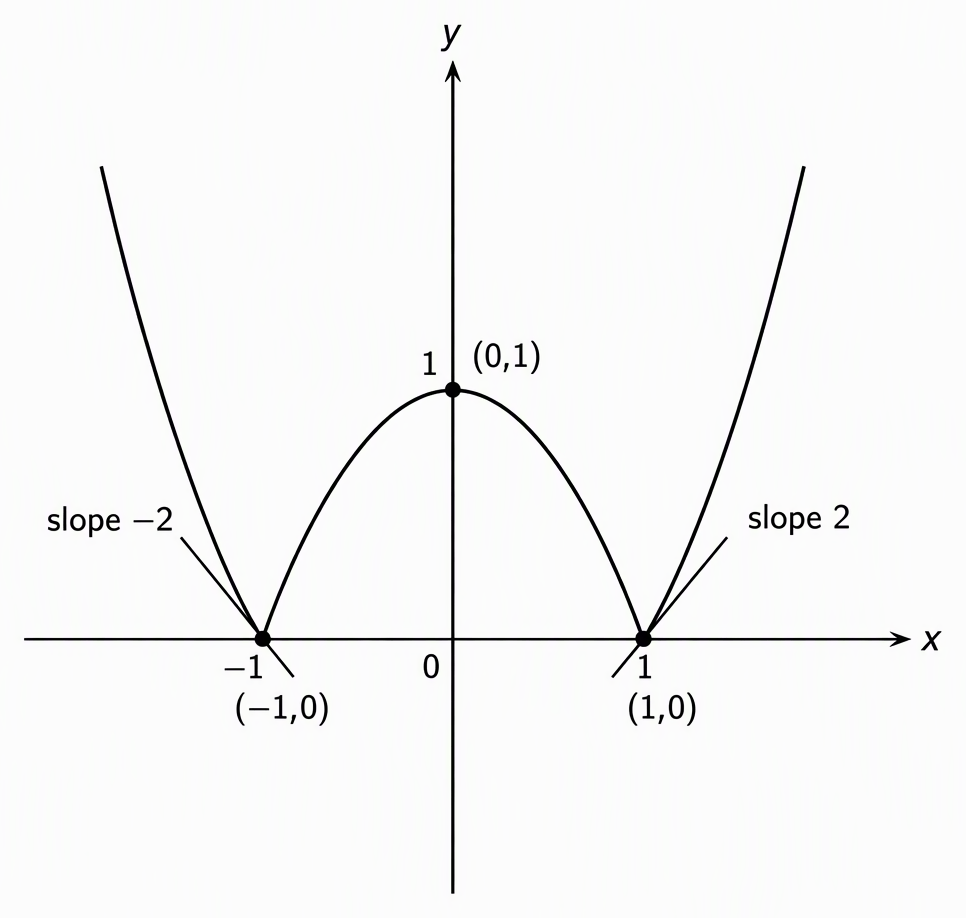
Error tag: one-sided derivatives. Repair: find sign-change intervals, remove the modulus correctly, and compare one-sided derivatives at every join. A zero inside a modulus is a candidate, not proof of a corner.
Why must I check continuity before differentiating Q6?
Matching branch slopes is insufficient if the function jumps at the join. Enforce continuity first, then match the one-sided derivatives.
The right-hand branch is continuous at zero. With continuity secured, calculate the one-sided derivatives:
Error tag: continuity before differentiability. The branch derivatives alone do not test continuity. Repair: check the left limit, right limit and function value before comparing derivatives in every piecewise problem.
What should I practise after checking these six questions?
Repair the cause of the error, then test the repair on an unseen question. Keep the resource if only your algebra failed; change the practice format if you need help choosing a rule or executing under whole-paper constraints.
- If the setup was wrong, return to the relevant rule. Solve structurally different examples, not the same expression with changed numbers. If only algebra failed, redo the calculation before changing resources.
- Attempt a fresh variation without notes. Later, mix it with other question types so the method is no longer signposted. Explain why the chosen rule applies.
- Move to identified Main PYQs. Use authentic single-correct and numerical-answer questions, retaining their source details. Do not plan around a guaranteed differentiation question count or chapter weightage.
- Keep topic boundaries clear. Applications of Derivatives and Differential Equations are related but distinct topics. Neither should silently replace a differentiation practice set.
- Apply the correct paper instructions. Main practice must account for its marking scheme:
Compulsory question slots are not an instruction to guess blindly. For Advanced, read the instructions for the specific paper because question types and marking vary; never apply the Main mock pattern to Advanced.
Once repaired skills hold up in mixed practice, use a JEEnius free full-length mock as a later check of whole-paper execution, not as a substitute for these questions. For each lost mark, identify whether the cause was mathematics, question selection or time allocation, then choose the corresponding repair.
Next step: full-length mock tests on JEEnius and sit a full 75-question, 300-mark, 180-minute paper and get a scored per-subject breakdown (free tests included).
If that step was the hard part, work through Differential Equations JEE 2024: 1 February Shift 2.
Frequently asked questions
Which differentiation questions should I practise first for JEE?
Start with rule-wise drills if you miss inner derivatives or apply derivative rules incorrectly. Move to mixed PYQs when your rule application is secure, and use full-length mocks to test question selection and time allocation across subjects.
Are these differentiation questions actual JEE PYQs?
No, these are six original practice questions with worked solutions and error-specific repair tasks. For authentic PYQ practice, retain the exam, year, and paper or shift details, then check the corresponding official answer key.
Are these six differentiation questions enough for JEE Advanced?
No, this set is a diagnostic, not a complete differentiation question bank or a reproduction of JEE Advanced difficulty. Once routine differentiation is secure, practise problems combining derivatives with domains, modulus, piecewise definitions and differentiability.
Why should I check continuity before differentiability?
A function cannot be differentiable at a point where it is discontinuous. For a piecewise function, first compare the left limit, right limit and function value at the join, then compare the one-sided derivatives.