
Which free d-block practice questions for JEE should I start with?
Use NCERT-based drills to repair factual and conceptual gaps, verified PYQs to check exam application, and self-timed mixed sets to test retrieval after revision. If you do not know your weak area, attempt the six free d-block practice questions for JEE below before choosing a route. Each has a worked explanation, so you can check the reasoning, not just the answer.
These are original practice questions, not previous-year questions. They test configurations, transition-element classification, magnetism, colour and electron balancing.
This comparison covers practice formats, not a ranking of websites or question banks. Choose the next set by the mistakes you make here, rather than repeating questions whose answers you recognise.
How do NCERT-based drills, verified PYQs and timed mixed sets compare?
Choose by the error you need to expose, not by which format sounds hardest. Original NCERT-based drills check individual rules. Verified JEE PYQs show how those rules were actually tested. Self-timed mixed sets assembled from checked questions test retrieval without a subtopic cue.
- Best use
- Original NCERT-based drills: Definitions, electronic configurations and exceptions.
- Verified JEE PYQs: Applying concepts in authentic exam questions.
- Self-timed mixed sets: Retrieving the right rule without a subtopic cue.
- Prerequisite knowledge
- Drills: Read the corresponding NCERT explanation.
- PYQs: Understand the basic rule and its limits.
- Mixed sets: Resolve known conceptual errors first.
- Mistake exposed
- Drills: Incorrect facts or atom-versus-ion confusion.
- PYQs: Misreading conditions or accepting partly correct options.
- Mixed sets: Slow recall, rushed reading and difficulty switching between concepts.
- Solution quality needed
- Drills: The rule behind each answer.
- PYQs: Traceable paper or session details, a checked key and reasoning.
- Mixed sets: Checked answers explaining the stated conditions.
- Main limitation
- Drills: Isolated recall does not establish exam readiness.
- PYQs: Familiar answers can hide weak reasoning.
- Mixed sets: Timing unresolved gaps mainly measures those gaps.
- When to move on
- Drills: After independently explaining fresh examples.
- PYQs: After justifying answers and rejecting distractors.
- Mixed sets: After reviewing errors before another attempt.
These categories overlap: a timed set can contain PYQs. The choice is about how you use questions, not three separate sources.
Free questions and free worked explanations are different offers. Check solution access rather than assuming an external resource supplies both.
Which route fits my current preparation problem?
Pick the route that matches your mistake, not your class or attempt number alone. A dropper may still need configuration drills, while a first-time learner who explains configurations correctly can move beyond them. Use these situations to choose.
- Class 11 student studying early, or any first-time learner confusing atoms and ions: Choose untimed NCERT-based drills. Write the neutral configuration before removing electrons, and identify which shell loses them first.
- Class 12 student remembering textbook statements but struggling with combined options: Prioritise verified Main PYQs. Explain why each rejected option is wrong, including the condition that makes it wrong.
- Dropper recognising old answers: Mix fresh original questions with PYQs. Require a written reason before accepting a correct option as evidence of understanding.
- Student accurate without a clock but rushed under pressure: Use a checked, self-timed mixed set after resolving errors. Review misreading separately from slow recall.
- Advanced aspirant: Use these fundamentals as a diagnostic, then move to verified Advanced questions. This short set cannot establish Advanced readiness.
For parents, an independently explained answer is a better immediate check than a worksheet count. Ask the student to explain one rejected option or what would change if the ion changed. That checks the rule behind the answer rather than completion alone.
Can I try six free d-block practice questions before seeing the answers?
Attempt this original foundation diagnostic without notes, and write a reason beside every answer. These free d-block practice questions for JEE are not a predicted paper, a PYQ collection or complete chapter coverage. All answers are in the next section.
For numerical questions, show the electron count or electron transfer. If uncertain, record the assumption behind your answer.
Question 1: Ground-state configurations, single correct
Which pair gives the accepted ground-state configurations of chromium and copper, respectively? Each option lists chromium first.
Question 2: Ion configuration, single correct
Which configuration represents the ground state of the iron(III) ion? Check which electrons are removed first, not merely the total number removed.
Question 3: Classification, single correct
Under the usual transition-element definition, which statement correctly compares copper and zinc?
- A: Both are transition elements because both belong to the d-block.
- B: Neither is a transition element because both neutral atoms have filled d subshells.
- C: Zinc is a transition element, but copper is not.
- D: Both belong to the d-block; copper qualifies as a transition element through copper(II), while zinc does not.
Question 4: Magnetism, numerical answer
How many unpaired electrons are present in a high-spin manganese(II) ion? As an optional extension, calculate its spin-only magnetic moment, keeping it separate from the requested integer answer.
Question 5: Colour, single correct
Among these aqueous ions, which is expected to show colour associated with d–d transitions? Consider ordinary aqueous conditions, not an added coloured ligand.
Question 6: Electron balancing, numerical answer
In acidic medium, one mole of permanganate ions oxidises how many moles of iron(II) ions? The products are iron(III) ions and manganese(II) ions. Use these products, not a permanganate reaction from a different medium.
What are the answers, and which rule explains each one?
The key is Q1: B; Q2: C; Q3: D; Q4: 5; Q5: B; Q6: 5. Check your reasoning even where your option matches. Use the concept tags below to separate a remembered answer from a rule you can apply.
Q1: B. Error tag: ground-state exceptions
The accepted ground-state configurations are:
“Half-filled or fully filled is stable” is a memory aid here, not a universal configuration rule. Ground states depend on the total energy balance; do not move electrons simply to manufacture a half-filled subshell.
Q2: C. Error tag: electron-removal order
Neutral iron loses both 4s electrons before losing a 3d electron:
Options A and B leave 4s electrons while removing 3d electrons too early. Option D describes iron(II), not iron(III).
Q3: D. Error tag: transition-element definition
A transition element has an incompletely filled d subshell in its atom or can form cations with an incompletely filled d subshell. Copper qualifies through copper(II), despite its neutral atom having a filled d subshell.
Zinc and its usual zinc(II) ion retain filled d subshells. D-block membership alone does not satisfy the transition-element definition.
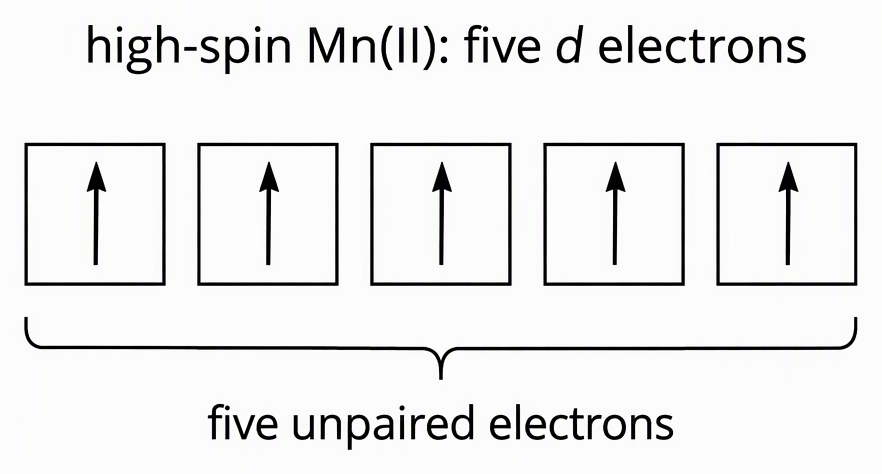
Q4: 5. Error tag: unpaired-electron counting
Manganese(II) has five d electrons. Under the stated high-spin assumption, each occupies a separate d orbital, giving five unpaired electrons.
For the optional spin-only calculation, use the number of unpaired electrons:
Q5: B. Error tag: colour mechanism
Titanium(III) is expected to show this colour because its partially filled d subshell permits d–d transitions in its aqueous environment. Compare the electron counts:
Absence of d–d transitions does not mean every compound containing an empty or filled d subshell must be colourless. Other mechanisms, including charge transfer, can produce colour.
Q6: 5. Error tag: medium-specific electron balance
In acidic medium, permanganate accepts five electrons:
Each iron(II) ion supplies one electron:
Therefore, one mole of permanganate oxidises five moles of iron(II). The ratio follows from electron transfer to the stated product, not from a coefficient memorised without its medium.
How should my errors decide the next practice set?
Repair the rule you missed before adding timing. These six questions identify particular errors, not a readiness score or percentile. Choose your next set using the reasoning you got wrong.
- Configuration or definition error: Revisit the corresponding NCERT explanation. Do fresh atom-versus-ion drills before a mixed set.
- Correct d-electron count, wrong colour or magnetism reasoning: Practise questions specifying the ion and, where relevant, the spin assumption. Name the colour mechanism.
- Permanganate error: Practise electron balancing in the stated medium instead of memorising an isolated coefficient.
- All answers correct, weak explanations: Recognition is not mastery. Write the reasoning, then attempt verified PYQs.
- All correct with sound reasoning: Broaden coverage to oxidation-state trends, other properties and dichromate chemistry before judging chapter readiness.
I recommend an error log with four fields: question, wrong assumption, corrected rule, fresh follow-up question. Close an entry only after explaining a fresh example.
For later whole-paper practice, JEEnius includes free full-length mocks with 75 questions, 300 marks, 180 minutes and a scored per-subject breakdown. That subject breakdown does not isolate d-block mastery; use your written error log for that narrower check.
What else should I check before using free d-block practice for JEE?
Check coverage, question origin and explanations before treating a collection as complete preparation. Free access alone tells you nothing about whether its key is checked or its chapter coverage is complete.
Is NCERT-based practice enough, or do I need PYQs?
NCERT-based practice repairs definitions and basic reasoning; PYQs check application in authentic exam questions. Neither is sufficient for every student. Choose according to the errors you can demonstrate.
Does this diagnostic represent Main or Advanced?
No. It is an original foundation set, not an official paper for either exam. It neither establishes Advanced readiness nor implies a fixed Advanced question pattern.
Is this a complete d- and f-block question collection?
No. It samples selected d-block fundamentals and does not test f-block chemistry. Broaden coverage before making a chapter-level judgement.
What should I do when answer keys disagree?
Check the exact ion, reaction medium, spin assumption and question provenance. For a claimed PYQ, locate the paper or session and checked key before trusting a third-party explanation.
How many questions should I complete?
There is no supported universal minimum here. Prioritise broader coverage and independent reasoning. Choose one error, write its corrected rule, and solve a fresh question without looking at the explanation.
Next step: full-length mock tests on JEEnius and sit a full 75-question, 300-mark, 180-minute paper and get a scored per-subject breakdown (free tests included).
If that step was the hard part, work through Adjoint and Inverse JEE 2025: Why the Answer Is 280.
Frequently asked questions
Are these d-block questions JEE previous-year questions?
No. These six questions are original foundation drills with worked explanations, not previous-year questions. They test selected d-block fundamentals and do not establish JEE Main or Advanced readiness.
Is NCERT-based d-block practice enough for JEE?
NCERT-based drills repair definitions, configurations and basic reasoning, while verified PYQs test application in authentic exam questions. Choose according to your errors rather than treating either format as sufficient for every student. Add timed mixed sets after resolving known conceptual gaps.
How many d-block questions should I practise for JEE?
There is no universal minimum supported by this diagnostic. Prioritise coverage and independent reasoning over worksheet counts. Correct one mistaken rule, then solve and explain a fresh question without looking at the solution.
What should I do when d-block answer keys disagree?
Check the exact ion, reaction medium, spin assumption and question source before comparing explanations. For a claimed PYQ, locate the paper or session details and a checked key before trusting a third-party solution.