
Which Chemical Kinetics practice should I choose for JEE?
For chemical kinetics practice questions for JEE, use drills if you cannot choose the rate equation, Main PYQs if you solve standard problems independently, and Advanced PYQs when you can combine ideas. Drills repair concepts, Main PYQs calibrate against past-paper demands, and Advanced PYQs stretch linked reasoning.
Start with the six author-created questions with worked solutions below, not PYQs. These are complementary stages, not competing resources with one universal winner.
How do topic-wise drills compare with Main and Advanced PYQs?
Drills target an exact skill; PYQs test you against actual past-paper demands. Choose by the learning gap, not an advertised difficulty label. “Free” should mean you can see the question and check its answer without payment, as you can with the diagnostic below.
Each comparison uses this order: original topic-wise drills; JEE Main PYQs; JEE Advanced PYQs.
- Purpose: Repair a specific skill; calibrate against Main questions; practise linked reasoning.
- Prerequisites: The concept being drilled; independent use of standard kinetics methods; standard calculations plus an explanation of their assumptions.
- Exam authenticity: Author-set difficulty is not evidence of exam difficulty; authentic Main demands when provenance is verified; authentic Advanced demands, but difficulty and format vary across questions and years.
- Solution checking: Inspect derivation, dimensions and assumptions; compare with the official key and check the explanation separately; check the official key, reasoning and paper-specific instructions separately.
- Main limitation: Narrow drills can reveal the intended method too easily; remembered Main solutions can masquerade as competence; Advanced problems can hide a basic gap under several reasoning steps.
- When to move on: You can justify the method on an unseen question; unfamiliar Main questions no longer expose repeated foundational errors; after Advanced work, return to whichever skill failed.
An official answer key establishes the accepted answer, not the reasoning. An explanatory solution must still justify its rate law, algebra and assumptions.
Which option fits my current preparation?
Choose by what you can demonstrate on paper, not by your class label. Selecting a rate law independently matters more than recognising a worked example. Use these readiness checks to choose your next set.
- Class 11, studying ahead: Cover concentration, logarithms and the relevant kinetics concepts before starting drills. Early Advanced practice is not compulsory.
- Class 12, just taught the chapter: Attempt the original set below before collecting a large PYQ compilation. Repair rate-law selection errors first.
- Class 12, solving textbook examples independently: Prioritise unseen Main PYQs. Use drills only for skills that fail.
- Dropper, recognising most Main PYQs: Write a fresh derivation and explain the assumptions. Recalling an option is not evidence that you can solve an unfamiliar version.
- Advanced aspirant: Move to Advanced PYQs when you can explain standard calculations and their assumptions without a solution prompt.
For students and parents considering a paid resource, identify the missing function first: unfamiliar practice, explanations or reliable checking. If the student cannot explain why a rate law applies, choose better explanations before more questions.
Can I try six free Chemical Kinetics questions now?
Attempt the six questions below without notes, and write a reason alongside each answer. Every question is original practice, not a JEE PYQ. All numerical values are constructed problem data, not exam statistics.
This set diagnoses foundational reasoning, not complete Advanced-level readiness. Its question formats do not reproduce a full exam pattern. Attempt all six before reading the worked answers.
1. What is the overall order from these rate changes?
Original practice, not a JEE PYQ. Single-correct MCQ. Use the two rate changes to determine the exponents independently.
Doubling the concentration of A at fixed B concentration doubles the rate. Doubling the concentration of B at fixed A concentration quadruples it. What is the overall order?
- A: 1
- B: 2
- C: 3
- D: 4
2. What are the units of this rate constant?
Original practice, not a JEE PYQ. Written units answer. Determine the complete unit of the rate constant, including the powers of volume, amount and time.
Use these units for rate and concentration:
3. How long does first-order consumption take?
Original practice, not a JEE PYQ. Numerical answer. A reactant undergoes first-order decay with a constant half-life of 10 minutes. How many minutes are required for 87.5% of the initial reactant to be consumed?
4. What concentration remains during zero-order decay?
Original practice, not a JEE PYQ. Numerical answer. Find the concentration after 12 minutes, assuming zero-order behaviour throughout that interval.
Report the answer in:
5. What activation energy does this Arrhenius slope give?
Original practice, not a JEE PYQ. Numerical answer. For a natural-log Arrhenius plot, use the following axes and slope.
Assume constant activation energy over the temperature interval. Use:
Find the activation energy to the nearest whole number in:
6. What changes when the excess reactant concentration doubles?
Original practice, not a JEE PYQ. Short written answer. B is in large excess, so its concentration stays effectively constant during a run.
Express the observed first-order rate constant using the underlying rate constant and B concentration. What happens to each constant if the excess concentration of B doubles in a separate run at the same temperature?
How do I check the answers and identify my mistake?
Check each step against the reasoning below, not just the final value. A correct answer reached through an invalid assumption still needs repair. For each mismatch, identify whether the cause was equation selection, concentration interpretation, units, graph reading or experimental assumptions.
How does Question 1 give third order?
Answer: option C, overall order 3. Compare rates while changing only one concentration; the fixed concentration and rate constant cancel.
Do not infer experimental order from the overall balanced equation. Stoichiometric coefficients do not generally supply the exponents in an experimentally determined rate law.
How do I derive the units in Question 2?
Divide the units of rate by the units of the concentration factors. The overall concentration power is three-halves, so the rate constant needs a negative one-half concentration power.
Using inverse seconds for every rate constant is wrong. That unit belongs to a first-order rate constant when time is measured in seconds; the unit changes with overall order.
Why does Question 3 take three half-lives?
Answer: 30 minutes. When 87.5% is consumed, 12.5% remains, so convert to the fraction remaining before counting half-lives.
The half-life sequence tracks reactant remaining, not reactant consumed. Substituting the consumed fraction into a decay expression answers a different question.
How do I apply the zero-order law in Question 4?
Answer: the remaining concentration is 0.040 moles per litre. Zero-order decay removes equal concentration amounts in equal time intervals, while that behaviour holds.
Retain concentration units after subtraction. Never extrapolate this expression to negative concentrations: after depletion, the assumed constant consumption rate cannot continue.
How does the Arrhenius slope give Question 5's answer?
Answer: 50 kilojoules per mole, rounded as requested. For a natural-log Arrhenius plot, the slope is negative activation energy divided by the gas constant.
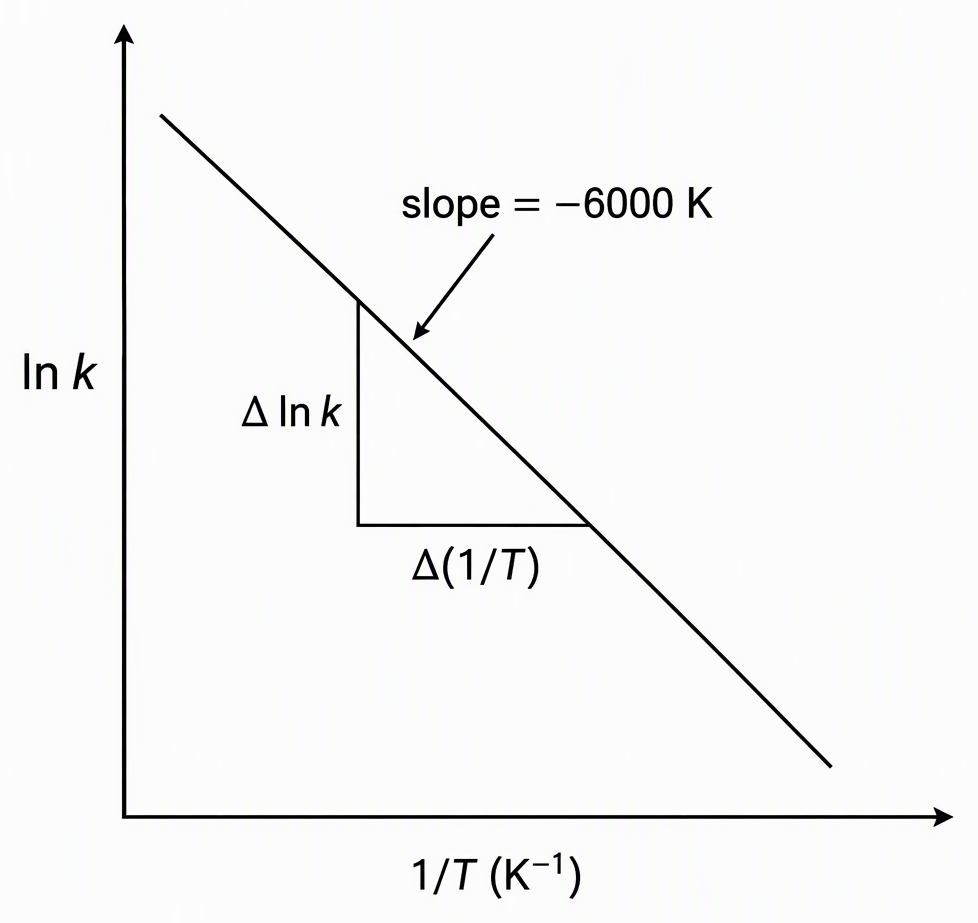
The horizontal axis has inverse-kelvin units, so the slope has kelvin units. Check the logarithm base before using the slope:
Why does only the observed constant change in Question 6?
Answer: the observed constant doubles; the underlying constant stays unchanged at fixed temperature. Absorb the effectively constant excess concentration into the observed constant.
For concentrations in moles per litre and time in seconds:
The underlying law remains second order overall. Its observed first-order form depends on B staying effectively constant; “large excess” is an experimental assumption, not a change in the underlying constant.
Which practice should each error send me to?
Choose the next set by the failed skill, not your total correct count. Use this guide after identifying the first incorrect step.
- Questions 1–2: Rate-law inference and dimensional-analysis drills.
- Questions 3–4: Integrated-law drills, especially remaining concentration and validity limits.
- Question 5: Logarithm conversion and graph-slope work.
- Question 6: Explain experimental assumptions before attempting tougher linked problems.
- All six correct with defensible reasoning: Attempt unseen Main PYQs next. This result does not establish exam readiness or predict a score.
How do I build a free practice sequence that closes the gap?
Attempt without notes, inspect the first incorrect step, redo from a blank page, then solve an unseen question testing the same skill. Reading a solution is not the final step. The unseen question checks whether you can apply the correction independently.
For PYQs, prefer questions whose year, paper or shift, and answer-key provenance can be checked. Match the key to the actual question and option order. No external collection is being claimed here as checked or freely accessible.
For Advanced PYQs, read the marking instructions attached to the actual paper. Question types and marking schemes vary, so do not carry assumptions from a Main worksheet into an Advanced attempt.
For optional practice in another Chemistry chapter, use Chemical Bonding Practice Questions JEE: 6 Worked Examples.
Should I set one time limit for every kinetics question?
No. Chapter accuracy and performance inside a mixed paper are different skills. First establish that you can select and justify the method. Then check whether you can do so while switching among subjects and deciding which questions to attempt next.
When you reach that stage, JEEnius includes free full-length mocks: a 75-question, 300-mark, 180-minute paper with a scored per-subject breakdown. Use a mixed paper to check application under exam conditions, then return to the first kinetics step you could not justify.
Next step: full-length mock tests on JEEnius and sit a full 75-question, 300-mark, 180-minute paper and get a scored per-subject breakdown (free tests included).
Frequently asked questions
Should I practise chemical kinetics drills or JEE PYQs first?
Start with topic-wise drills if you cannot select the rate equation independently. Use unseen JEE Main PYQs once you can solve standard problems without prompts. Move to Advanced PYQs when you can combine ideas and explain the assumptions behind standard calculations.
Are these six chemical kinetics questions actual JEE PYQs?
No. All six are author-created practice questions with worked solutions, not questions from past JEE papers. They diagnose foundational reasoning and do not reproduce a complete exam pattern.
Does solving all six questions mean I am ready for JEE Advanced?
No; getting all six correct with defensible reasoning is a reason to attempt unseen Main PYQs next. This diagnostic does not establish complete Advanced readiness or predict a score. Advanced practice requires linked reasoning as well as command of standard methods and their assumptions.
How should I revise after getting a chemical kinetics question wrong?
Find the first incorrect step and classify the error: equation selection, concentration interpretation, units, graph reading or experimental assumptions. Study the reasoning, redo the question from a blank page, then solve an unseen question testing the same skill. Choose your next drill by the failed skill, not your total correct count.