
Which free Chemical Bonding questions should you start with for JEE?
Use JEE Main PYQs as your benchmark after completing the chapter, not as the starting point for every weakness. For free chemical bonding practice questions for JEE, choose NCERT exercises to repair fundamentals and Advanced PYQs when you can justify Main-level answers and combine concepts.
The six original questions below have worked explanations, without a download or signup. Use them as a starting check to choose your next practice source, not as a replacement for previous-year questions.
How do NCERT exercises, Main PYQs and Advanced PYQs compare?
NCERT exercises support conceptual repair; Main PYQs provide authentic Main practice; Advanced PYQs test a different exam. The original diagnostic below checks selected misconceptions and includes worked explanations. Compare the options by what they test and what you need before attempting them:
- Option: NCERT chapter exercises
- Best use: Repairing definitions and basic reasoning.
- Prerequisite: Read the relevant theory and examples.
- Explanation availability: The textbook teaches concepts; do not assume every exercise has a worked solution.
- Main limitation: Not a substitute for exam-format practice.
- Option: JEE Main PYQs
- Best use: Authentic Main question practice.
- Prerequisite: Completed chapter theory.
- Explanation availability: Official keys confirm answers; worked reasoning requires a separate explanation.
- Main limitation: Remembered answers can hide weak reasoning.
- Option: JEE Advanced PYQs
- Best use: Combining concepts under exam conditions.
- Prerequisite: Ability to justify Main-level answers.
- Explanation availability: Official keys and worked explanations are different resources.
- Main limitation: Advanced is a different exam; question types and marking can vary.
- Option: This original diagnostic
- Best use: Locating specific misconceptions.
- Prerequisite: Familiarity with basic bonding terms.
- Explanation availability: Every answer is explained below.
- Main limitation: Neither an exhaustive chapter bank nor an official paper.
Source note: Use official NCERT digital textbooks and official exam papers and keys. A key confirms the accepted answer but does not necessarily explain the reasoning. Do not assume an official chapter-wise collection exists or that a commercial collection is entirely free.
Which practice route fits your current stage?
Choose by the reasoning you can demonstrate, not just your class or attempt year. A Class 11 student may be ready for Main PYQs, while a dropper may need to repair a specific misconception. These options form a sequence, not a permanent choice of one source over the others.
- Class 11, confusing geometry with shape: Return to Lewis structures and electron-pair counting. If you call ammonia tetrahedral without specifying electron-pair geometry, revise the distinction and attempt relevant NCERT exercises before relying on timed PYQs.
- Class 12, chapter completed but readiness unchecked: Attempt unseen Main PYQs without looking at solutions. Write the governing rule before checking the key.
- Dropper, familiar with PYQ answers: Explain why every distractor is wrong. Then attempt unfamiliar original questions to check whether you can apply the same reasoning without recalling an answer.
- Advanced aspirant, consistently justifying Main answers: Move to Advanced PYQs. Read each question’s actual marking instructions instead of carrying over assumptions from Main or another Advanced paper.
- Unsure where the weakness lies: Attempt the diagnostic first. Use the concept-level error map below rather than choosing a source from your total score.
The useful distinction is not “easy versus hard”. It is repairing a rule versus applying that rule without a hint.
Can you solve these six free Chemical Bonding questions without help?
Attempt all six before reading the key, and write a short reason beside each choice. These are original single-correct practice questions, not PYQs, with four options each. They check selected misconceptions, not complete chapter coverage, and their score does not predict JEE marks.
1. What are ammonia’s electron-pair geometry and molecular shape in the VSEPR model?
Consider three bonding pairs and one lone pair around nitrogen.
- A. Both are tetrahedral.
- B. Electron-pair geometry is tetrahedral; molecular shape is trigonal pyramidal.
- C. Electron-pair geometry is trigonal planar; molecular shape is trigonal pyramidal.
- D. Electron-pair geometry is tetrahedral; molecular shape is bent.
2. Which gives the bond angles in methane, ammonia and water from largest to smallest?
Compare the hydrogen–central atom–hydrogen angles.
- A. Water, ammonia, methane.
- B. Ammonia, methane, water.
- C. Methane, ammonia, water.
- D. Methane, water, ammonia.
3. Which statement correctly compares the molecular polarity of boron trifluoride and ammonia?
Consider their usual molecular geometries.
- A. Boron trifluoride is nonpolar because its bond dipoles cancel; ammonia is polar.
- B. Both are polar because both contain polar bonds.
- C. Boron trifluoride is polar; ammonia is nonpolar because its three bonds are identical.
- D. Both are nonpolar because each has three identical surrounding atoms.
4. A ground-state oxygen molecule loses one electron to form the singly positive oxygen molecular ion. Which statement is correct?
Use molecular orbital theory.
- A. Bond order falls from 2 to 1.5; both species are paramagnetic.
- B. Bond order rises from 2 to 2.5; the ion is diamagnetic.
- C. Bond order remains 2; both species are paramagnetic.
- D. Bond order rises from 2 to 2.5; both species are paramagnetic.
5. How should the two nitrogen–oxygen bonds in the nitrite ion be described?
Consider the resonance hybrid, not one canonical structure.
- A. One remains single and the other remains double.
- B. They are equivalent, with bond character intermediate between single and double.
- C. They switch repeatedly between single and double bonds.
- D. Both become ordinary single bonds because resonance removes the double bond.
6. Which comparison of lithium fluoride and lithium iodide follows Fajans’ rules?
The cation is held constant.
- A. Lithium fluoride has greater covalent character because fluoride is smaller.
- B. They have equal covalent character because their cations are identical.
- C. Lithium iodide has greater covalent character because iodide is more polarisable.
- D. Lithium iodide has greater covalent character because iodide is less polarisable.
What are the correct answers and why?
The answer key is 1 B, 2 C, 3 A, 4 D, 5 B, 6 C. Check your explanation as carefully as your option. A correct choice reached through an incorrect rule still needs repair.
1. B, VSEPR counting. Three bonding pairs and one lone pair give four electron domains, arranged tetrahedrally. Molecular shape names the arrangement of atoms, so ammonia is trigonal pyramidal. A counts the domains correctly but incorrectly includes the lone pair when naming molecular shape.
2. C, lone-pair repulsion within this comparison. Methane has no central lone pair, ammonia has one, and water has two. Lone-pair repulsions compress the bond angles in this series:
D incorrectly puts water above ammonia. This is not a universal rule for unrelated molecules: central-atom identity and bonding environment also matter.
3. A, vector cancellation. Boron trifluoride has three equal bond dipoles in a trigonal-planar arrangement, so their vector sum is zero. Ammonia’s pyramidal arrangement has a nonzero molecular dipole. B confuses polar bonds with a necessarily polar molecule.
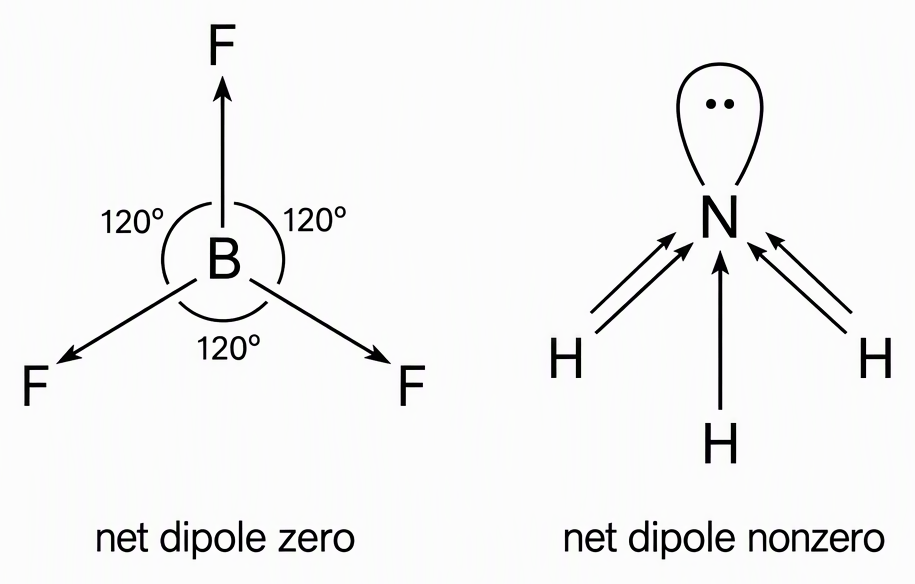
4. D, antibonding occupation. Oxygen has two unpaired electrons in its antibonding pi orbitals. Removing one leaves one unpaired electron, so both species remain paramagnetic.
B gets bond order right but wrongly assumes ionisation removes all unpaired electrons. Count the remaining unpaired electrons separately from calculating bond order.
5. B, resonance-hybrid interpretation. The equivalent canonical structures together represent delocalised bonding, giving equivalent nitrogen–oxygen bonds with character intermediate between single and double. C is tempting but false: resonance is not bonds switching places over time. Neither canonical structure alone describes the actual ion.
6. C, anion polarisability. With the lithium cation unchanged, iodide’s larger electron cloud is more easily distorted than fluoride’s, giving lithium iodide greater covalent character. A incorrectly treats smaller anion size as greater polarisability; it confuses anion distortion with cation polarising power.
What should you practise after each wrong answer?
Match the repair to the failed idea, not to the number of wrong answers. First separate a conceptual error from a misread option or remembered answer. A conceptual error needs theory and fresh application; a misread needs a better checking habit; recall needs an unfamiliar question.
- Questions 1 or 2: Revise Lewis structures, electron-pair counting and VSEPR. State electron-pair geometry and molecular shape separately, then do basic NCERT exercises before timed questions.
- Question 3: Practise molecular symmetry and vector cancellation. Mark bond-dipole directions and find their resultant. Memorising electronegativity does not address this error.
- Question 4: Draw the applicable molecular orbital occupation. Identify whether the removed electron is bonding or antibonding, then recount unpaired electrons independently of bond order.
- Question 5: Explain the resonance hybrid in words. Memorising canonical structures is insufficient if you still describe them as alternating real structures.
- Question 6: Make controlled comparisons under Fajans’ rules. Hold the cation constant before comparing anion polarisability; study changes in cation polarising power separately.
Do not declare yourself “Advanced-ready” from six correct answers. Check whether you can explain each rejected option without borrowing the solution’s wording, then choose practice for the reasoning you could not justify.
How can you build a free practice sequence without collecting more PDFs?
Follow this sequence: diagnostic, targeted theory repair, relevant NCERT exercises, unseen Main PYQs, then Advanced PYQs where appropriate. Pick questions that test the corrected reasoning without showing the answer first. After targeted practice, mix concepts so a chapter subheading does not tell you which rule to apply.
- Record the exact assumption. For each error, write both versions: “I counted atoms only” and “electron-pair geometry includes lone pairs.”
- Practise that concept directly. Use the relevant NCERT theory and exercises, checking reasoning rather than only final answers.
- Mix concepts. Combine shape, polarity, resonance and molecular orbital questions without topic labels.
- Reattempt with the solution hidden. Getting a familiar PYQ right from memory shows answer recall, not the ability to solve a fresh question.
- Preserve PYQ provenance. Keep the exam, year and question identifier with each authentic question. Check against the official final key where available.
If an explanation conflicts with the official key, investigate the exact wording, option order and any correction. Do not silently change the answer to make the sources agree.
Use official materials and legitimately free resources, not unauthorised copies of paid books. A freely shared PDF is not automatically a legitimate source.
This diagnostic leaves other areas to practise, including hydrogen bonding and coordinate bonding. It does not replace checking the applicable official syllabus: use jeemain.nta.nic.in for Main and the official JEE Advanced website for Advanced.
When should you test Chemical Bonding inside a full paper?
Move to a full paper once you can apply your corrected reasoning to fresh, mixed questions. A full paper checks retrieval among other chapters, question selection and time management. It does not replace targeted Chemical Bonding practice, and a Chemistry total alone cannot identify which bonding concept failed.
After the paper, revisit bonding questions you skipped or rushed. Separate “I did not know the rule” from “I knew it but chose poorly under time pressure”, then reattempt with the solution hidden. That distinction decides whether your next session needs theory or timed practice.
For this exam-context check, JEEnius offers full-length mock tests, with free tests included, providing a 75-question, 300-mark, 180-minute paper and a scored per-subject breakdown. These are JEE Main-format numbers, not an Advanced pattern. Use the full paper to test your decisions under time pressure, then return to the exact Chemical Bonding error you recorded.
Next step: full-length mock tests on JEEnius and sit a full 75-question, 300-mark, 180-minute paper and get a scored per-subject breakdown (free tests included).
If that step was the hard part, work through Three Dimensional Geometry JEE 2026: Squared Length of CD.
Frequently asked questions
Where can I practise Chemical Bonding questions for JEE for free?
Use official NCERT digital textbooks for exercises and official JEE papers and keys for authentic exam practice. This article also provides six original single-correct questions with worked explanations, without a download or signup. Official answer keys confirm accepted answers but do not necessarily explain the reasoning.
Are NCERT Chemical Bonding exercises enough for JEE Main?
NCERT exercises help repair definitions and basic reasoning, but they are not a substitute for exam-format practice. After completing the chapter theory, attempt unseen JEE Main PYQs and write the governing rule before checking the key.
When should I start JEE Advanced Chemical Bonding PYQs?
Start Advanced PYQs when you can consistently justify Main-level answers and combine concepts. Six correct diagnostic answers alone do not establish Advanced readiness. Read each Advanced question's actual marking instructions rather than assuming a fixed pattern.
How should I revise Chemical Bonding after getting questions wrong?
Identify whether each error came from a wrong concept, a misread option or answer recall. For conceptual errors, repair the relevant theory, attempt suitable NCERT exercises and then solve fresh questions with solutions hidden. Mix concepts afterwards so topic labels do not reveal which rule to apply.