
Should I start AOD practice with drills, PYQs or mocks?
Use concept drills to repair reasoning, authentic PYQs to check exam relevance and full-length mocks to test execution. When choosing Application of Derivatives practice questions for JEE, start with drills if you cannot justify a sign chart, an endpoint check or an extremum classification.
Once those decisions are secure, choose authentic previous-year questions. Choose full-length mocks when the weakness is selection, pacing or performance across subjects.
Six free questions with worked solutions follow below. These are original teaching drills, not claimed JEE PYQs or predictions of chapter weightage.
How do concept drills, authentic PYQs and full-length mocks compare?
Drills isolate misconceptions, authentic PYQs show what an exam actually asked, and full-length mocks test time allocation across subjects. Pick the format that exposes your current weakness. A full paper is inefficient for repairing one AOD concept; isolated drills cannot establish readiness for an unseen exam question.
Compare the original drills on this page, authentic JEE PYQs and full-length JEE Main mocks by these criteria:
- Purpose: Drills repair specific decisions; PYQs check exam relevance; mocks test whole-paper execution.
- Topic isolation: Drills are tightly focused; chapterwise PYQs isolate AOD but remove paper context; mocks mix Mathematics with Physics and Chemistry.
- Exam authenticity: These drills are authored exercises; authentic PYQs are actual past questions; mocks simulate a paper but are not official exam questions.
- Pacing value: Drills reveal unnecessary steps; PYQs support question-level timing practice; mocks expose time allocation across subjects.
- Feedback needed: Drills need written reasoning; PYQs need solution comparison and error analysis; mocks need score review plus question-by-question analysis.
- Limitation: Six related drills cannot establish unseen-question readiness; remembered PYQ solutions can inflate confidence; full papers are inefficient for repairing one AOD misconception.
- Numerical format: This diagnostic contains six questions; a chapterwise PYQ selection has no fixed length; the Main Paper 1 mock format is 75 questions, 300 marks and 180 minutes.
Those mock figures describe JEE Main Paper 1, not JEE Advanced. Do not use the Main format to judge Advanced pacing.
Which practice should I choose in Class 11, Class 12 or a drop year?
Choose by what you can explain independently, not by your class or attempt number. Differentiating correctly, classifying an extremum and solving under a full-paper time limit are different skills. Use the difficulty you actually encounter to choose your next exercise.
- Class 11, starting early: Check differentiation, inequalities and domain handling first. Studying ahead is not a reason to begin with Advanced-level problems before these foundations are secure.
- Class 12, differentiating correctly but misclassifying extrema: Start with the drills below. Write the sign change or value comparison that supports each answer, not just the derivative.
- Textbook exercises feel easy, but unfamiliar wording causes a stall: Use authentic Main PYQs. Follow with Advanced PYQs when that matches your target exam and your reasoning is secure.
- Dropper, recognising old PYQs immediately: Recognition is not fresh problem-solving ability. Use unseen practice and timed full papers, rather than counting recalled solutions as new successes.
- Chapterwise work is sound, but mock scores fall: Choose full-length mocks. Classify the loss as selection, algebra, pacing or conceptual error before deciding what to practise.
Which six free AOD questions should I solve first?
Solve all six before checking the solutions, and record the domain and the reason for every classification. This is original diagnostic practice, not a complete chapter test. The question count and numerical values are authored exercise content, not exam statistics.
The set deliberately reuses a cubic. Keeping the derivative familiar while changing the task tests whether you understand the application rather than only the calculation.
- Monotonicity and local extrema: On the real line, determine the intervals of increase and decrease. Classify the local extrema and give their values.
- Derivative-test traps: Decide whether the first function has a local extremum at zero and whether the second has one at two. Justify both decisions without relying only on a stationary-point test.
- Absolute extrema: Find the absolute maximum and minimum, including where each occurs, on the stated interval.
- Parameter reasoning: Find every real value of the parameter for which this function is strictly increasing on the entire real line.
- Optimisation: A rectangle has perimeter 20 units and positive side lengths. Find its maximum possible area and the dimensions at which that area occurs. State the allowed interval for your chosen variable.
- Graphical reasoning: Determine the number of distinct real solutions for every real value of the parameter. Treat boundary cases separately.
Keep your first attempt visible when checking. Mark whether each error came from differentiation, a missing condition or an unjustified conclusion.
How do I solve these questions beyond calculating the derivative?
Use the derivative to establish behaviour, then answer the specific question about the function. Stationary points are candidates, not automatic extrema. Restricted intervals, nondifferentiable points and parameter boundaries each require a decision beyond the derivative calculation.
Where does the cubic increase, decrease and turn in Question 1?
The function increases on the two outer intervals and decreases between its stationary points. Factoring the derivative gives the boundaries and the sign on each interval.
The positive-to-negative change gives a local maximum; the negative-to-positive change gives a local minimum. Substitute the stationary points into the original function for their values.
Mistake diagnosis: Wrong classifications here usually mean the sign chart was skipped or read backwards.
Does a zero or undefined derivative imply an extremum in Question 2?
The cubic has no local extremum at zero, while the absolute-value function has a minimum at two. A zero derivative is not sufficient for an extremum, and differentiability is not required for one.
The cubic remains strictly increasing through zero, with smaller values immediately to the left and larger values immediately to the right. The absolute-value function instead satisfies a direct value comparison.
Its left and right derivatives at two are negative one and positive one, so it is nondifferentiable there. Nevertheless, two is both a local and an absolute minimum point.
Mistake diagnosis: Assuming extrema must occur exactly where the derivative is zero fails both parts.
Which candidates determine the absolute extrema in Question 3?
The minimum is negative two at one, and the maximum is 18 at three. Because the function is continuous on a closed interval, compare both endpoints with every interior stationary point.
Only one stationary point lies inside the specified interval; the stationary point at negative one is outside this question’s domain. A local turning-point answer cannot replace the endpoint comparison.
Mistake diagnosis: Choosing only stationary points misses the absolute maximum at an endpoint.
Which parameter values allow strict increase in Question 4?
Exactly the nonpositive parameter values work. Split the parameter into negative, zero and positive cases rather than demanding a positive derivative everywhere.
A positive derivative everywhere is a sufficient condition, not a necessary condition, for strict increase. An isolated derivative zero need not prevent it; an interval of negative derivative does.
Mistake diagnosis: Requiring strict positivity everywhere incorrectly excludes the zero-parameter case.
How does the perimeter constraint produce the maximum in Question 5?
The maximum area is 25 square units, attained by a square with both sides five units. Use the perimeter to express the area in one variable and retain the positive-side restriction.
The derivative is positive before five and negative after five throughout the allowed domain. The area therefore reaches its absolute maximum at five, not merely a stationary value.
Mistake diagnosis: Omitting the domain leaves the physical constraint unchecked.
How many distinct roots occur in Question 6?
There are three distinct roots between the turning levels, two at either turning level and one outside them. Count intersections with a horizontal line across the cubic’s three monotonic branches.
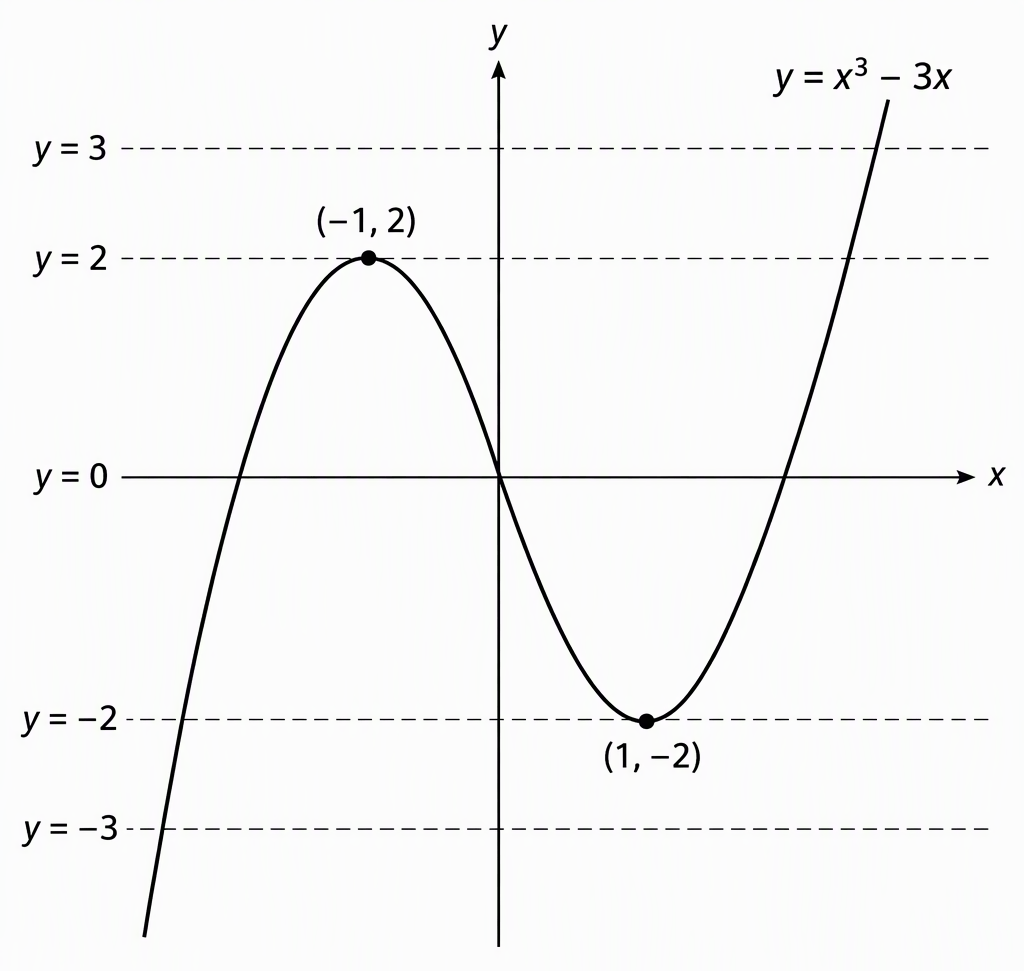
At either boundary level, the touching intersection corresponds to a repeated algebraic root. It still counts as only one distinct root.
Mistake diagnosis: Counting multiplicity instead of distinct intersections gives the wrong boundary answer.
What should I practise next based on my errors?
Choose the next format from your failed reasoning step, not just your total score. Look for tasks that require the missing decision, rather than another familiar derivative calculation. Six correct answers are useful evidence, but six related drills cannot establish chapter mastery.
- Question 1 failed: Repair derivative factorisation and sign charts before collecting harder problems.
- Questions 2–4 failed: Practise extremum conditions, interval restrictions and parameter cases. A correct derivative alone is not a complete solution.
- Questions 5–6 failed: Focus on translating constraints into a function and interpreting graphs or ranges.
- All six were independently correct: Move to authentic PYQs. Preserve their wording and check your reasoning against a reliable worked solution, not just an answer key.
This set does not exhaust AOD. Rates-of-change modelling and more involved function or parameter problems still need practice.
For Main, progress to mixed single-correct and numerical-answer practice before evaluating execution in a full-length mock. For Advanced, use authentic questions with their stated instructions and marking schemes: its pattern is not fixed.
For the final transfer check, JEEnius includes free full-length Main mocks: 75 questions, 300 marks and 180 minutes, with a scored per-subject breakdown. After the paper, label each lost opportunity as selection, algebra, pacing or concept, then choose your next practice session from that list.
Next step: full-length mock tests on JEEnius and sit a full 75-question, 300-mark, 180-minute paper and get a scored per-subject breakdown (free tests included).
If that step was the hard part, work through 3D Geometry / Vectors JEE 2026: Intersecting Lines.
Frequently asked questions
Should I start AOD practice with drills, PYQs or mocks?
Start with concept drills if you cannot justify sign charts, endpoint checks or extremum classifications. Move to authentic PYQs once those decisions are secure. Use full-length mocks when your main weakness is question selection, pacing or execution across subjects.
Are these six AOD questions actual JEE PYQs?
No. These are original teaching drills with worked solutions, not authentic JEE previous-year questions or predictions of chapter weightage. They diagnose specific reasoning gaps but do not establish chapter mastery.
Does a zero derivative always mean a maximum or minimum?
No; a zero derivative identifies a stationary point, not an automatic extremum. For example, x³ has derivative zero at x = 0 but remains strictly increasing through that point. Check the derivative's sign change or compare nearby function values before classifying the point.
How do I find absolute maxima and minima on a closed interval?
For a continuous function on a closed interval, compare values at both endpoints and all interior critical points, including any where the derivative is undefined. For f(x) = x³ − 3x on [0, 3], compare f(0) = 0, f(1) = −2 and f(3) = 18. The absolute minimum is −2 at x = 1, and the absolute maximum is 18 at x = 3.