
Which AC practice format should I choose for JEE?
Choose original chapter drills if RMS, phase or impedance is shaky, exam-specific PYQs when the basics are secure, and full-length mocks for whole-paper execution. These alternating current practice questions for JEE serve different purposes; there is no universal winner.
Five original AC questions with worked solutions are freely readable below. Use your mistakes to choose the next practice format.
How do chapter drills, PYQs and full-length mocks compare?
Drills isolate concepts, PYQs establish actual exam difficulty, and mocks test decisions across subjects. Drills cannot establish real-paper difficulty, remembered PYQ answers can exaggerate readiness, and mocks do not guarantee concentrated AC practice.
- Best use
- Original chapter drills: Repair one concept through controlled variations.
- Exam-specific previous-year questions: Calibrate reasoning against actual Main or Advanced questions.
- Full-length mock tests: Practise selection, pacing and calculation across a paper.
- Prerequisite knowledge
- Drills: Basic definitions; learn while practising.
- PYQs: Working knowledge of the chapter.
- Mocks: Enough syllabus coverage for a meaningful mixed-paper attempt.
- AC-only focus
- Drills: Yes, in this diagnostic.
- PYQs: Yes, if selected chapter-wise.
- Mocks: No guarantee.
- Exam fidelity
- Drills: Not a measure of exam difficulty.
- PYQs: Actual questions, if faithfully reproduced.
- Mocks: A specified format, not an actual future paper.
- Solution requirements
- Drills: Explain formula choices and misconceptions.
- PYQs: Retain original instructions and justify answers.
- Mocks: Require error review; check what explanations are supplied.
- Main limitation
- Drills: Limited whole-paper context.
- PYQs: Answer recall can mask weak reasoning.
- Mocks: Expose misconceptions without repairing them.
- Free access
- Drills: All five questions and solutions here are freely readable.
- PYQs: Check external access conditions.
- Mocks: For whole-paper practice, JEEnius includes free full-length 75-question, 300-mark, 180-minute tests with a scored per-subject breakdown. Check other providers separately.
What should Class 11, Class 12 and dropper students pick?
Choose by your current error, not your class or attempt number. A dropper with a phase misconception needs targeted drills; a Class 12 student who understands AC but loses marks in mixed papers needs whole-paper practice.
- Class 11, studying AC ahead of schedule: Establish sinusoidal quantities, cycle averages and basic circuit reasoning first. Explain how resistance, inductance and capacitance affect current before treating Advanced PYQs as a readiness test.
- Class 12, chapter completed but peak and RMS confused: Begin with targeted drills. Before substituting, state what each given value represents and why the chosen formula applies; then move to Main PYQs.
- Comfortable with direct Main-style applications: Use Advanced PYQs for linked reasoning. Read the original question instructions and marking scheme rather than assuming a single-correct format.
- Dropper who recognises PYQ answers: Attempt unseen original problems to check whether the method transfers. Change frequency, ask for a different quantity or reverse the known and unknown information. If chapter understanding holds, move to full-paper practice.
- Correct in AC-only sets, inaccurate in mixed papers: Prioritise full-length mocks. Review question selection, reading errors and calculation execution, not just formula recall.
A full mock cannot repair an unresolved phase or impedance misconception. If you repeatedly add resistance and reactance directly, fix that operation before collecting another whole-paper score.
Can I try five free AC questions before seeing the solutions?
Attempt all five questions before scrolling to the solutions. Each is an original learning exercise, not a historical JEE question or a reproduction of an official paper format. Difficulty labels describe reasoning demand, not verified exam difficulty.
Assume sinusoidal steady state, ideal components, positive resistance, inductance and capacitance, nonzero applied RMS voltage, and no extra source resistance. Peak and RMS notation is:
Resistance, inductance and capacitance are denoted respectively by:
For every answer, write one sentence explaining the physics. A correct expression reached through an incorrect phase argument still needs repair.
- Question A: Original learning exercise, cycle-average reasoning. A resistor carries the current given below. Find its RMS current, average current over one complete cycle and average power dissipated.
- Question B: Original learning exercise, phasor reasoning. An ideal series RL circuit has applied RMS voltage as defined above and satisfies the condition below. Find the RMS current, state whether current leads or lags the applied voltage, and find the phase angle.
- Question C: Original learning exercise, linked frequency reasoning. An ideal series RLC circuit is resonant at the first angular frequency below. Keeping applied RMS voltage fixed, find the impedance magnitude, RMS current and whether current leads or lags at the second frequency.
- Question D: Original learning exercise, power-factor reasoning. An ideal series RLC circuit has the condition below. Express average power using the given RMS voltage, RMS current and resistance as needed, identify the power factor, and state whether current leads or lags voltage.
- Question E: Original learning exercise, Advanced-style algebraic extension. The same series RLC circuit, with unchanged component values and applied RMS voltage, draws equal RMS currents at two distinct positive angular frequencies. Derive their relationship to the resonant angular frequency.
How do I solve these questions and identify my mistake?
Check averaging, phasor addition, frequency dependence, power factor and algebraic reasoning, not just final expressions. Getting all five right provides evidence about these methods, but this small diagnostic cannot predict marks, percentile or complete chapter mastery.
Why does Question A give zero average current but nonzero heating?
Signed current averages to zero because its positive and negative halves cancel. Heating does not cancel: instantaneous resistor power depends on current squared and remains nonnegative during both halves of the cycle.
Repair: Revise cycle averages if you used average current to calculate heating. Repeat the derivation for a cosine current; shifting the time origin cannot change average heating.
Why does current lag by 45 degrees in Question B?
Equal resistance and inductive reactance put the applied voltage 45 degrees ahead of current. The resistor and inductor voltage phasors are perpendicular, so their magnitudes cannot be added as ordinary scalars.
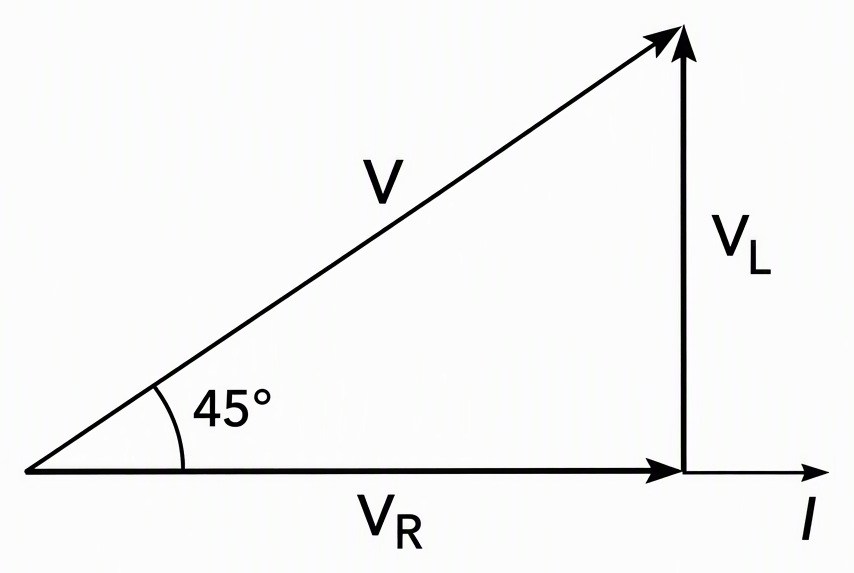
Here the phase angle measures voltage relative to current. Repair: Revise phasor addition if you obtained twice the resistance as the impedance; then repeat with inductive reactance twice the resistance.
What changes when the frequency doubles in Question C?
The circuit becomes net inductive, so current lags the applied voltage. Doubling frequency doubles inductive reactance but halves capacitive reactance, ending their cancellation at resonance.
Repair: Revise frequency dependence if you doubled both reactances. Repeat at half the resonant frequency and check the lead-or-lag decision before calculating current.
Why is the voltage-current product not the real power in Question D?
Only the resistor consumes average power in this ideal circuit. The RMS voltage-current product is apparent power; multiplying by the power factor gives real power. Current leads voltage because capacitive reactance exceeds inductive reactance.
The lead-or-lag sign does not make resistor heating negative. Repair: Revise power factor if you wrote the voltage-current product alone as average power; separate what the resistor dissipates from what the reactive components exchange with the source.
How do equal currents determine the frequency relation in Question E?
Equal RMS currents at unchanged voltage require equal impedance magnitudes. With resistance unchanged, net reactances have equal magnitudes. At distinct positive frequencies, they must have opposite signs because net reactance increases strictly with frequency.
Their sum is positive, so cancellation gives:
Repair: Revise algebraic reasoning if you kept only the positive square-root branch. The resonance frequency is their geometric mean, not generally their arithmetic mean.
What should I practise next, and how do I reject a weak free resource?
Repair any concept that required a formula lookup or exposed a misconception, then attempt a fresh variant before mixed questions. If the diagnostic methods were clear, move to Main PYQs covering both single-correct and numerical-answer questions. Advanced aspirants should then use Advanced PYQs with their original instructions.
Check an external free collection before using it:
- Provenance: Each claimed PYQ should identify its exam, year and paper or shift.
- Answers: Check that answers are accessible without unexpected payment.
- Explanations: Solutions should justify phase conventions and formula choices.
- Access: Check registration requirements and which material remains free.
An official answer key establishes the keyed answer. It is not an explanatory solution and need not teach the method.
For mixed-paper errors, use JEE Main Silly Mistakes: Five Steps to Reduce Errors to structure your review. Record whether each loss came from selection, reading, calculation or a concept gap.
JEE Advanced has two compulsory three-hour papers, with no fixed question-type or marking pattern. Do not apply Main mock specifications to Advanced preparation.
If whole-paper execution is now the problem, attempt a JEEnius free full-length mock: 75 questions, 300 marks and 180 minutes, with a scored per-subject breakdown. Then revisit your AC work and identify the first incorrect decision, not merely the final wrong answer.
Next step: full-length mock tests on JEEnius and sit a full 75-question, 300-mark, 180-minute paper and get a scored per-subject breakdown (free tests included).
Frequently asked questions
Should I practise AC chapter questions, JEE PYQs or full mocks?
Use chapter drills if RMS, phase or impedance is unclear. Move to exam-specific PYQs once the basics are secure, and use full-length mocks when question selection, pacing or mixed-paper accuracy is the problem. A mock cannot repair an unresolved concept gap.
Are these alternating current questions actual JEE PYQs?
No. All five are original learning exercises with freely readable worked solutions, not historical JEE questions. Their difficulty labels describe reasoning demand rather than verified exam difficulty.
Why does AC produce heat if its average current is zero?
For sinusoidal current, the positive and negative halves cancel over a complete cycle, giving zero average current. Resistor heating depends on current squared, so both halves contribute nonnegative power. For peak current I₀ through resistance R, average power is I₀²R/2.
What should I practise after solving these five AC questions?
Repair any concept that required a formula lookup or led to incorrect reasoning, then attempt a fresh variant. If the methods are clear, move to JEE Main PYQs covering single-correct and numerical-answer questions; Advanced aspirants should then use Advanced PYQs with their original instructions. Choose full-length mocks if your remaining errors occur mainly in mixed papers.