
Which magnetism practice questions should I solve for JEE first?
Previous-year questions are the default after theory, but not when directions or formula conditions remain unreliable. For magnetism practice questions for JEE, choose original concept drills to repair those gaps, Main or Advanced PYQs to test secure concepts against your target exam, and full mocks when chapter-wise success breaks down under paper conditions.
The five free diagnostic questions below include worked solutions. They cover Moving Charges and Magnetism plus Magnetism and Matter; electromagnetic induction and alternating current are outside this comparison. Start with them if you reverse forces, confuse angles or use formulas without checking their conditions.
How do concept drills, PYQs and full mocks compare?
Drills isolate a weakness, PYQs show actual exam demands, and mocks test execution across subjects. Pick the format that exposes your current problem: a full paper is a poor tool for repeatedly practising one field-direction rule.
- Purpose
- Original drills here: Identify a specific conceptual error.
- Main or Advanced PYQs: Check your application against the named exam.
- Full-length Main mocks: Test question selection, pacing and execution.
- Prerequisite knowledge
- Drills: Basic vectors, circular motion and torque.
- PYQs: Main needs independent chapter application; Advanced needs secure foundations for linked reasoning.
- Mocks: Enough preparation across subjects to make a full-paper attempt useful.
- Exam authenticity
- Drills: Newly authored exercises, not exam questions.
- PYQs: Actual Main or Advanced questions when their source is verified.
- Mocks: Simulations, not released examination papers.
- Isolation of weak concepts
- Drills: Strong, because each question targets a narrow skill.
- PYQs: Variable; Main and Advanced questions can combine skills.
- Mocks: Limited, since errors occur within a mixed paper.
- Pacing value
- Drills: Low.
- PYQs: Useful for target-exam question practice.
- Mocks: Best for whole-paper time allocation.
- Main limitation
- Drills: Success does not establish exam readiness.
- PYQs: Remembered answers can inflate confidence.
- Mocks: A paper may contain little magnetism.
For whole-paper practice, JEEnius offers 75-question, 300-mark, 180-minute mocks with scored per-subject breakdowns, including free tests. That is a paper-level check, not a promised magnetism-only assessment.
Which format fits my current preparation?
Choose from your observed errors, not your class or repeat status. A Class 12 student can need direction drills, while a Class 11 student studying ahead can be ready for PYQs. Resource labels such as “easy”, “hard” and “sufficient” tell you less than an independently written solution.
- Beginning the chapter, including Class 11 students studying ahead: Check vectors, circular motion and torque first. Then use focused magnetism drills.
- Class 12 student who knows formulas but reverses directions or confuses angles: Attempt this diagnostic before opening a large mixed collection.
- Main aspirant solving unfamiliar chapter questions independently: Prioritise Main PYQs, including single-correct and numerical-answer practice.
- Advanced aspirant with secure foundations: Choose Advanced PYQs. Follow the actual paper’s answer-selection and marking instructions.
- Dropper who recognises most PYQs: Seek genuinely unattempted questions where available. Require a written derivation, not recognition of the answer.
- Student who solves magnetism correctly alone but leaves it unfinished in papers: Use a full mock to examine question selection and time allocation.
Can I try free magnetism questions with worked solutions now?
Attempt all five questions before reading the solutions, and write the reason for every direction and formula. These are original diagnostic drills with symbolic short answers, not PYQs, numerical-answer exam items, a full chapter test or replicas of the JEE paper pattern.
The symbolic givens belong to these newly authored exercises, not supplied exam data or evidence of chapter weightage. The permeability of free space is denoted by:
What are the five diagnostic questions?
The questions check direction, force balance, superposition, loop stability and material response. Work without a timer first so that rushing does not hide a conceptual mistake. Keep your derivations, including any answer you later change.
1. Original diagnostic drill: charged particle
A non-relativistic particle has positive charge and mass, with initial velocity and uniform magnetic field specified below. No other forces act.
Find the initial force direction and trajectory radius. Does its speed change?
2. Original diagnostic drill: straight wire
An infinitely long wire lies on the z-axis and carries current in the positive z-direction. Find the field magnitude and direction at the specified point in vacuum.
3. Original diagnostic drill: two wires
Two infinitely long parallel wires in vacuum carry equal currents in the same direction.
Find the net magnetic field at their midpoint and the force per unit length between them. State whether they attract or repel.
4. Original diagnostic drill: current loop
A rigid loop carries maintained current in a uniform external magnetic field. Its magnetic moment makes the specified angle with the field.
Find the torque magnitude and classify the stability of these orientations:
5. Original diagnostic drill: magnetic material
A weak, linear, isotropic material has negative magnetic susceptibility in a nonzero applied field.
Find the magnetisation direction and classify the material. State whether its relative permeability is above or below one.
How do I solve the five diagnostic questions?
Identify the vector relationship or physical model before substituting values. Compare your reasoning as well as your final expression: a correct formula paired with a guessed direction still needs repair.
1. Charged particle
Use the magnetic-force cross product. For a positive charge, positive x crossed with positive z gives negative y:
The velocity is perpendicular to the field, so magnetic force supplies the centripetal force. Equating their magnitudes gives the radius:
Speed stays constant because magnetic force does no work:
Misconception exposed: A force changes velocity, but need not change speed.
2. Straight wire
For an infinitely long straight wire, the field magnitude is:
Apply the right-hand rule: point your right thumb along the current, positive z. Your curled fingers give the field direction, positive y at the point on positive x.
Misconception exposed: The field circles the wire; it does not point radially away from it.
3. Two wires
At the midpoint, equal distances give equal field magnitudes. The right-hand rule gives opposite directions, so superposition gives:
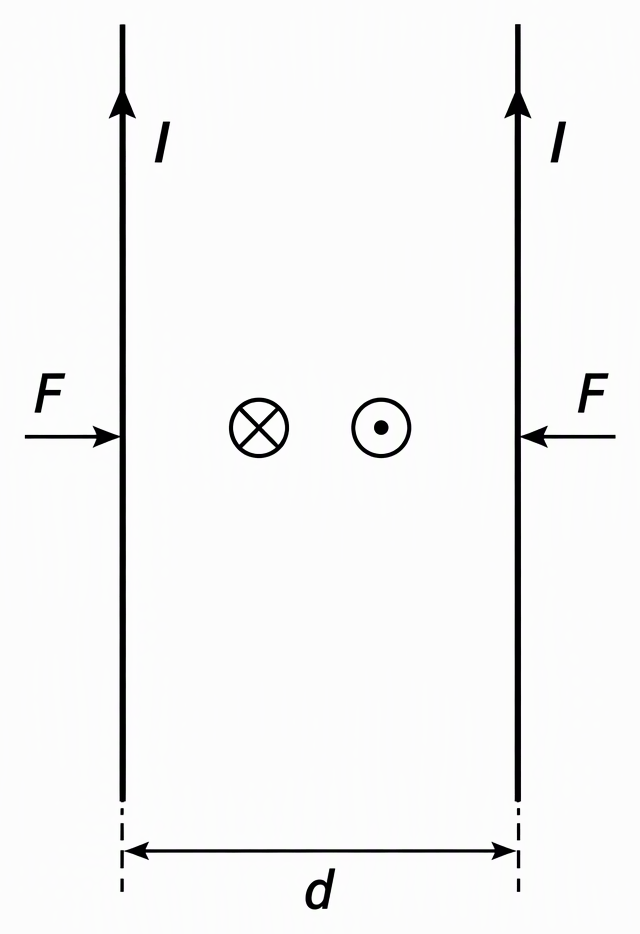
At either wire, the other wire produces a nonzero field. The current is perpendicular to that field, giving:
The magnetic-force direction makes the interaction attractive. Misconception exposed: Zero field at the midpoint does not mean zero field, or zero force, at a wire.
4. Current loop
The magnetic moment points along the loop’s normal. Use its angle with the field, not the angle of the loop’s plane:
Use orientation energy to decide stability:
At the first specified orientation, energy is minimum, so alignment is stable. At the second, energy is maximum, so alignment is unstable.
Misconception exposed: Zero torque alone does not prove stable equilibrium.
5. Magnetic material
The stated linear model gives:
Negative susceptibility makes magnetisation oppose the applied field. The material is diamagnetic, with relative permeability below one.
Misconception exposed: Magnetisation does not always point along the applied field.
What should I practise after each kind of mistake?
Use the error, not the total score, to choose your next set. These five drills locate common faults; they cannot certify mastery. Correct answers with explanations justify moving to unfamiliar Main or Advanced PYQs according to your target, not declaring the chapter complete.
- Wrong force or field direction: Practise vector cross products and right-hand rules before more timed work.
- Correct direction, wrong radius: Rebuild the force-balance equation. The drill uses perpendicular entry; oblique entry requires the perpendicular velocity component:
- Zero midpoint field confused with zero interaction: Label where each field is evaluated. Use the other wire’s field when calculating force on a wire, excluding its own field.
- Loop error: Separate the loop’s plane from its normal. Then distinguish torque from energy and stability.
- Material error: Compare these behaviours:
- Diamagnetic: Weak opposing magnetisation; negative susceptibility.
- Paramagnetic: Weak magnetisation along the field; positive susceptibility.
- Ferromagnetic: Strong response involving domains, often nonlinear and history-dependent, not generally described by constant susceptibility.
The diagnostic does not cover combined electric and magnetic fields, fields of loops and solenoids, or measuring-instrument applications. Include those in later chapter practice.
How can I use free PYQs and mocks without fooling myself?
Verify the source, attempt independently and review the setup before counting a question as solved. For any claimed PYQ, the exam, year and paper or shift must be identifiable. Compare it with released papers and official answer keys where available; use jeemain.nta.nic.in for official Main material.
An official answer key establishes the accepted answer. It is not a worked explanation, and an answer letter cannot diagnose an incorrect force balance.
- Attempt independently: Write the governing relation before substitution.
- Compare solutions: Find the first step where your reasoning diverged.
- Classify the error: Record direction, model selection, algebra, interpretation and time management separately.
- Reattempt later: Start from a blank page without looking at the earlier solution.
Do not use an arbitrary accuracy threshold to enter Advanced practice. Secure explanations and independent application matter more than success on remembered questions.
For Main-style practice, the current structure per subject is 20 single-correct MCQs and 5 numerical-answer questions. Both types award 4 marks for correct answers, deduct 1 for incorrect answers and award 0 for unattempted answers.
The full Main paper allows 180 minutes across all three subjects. Its whole-paper average is not a universal deadline for each magnetism question. Advanced has two compulsory three-hour papers, with variable question types and marking schemes: read the actual instructions.
If isolated magnetism work is sound but paper execution is weak, use a JEEnius free full-length mock and its scored per-subject breakdown to test the complete paper. Then inspect your unfinished questions and record whether the cause was a physics error, poor selection or time allocation.
Next step: full-length mock tests on JEEnius and sit a full 75-question, 300-mark, 180-minute paper and get a scored per-subject breakdown (free tests included).
Keep going with Domain of Functions JEE 2024: Domain vs Differentiability.
Frequently asked questions
Which magnetism questions should I solve first for JEE?
Start with focused concept drills if you still reverse force directions, confuse angles or apply formulas without checking their conditions. Once you can explain your solutions independently, prioritise unfamiliar JEE Main or Advanced previous-year questions according to your target exam.
Are these free magnetism questions JEE PYQs?
No. The five questions are original diagnostic drills with symbolic short answers and worked solutions, not previous-year questions or replicas of the JEE paper pattern. They check particle motion, wire fields and forces, loop stability and magnetic material response.
Are five magnetism questions enough for JEE preparation?
No; these five drills identify common conceptual gaps but cannot establish chapter mastery. They do not cover combined electric and magnetic fields, fields of loops and solenoids, or measuring-instrument applications. Include those topics in later practice and test your understanding with unfamiliar PYQs.
When should I take full mocks instead of chapter-wise magnetism practice?
Use full mocks when you solve magnetism questions correctly in isolation but leave them unfinished in complete papers, provided your preparation across subjects makes a full attempt useful. Review unfinished questions to distinguish physics errors from poor question selection or time allocation. A full mock may contain little magnetism, so it cannot replace focused chapter practice.