
Should you start with Laws of Motion drills, PYQs or a mock?
For Laws of Motion practice questions for JEE, start with targeted drills, then PYQs, not a full mock. The free, original questions and worked solutions below are not PYQs. Start here if free-body diagrams or static friction cause trouble.
If force equations are reliable, use JEE Main PYQs for exam-style interpretation; add Advanced PYQs for Advanced preparation. Use full mocks for selection, timing and performance across subjects, not isolated chapter diagnosis.
How do concept drills, PYQs and free full-length mocks compare?
Drills expose modelling mistakes; PYQs test interpretation of authentic exam questions; mocks test whole-paper decisions. This compares practice formats, not competing platforms tested hands-on. Each item follows the same order: original on-page drills, Laws of Motion PYQs identified in official papers, then JEEnius full-length mocks with free tests included.
- Best use: Drills test individual force models. PYQs test applying those models to actual exam statements. Mocks test question selection and performance across Physics, Chemistry and Mathematics.
- Chapter focus: Drills stay within Laws of Motion. PYQs require identifying relevant questions in official papers. Mocks cover the full paper, not this chapter alone.
- Ability to isolate an error: Drills separate friction, system boundaries and acceleration direction. PYQs can combine concepts, making the cause of failure harder to locate. A mock’s subject score cannot isolate a force-diagram error.
- Exam-format exposure: Drills are not difficulty-calibrated or predictively scored. Main PYQs provide authentic Main questions. Advanced PYQs provide authentic Advanced questions, with no fixed question-type or marking pattern. The full-length mocks provide 75 questions, 300 marks and 180 minutes.
- Solution availability: These drills include worked solutions. For PYQs, check access to explanatory solutions: an official answer key is not a worked solution. The verified mock output is a scored per-subject breakdown.
- Principal limitation: Drills do not establish exam readiness. Remembered PYQs can reward recognition rather than solving. A full mock need not contain enough Laws of Motion questions to diagnose this chapter.
Which option fits your current preparation?
Choose by what you can do without help, not by your class or number of attempts. A Class 11 student may be ready for PYQs on a well-understood topic; a dropper may need a friction drill. These are readiness recommendations, not official thresholds or promises of marks.
- Class 11, just taught friction: Choose drills if you automatically use the coefficient times the normal reaction as actual friction. First decide whether the surfaces remain at rest relative to each other or slip. Static friction adjusts; it is not always at its maximum.
- Class 12, revising mechanics: Choose Main PYQs if you draw free-body diagrams unaided but struggle to convert an unfamiliar statement into equations. Your next task is interpretation, not another round of familiar demonstrations.
- Dropper recognising PYQ answers: Attempt the original diagnostic below with solutions covered. Then use unfamiliar or genuinely unremembered questions. Recognising the answer or recalling a trick is not independent solving.
- Advanced aspirant: Move to Advanced PYQs when you can explain force directions, system boundaries and constraints. Finishing a predetermined question count is not a useful entry test.
- Student with sound chapter work but inconsistent papers: Choose a full-length mock. Review time spent, questions selected and subject-wise performance rather than treating every lost mark as a concept gap.
Which free Laws of Motion questions should you attempt before reading solutions?
Attempt these five original, untimed diagnostic questions before opening the solutions. They are not previous-year questions, an official paper section or a difficulty-calibrated test. For each one, draw a free-body diagram and state the contact or motion assumption before writing equations.
All masses are positive. Gravitational acceleration is uniform and directed downward, with magnitude:
Use a ground frame treated as inertial. Ignore air resistance, and use the idealised contact conditions stated in each question. Your diagram must include forces acting on the chosen body, not forces that body exerts elsewhere.
1. When does a horizontal block start sliding?
A block initially rests on a horizontal surface. Its mass, friction coefficients and applied horizontal force satisfy:
The constant force acts right, with no vertical component. Find the friction force, including its direction, and the block’s acceleration in both cases:
Treat the exact threshold explicitly. Do not assume slipping before checking whether static friction can maintain rest.
2. What are the acceleration and tension of two connected blocks?
Two blocks lie on a smooth horizontal surface, joined by a taut, light, inextensible string. A constant horizontal force pulls the second block right, away from the first:
Find their common acceleration and the string tension. Write one equation for the combined system and another for the first block alone; explain which forces belong in each.
3. What does a scale read in a lift moving upward but slowing?
A student stands on a horizontal scale in a lift. The student’s mass is:
The lift moves upward but has a downward acceleration of magnitude:
Find the scale’s force reading, not a displayed mass value. The student remains at rest relative to the lift; identify the acceleration direction before choosing signs.
4. Which way does friction act on a block placed on a moving belt?
A horizontal belt moves right at constant speed. A block is placed gently on it with zero horizontal ground-frame velocity, and the two surfaces initially slip.
Identify the direction of friction on the block while slipping continues. Explain which relative motion determines that direction, rather than relying on the phrase “friction opposes motion”.
5. Can a block remain at rest against a rough vertical wall?
A block is pushed horizontally against a fixed vertical wall by a constant force. The relevant quantities are:
Find the condition under which rest is possible and the actual friction force while the block remains at rest. The applied push has no vertical component; distinguish required friction from available friction.
How do you solve these questions and identify the underlying mistake?
Check the physical model before checking the algebra. A correct final expression reached through an incorrect force diagram is not a reliable solution. Compare your contact assumption, chosen system and force directions with the reasoning below to choose between targeted drills and PYQs.
1. Why is static friction not always at its limiting value?
Static friction supplies only the force needed to prevent slipping, up to its limit. Vertical equilibrium fixes the normal reaction; while rest is possible, friction balances the applied force and acts left for a positive applied force:
At equality, rest remains possible at limiting equilibrium. Above that threshold, the block slides right and kinetic friction acts left:
Error label: premature limiting-friction assumption. If you used maximum static friction for every applied force, practise fresh stick-or-slip decisions before moving to mixed PYQs.
2. Why does tension disappear from the combined-system equation?
Tension is internal to the two-block system: the ideal string pulls the blocks with equal, opposite forces. Those forces cancel when the block equations are added, leaving the applied force as the net external horizontal force:
For the first block alone, tension is external and is its only horizontal force:
Error label: wrong system boundary. If tension appeared as a net force on the combined system, practise paired whole-system and individual-body diagrams.
3. Why does upward motion not imply a larger scale reading?
Acceleration, not velocity, determines the change in scale reading. The scale reads the upward normal force; choosing upward positive gives a negative acceleration because the lift is slowing while moving upward:
Error label: velocity–acceleration confusion. If your sign followed the direction of travel, compare lifts moving the same way but accelerating differently.
4. Why does friction accelerate the block to the right?
Friction acts right because the block slips left relative to the belt. Initially the block has no horizontal ground-frame velocity, yet kinetic friction already has a definite direction.
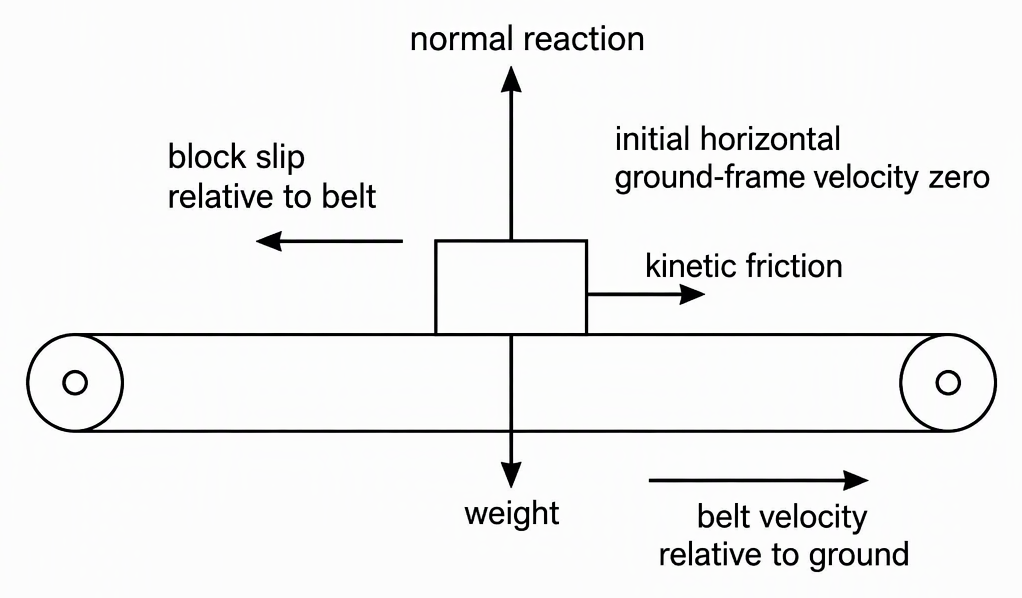
Friction opposes relative slipping at the contact, not necessarily the block’s ground-frame motion. Error label: wrong relative-motion reference. Practise comparing the velocities of the two contacting surfaces before assigning friction directions.
5. Why can actual wall friction be smaller than its maximum?
The block needs upward friction equal to its weight, not the maximum available friction. Horizontal equilibrium makes the normal reaction equal to the push; rest is possible only if the contact can supply the required upward force:
This includes limiting equilibrium. Error label: confusion between required and available friction. If you replaced actual friction with its maximum, practise changing the push while checking whether rest remains possible.
An incorrect diagram or contact assumption calls for targeted drills. Reliable setups support moving to PYQs; an isolated algebra slip calls for an algebra check, not relearning the whole chapter.
What should you practise next, and when does a free mock become useful?
Repair the missed physical condition, test it on an unfamiliar PYQ, then use a mock for whole-paper execution. Re-solving an unchanged question from memory is not enough: it tests recall without showing whether you can model a changed setup.
- Change the condition you missed. After the lift question, find the reading when the lift accelerates upward rather than slowing upward. After the wall question, increase the horizontal push and decide whether actual static friction changes.
- Use traceable PYQs. Choose questions whose paper, year and Main or Advanced provenance can be checked. Attempt before opening the answer key. Record the failure as diagram, assumption, equation, algebra or interpretation; the original set above is diagnostic practice, not PYQs.
- Move to a mock for whole-paper problems. Review time spent, abandoned attempts and subject-wise performance. Full-paper performance alone cannot establish chapter mastery, and Main’s question format or marking must not be applied to Advanced.
When your chapter setups are dependable but paper execution is inconsistent, use a JEEnius full-length mock: free tests are included, with 75 questions, 300 marks, 180 minutes and a scored per-subject breakdown. Before your next attempt, choose one behaviour to review afterward, such as time lost persisting with questions you could not set up.
Next step: full-length mock tests on JEEnius and sit a full 75-question, 300-mark, 180-minute paper and get a scored per-subject breakdown (free tests included).
Keep going with Integration Techniques JEE 2024: Reflection Errors and Bounds.
Frequently asked questions
Should I start Laws of Motion practice with drills or PYQs?
Start with targeted drills if free-body diagrams, friction directions or contact assumptions cause trouble. Move to JEE Main PYQs when you can set up force equations unaided but struggle with unfamiliar statements. Add Advanced PYQs when you can explain force directions, system boundaries and constraints reliably.
Are these Laws of Motion questions JEE PYQs?
No. These are five free, original diagnostic questions with worked solutions, not previous-year questions or a difficulty-calibrated test. Use them to identify modelling errors, then attempt PYQs whose paper, year and Main or Advanced provenance can be checked.
Is static friction always equal to its maximum value?
No. Static friction adjusts to the force required to prevent slipping, up to its limit of the coefficient of static friction times the normal reaction. For a block at rest against a vertical wall under a horizontal push, actual friction equals its weight, provided the available static friction can support it.
Can a full JEE mock test show whether I have mastered Laws of Motion?
Not by itself: a full mock may contain too few Laws of Motion questions to diagnose the chapter. Use drills and PYQs to check your force models and interpretation. Use full mocks to assess question selection, timing and performance across Physics, Chemistry and Mathematics.