
Which free JEE Chemistry question bank should I choose?
Choose a free JEE Chemistry question bank with chapterwise explanations for weak topics, use previous-year questions to check exam-level readiness, and use full-length mocks to test performance across subjects. For one primary practice source, choose chapterwise PYQs with explanations, provided you can check the explanations and continued free access before committing.
This comparison covers four formats: previous-year papers with answer keys, chapterwise PDFs, chapterwise web banks and full-length mocks. These are resource formats, not a ranking of websites with supposedly verified access and quality.
A paper preserves exam context; a chapter collection isolates a weakness. Neither automatically provides worked explanations. Check those before choosing: a correct answer letter cannot show you where your reasoning failed.
How do PYQ papers, PDFs, web banks and full mocks compare?
Use chapterwise resources to repair topics and full papers to test performance. For every unverified capability below, check before choosing, especially access to complete explanations. Free questions are not enough if the reasoning you need is locked.
- Resource type: Previous-year papers with answer keys
- Best use: Seeing questions in their original exam context.
- Organisation: Paper order; chapterwise practice requires sorting.
- Answer support to check: The matching final key and separate worked explanations. An answer key is not a teaching solution.
- Access conditions to check: Paper access, download permission and access to explanations.
- Main limitation: Inefficient for repairing one weak chapter.
- Resource type: Chapterwise PDFs
- Best use: Focused practice or offline study.
- Organisation: Check chapter coverage and any topic subdivisions.
- Answer support to check: Worked solutions and readable chemical notation.
- Access conditions to check: Legitimate download permission and whether solutions are included.
- Main limitation: Requires syllabus checking and manual error tracking.
- Resource type: Chapterwise web banks
- Best use: Topic selection and repeated practice, when available.
- Organisation: Check the actual chapter and topic grouping.
- Answer support to check: Full reasoning, not merely the correct option.
- Access conditions to check: Login requirements and whether questions, solutions and continued use remain free.
- Main limitation: Questions may be accessible while explanations or further practice are restricted.
- Resource type: JEEnius full-length mocks
- Best use: Use these for complete-paper performance testing.
- Organisation: Verified 75-question, 300-mark, 180-minute papers.
- Answer support: A scored per-subject breakdown is verified; worked solutions are not established by the supplied facts.
- Access conditions: Free tests are included; do not assume unlimited free use.
- Main limitation: Not a substitute for targeted chapter practice. The supplied facts do not establish a free standalone chapterwise Chemistry bank.
Main versus Advanced suitability depends on the actual questions and exam labels, not whether the resource is a PDF or a website. “JEE practice” does not establish coverage of both exams.
Which option suits Class 11, Class 12 and droppers?
Choose focused chapter practice for unfinished foundations, chapterwise PYQs for revision and full-paper tests for execution problems. Keep one primary practice source and one complementary testing format. Repeatedly switching resources makes it harder to track whether you have corrected the same mistakes.
- Class 11, just after mole concept or chemical bonding: Start with focused questions and explanations. If you cannot set up a mole calculation or explain a bonding choice, a full mock is a poor repair tool: it mixes that weakness with unfinished material.
- Class 12, revising completed chapters: Prioritise chapterwise PYQs. Then mix topics so the chapter heading no longer reveals the method.
- Dropper, repeating familiar PYQs: Mark recalled answers separately from independently solved answers. Recognising an option is not the same as rebuilding the reasoning. Use a full-paper test outside the familiar chapter sequence.
- Unreliable internet or limited device access: Prefer a legitimately downloadable PDF, if available. Inspect its solutions and notation before committing.
- Advanced aspirant: Choose explicitly identified Advanced questions and read that paper’s instructions. A Main-labelled collection is not evidence of Advanced coverage.
- Comfortable in Chemistry alone, but losing marks in the complete exam: Add a full-length mock rather than another chapter PDF. Examine pacing, subject switching and question selection.
For parents helping choose, check whether the student can explain an error and later solve the question independently. A large collection without usable explanations is not the economical choice, even when access costs nothing.
How can I check whether a Chemistry question bank is trustworthy?
Check provenance, syllabus fit, worked reasoning and free-access limits before relying on a bank. Inspect questions and complete solutions from the branches you plan to study. This is a defect check, not proof that every answer in the collection is correct.
- Check provenance. Look for identifiable paper details and exam labels, with PYQs separated from original practice. A year label does not prove authenticity. Compare doubtful wording and options with the original paper.
- Check syllabus fit. Compare coverage with the official syllabus for your exam year. Use jeemain.nta.nic.in for Main and the official JEE Advanced website for Advanced. A large archive can contain material outside your target syllabus.
- Inspect Physical Chemistry reasoning. Solutions should show assumptions, units and the setup, not jump to a number. Use Equilibrium JEE 2018: Fixed-pH Solubility Solution to examine how a stated condition affects the setup, not as proof of an entire bank’s quality.
- Inspect Organic Chemistry notation. Structures, charges, reagents and reaction conditions must be legible. Where reasoning is required, the explanation should justify the product.
- Inspect Inorganic Chemistry explanations. Look for the relevant fact or exception and its context, not a repeated answer option. Compare NCERT-based claims with the relevant passage.
- Resolve disagreements carefully. An official final key establishes the accepted answer for that paper; an educator’s explanation teaches the reasoning. Check paper version, transcription, conditions and any key revisions before seeking clarification. Neither an unexplained community answer nor an answer letter is a teaching solution.
- Inspect free-access limits. Open both a question and its full explanation. Check account requirements and stated limits before committing. A free preview does not establish continued free practice.
How should I use the bank for Physical, Organic and Inorganic Chemistry?
Use branch-specific correction methods, but keep one error log. Physical Chemistry needs setup checks, Organic needs reasoning about transformations, and Inorganic needs precise recall tied to a source. This is a suggested workflow, not a proven schedule or a guarantee of higher marks.
- Physical Chemistry: Solve before viewing explanations and, where the question permits, before viewing options. Record units and assumptions. Separate setup errors, such as choosing the wrong relation, from arithmetic errors after a correct setup.
- Organic Chemistry: Write the transformation and relevant conditions before checking the answer. For a wrong product, identify the missing prerequisite: structure, electronic effects, stability or reaction logic. Do not memorise an isolated product as the correction. Use How to Study Hydrocarbons JEE: Reactions and Practice for a fuller workflow.
- Inorganic Chemistry: Retrieve the fact before consulting the source. After an error, read the relevant passage and record the exact exception or statement that caused confusion. “Revise the chapter” is too broad.
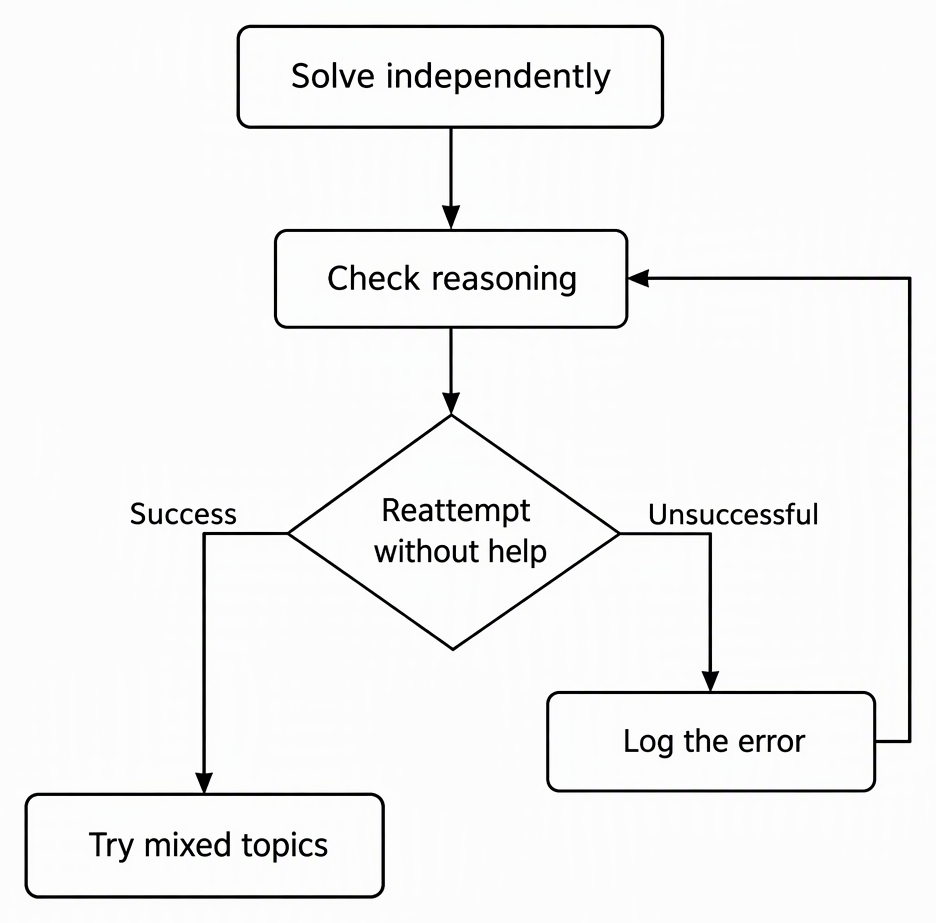
Keep a notebook or simple document with these fields. Record the correction, not just the question number.
- Chapter: Where the error belongs.
- Error type: Recall, concept, setup, arithmetic or misreading.
- Corrected reasoning: The missing step or exact fact.
- Reattempt outcome: Solved independently, guessed again or still unresolved.
Reattempt incorrect and guessed questions with the solution hidden, then move to mixed-topic practice. Answering immediately after reading a solution checks short-term recall; recognising the method without a chapter label is a stronger check.
When should I move from a question bank to a full mock?
Move to complete-paper testing when you need to diagnose execution, not just Chemistry knowledge. These formats test different problems:
- Chapter practice: Isolates a topic and its methods.
- Chemistry-only test: Checks performance across Chemistry topics.
- Complete JEE Main mock: Tests Chemistry alongside Physics and Mathematics, including subject switching, question selection and pacing.
Current Main Chemistry has 25 questions: 20 single-correct MCQs and 5 numerical-answer questions, worth 100 marks. The 180 minutes belong to the complete Main paper, not Chemistry alone. Marking awards four marks for a correct answer, deducts one for a wrong answer and gives zero for an unattempted question.
Advanced has two compulsory papers of three hours each, with question types and marking that vary by year. Read the paper-specific instructions rather than applying Main assumptions.
Is a free PDF enough for Chemistry preparation?
A PDF can be your primary practice source if it has suitable questions, readable notation and explanations you can trust. Chapter-organised practice alone cannot check complete-paper pacing, so pair it with exam-format testing rather than collecting more PDFs.
Should I replace my bank when questions start feeling familiar?
Not automatically: first separate remembered answers from independently reconstructed solutions, then try mixed-topic questions. If you cannot explain familiar answers, repair that reasoning before changing resources.
For the next testing step, read Free JEE Chemistry Mock Test: Choose the Right Format. JEEnius offers full-length 75-question, 300-mark, 180-minute mocks with a scored per-subject breakdown, with free tests included.
Repair topics with the bank, calibrate using PYQs and test complete-paper execution with mocks. Choose your next session by the error you need to diagnose, not by the next resource you find.
Frequently asked questions
Which free JEE Chemistry question bank should I choose?
Choose chapterwise PYQs with worked explanations as your primary practice source, after checking solution quality and continued free access. Use focused chapter practice to repair weaknesses and full-length mocks to test pacing, question selection and subject switching.
Is a free PDF enough for JEE Chemistry preparation?
A free PDF can be your primary practice source if its questions fit your syllabus and it includes readable notation and trustworthy explanations. Chapterwise practice cannot test complete-paper pacing, so pair the PDF with exam-format tests.
How do I check if a JEE Chemistry question bank is reliable?
Check identifiable paper details, exam labels and coverage against the official syllabus for your exam year. Inspect complete solutions for Physical, Organic and Inorganic Chemistry, including units, reaction conditions and factual context. Check login requirements and whether explanations and continued practice remain free.
Should I change my question bank if I remember the answers?
Not automatically: separate remembered options from solutions you can reconstruct independently. Reattempt questions with the explanations hidden, then try mixed-topic practice without chapter labels. If you cannot explain a familiar answer, repair the reasoning before changing resources.