
Which indefinite integration practice should I choose for JEE?
For indefinite integration practice questions for JEE, use method-wise drills when you cannot execute a technique, mixed questions when you cannot identify it, and previous-year questions when you need to test yourself against actual exam problems. My default for students who know the methods is unlabelled mixed practice: it tests selection without a heading supplying the answer.
These formats complement each other; they are not competing brands or a universal ranking. An original, free, on-page practice set with worked solutions follows below. No download or registration is needed.
How do method-wise drills, mixed practice and PYQs compare?
Method-wise drills isolate execution, unlabelled mixed practice tests recognition, and verified previous-year questions provide authentic exam context. PYQs can themselves be method-wise or mixed. The comparison below concerns how you use questions, not mutually exclusive categories.
- Best use
- Method-wise drills: Repair a specific technique.
- Unlabelled mixed practice: Select the first step independently.
- JEE previous-year questions: Test preparation against actual exam problems.
- Is the method revealed?
- Method-wise drills: Usually, through the heading.
- Unlabelled mixed practice: No explicit technique label.
- JEE previous-year questions: Depends on how the collection is organised.
- Technique coverage
- Method-wise drills: Isolate substitution, integration by parts, partial fractions or trigonometric manipulation.
- Unlabelled mixed practice: Depends on question selection.
- JEE previous-year questions: Does not guarantee systematic coverage.
- Exam authenticity
- Method-wise drills: The format alone establishes none.
- Unlabelled mixed practice: The format alone establishes none.
- JEE previous-year questions: Authentic when provenance is verified.
- Useful solution detail
- Method-wise drills: Intermediate calculation steps.
- Unlabelled mixed practice: Recognition clues and reasons for choosing a method.
- JEE previous-year questions: Reasoning tied to the actual wording and answer.
- Main limitation
- Method-wise drills: The heading can give away the first step.
- Unlabelled mixed practice: Value depends on selection and solution quality.
- JEE previous-year questions: Gaps remain if you expect complete technique coverage.
What should Class 11, Class 12 students and droppers practise?
Choose by your error, not your class alone. If you recognise partial fractions but cannot decompose the expression, choose method-wise drills. If you solve a question under a “substitution” heading but freeze without it, choose mixed practice. Choose verified PYQs when you can select and execute methods independently and need real exam wording and context.
- Class 11 students studying ahead: Check algebra, logarithms, trigonometric identities and differentiation first. If you cannot differentiate a proposed answer reliably, harder integrals are a poor next step. Repair the prerequisite, then practise the relevant integration technique.
- Class 12 students: Use drills for specific faults, such as recognising substitution but repeatedly losing a factor, or mishandling partial fractions. Once execution is stable, remove the headings.
- Droppers: Diagnose before restarting every integration exercise. Revisit the structures behind your errors, then test them in an unlabelled set rather than repeating techniques you already execute reliably.
This set checks direct antiderivative work. Success here does not establish readiness for all JEE Advanced calculus. Broader problems may combine integration with functions, definite integrals, inequalities or reasoning that these questions do not test.
Which free indefinite integration questions can I try right now?
Attempt this original mixed practice set, not JEE PYQs, before reading the solutions. No method labels are supplied: choosing the first step is part of the exercise.
Before calculating, write your proposed first step beside each question. Record whether you needed a hint, including a glance at the solution, even if you later finish correctly.
Q1. Find the indefinite integral.
Q2. Find the indefinite integral on an interval where it is defined.
Q3. Find the indefinite integral on the stated domain.
Q4. Find the indefinite integral wherever the integrand is defined.
Q5. Find the indefinite integral on the stated domain.
Q6. Find the indefinite integral.
This compact diagnostic samples useful structures; it is not a complete integration question bank or a rank predictor. Attempt every question before continuing, so the solutions do not supply your first steps.
How do I check both my method and my answer?
Check the structural clue first, the calculation second, and the derivative last. Differently written antiderivatives can both be correct when their derivatives match the integrand on the relevant interval. The integration constant may differ between disconnected intervals of the domain.
How do I solve Q1 without losing a factor?
Substitute the denominator because its derivative is twice the numerator. The likely error is missing the one-half coefficient.
The logarithm needs no absolute-value signs because its argument is positive. Differentiating the answer without the coefficient exposes the error:
How do I split the denominator in Q2?
Factor the denominator and use partial fractions. A common error is adding the fractions instead of subtracting them, which changes the numerator.
This holds on intervals excluding the singular points. Check the subtraction by differentiating:
Why does integration by parts suit Q3?
Differentiating the logarithm leaves a reciprocal, while the polynomial factor is easy to integrate. The likely mistake is dropping the subtraction in integration by parts or integrating the remaining term incorrectly.
Differentiation shows why the subtraction matters. The extra terms must cancel:
How do I solve Q4 without changing its domain?
Multiply by the conjugate locally to expose standard trigonometric derivatives. The resulting secant and tangent expressions introduce restrictions absent from the original integrand, so use them only where they are defined.
The following final form is valid wherever the original integrand is defined. Direct differentiation verifies it:
The tangent-minus-secant expression is equivalent only where its individual terms exist. It is undefined when sine equals one, although the original integrand is defined there. Accidentally excluding those points is the main trap.
What is the inner function in Q5?
Substitute the logarithm because its derivative is already present as the reciprocal factor. The remaining integral is the standard inverse-tangent form; ignoring the inner derivative is the likely error.
This is not simply the inverse-tangent integral in the original variable. The chain-rule check must include the reciprocal factor:
How do I recognise the hidden substitution in Q6?
Read the denominator as one plus the square of a product. That product has exactly the derivative shown in the numerator. Substituting only the exponential misses this match.
Differentiate to check the substitution. Both the product rule and the outer derivative are needed:
How should my mistakes decide the next practice set?
Use your first-step record to separate recognition failures from calculation failures. A missing first step calls for targeted structure practice; a correct first step followed by a wrong answer calls for calculation repair. A hint-assisted answer counts as practice, not independent mastery.
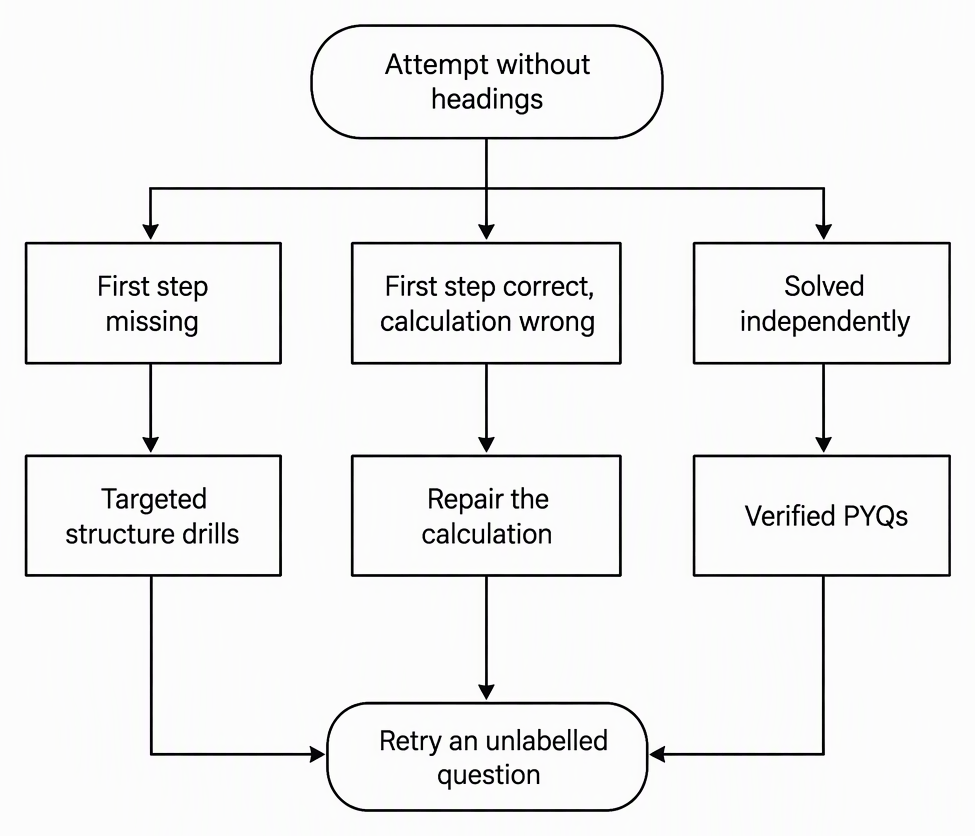
- First step missing: Study a small set organised around that structure, then retry an unlabelled question without its heading.
- First step correct, answer wrong: Practise the relevant algebra, chain-rule factor or integration-by-parts calculation rather than searching for harder questions.
- Correct after a hint: Mark it assisted and attempt a fresh question with the same underlying structure.
- Solved independently: Move to verified JEE Main PYQs, then appropriate Advanced problems. Prefer questions traceable to an exam paper and a reliable answer key. No fixed score on this short set establishes readiness.
Chapter drills isolate technique. Full-paper practice tests question selection and switching between subjects.
For that next stage, JEEnius offers full-length mock tests, including free tests, with 75 questions, 300 marks, 180 minutes and a scored per-subject breakdown. These describe JEE Main-style practice, not a fixed JEE Advanced pattern. Repair the error identified here, retry without a heading, then use a full paper to check whether that skill holds when integration is no longer the only task.
Next step: full-length mock tests on JEEnius and sit a full 75-question, 300-mark, 180-minute paper and get a scored per-subject breakdown (free tests included).
Read next: Scalar and Vector Products JEE 2024: Triangle Solution.
Frequently asked questions
Should I practise indefinite integration method-wise or in mixed sets?
Use method-wise drills when you recognise a technique but cannot execute it reliably. Use unlabelled mixed sets when you can perform the techniques but struggle to choose the first step. Once you can select and execute methods independently, test yourself with verified JEE previous-year questions.
Are these indefinite integration questions JEE PYQs?
No, these are six original mixed practice questions, not JEE previous-year questions. The set is free to attempt on the page, with worked solutions and no download or registration required.
How do I check if my indefinite integral answer is correct?
Differentiate your proposed antiderivative and check that it reproduces the integrand on the relevant interval. Also check domain restrictions, logarithmic absolute values and chain-rule factors. Differently written answers can both be correct, and integration constants may differ between disconnected intervals.
Are these six integration questions enough for JEE Advanced?
No, this compact set checks direct antiderivative work and samples only a few useful structures. JEE Advanced problems may combine integration with functions, definite integrals, inequalities or other reasoning. Solving this set independently is a reason to progress to verified PYQs, not proof of complete Advanced readiness.